
Physics Isn’t Human-Sized Anymore
AI Is Expanding The Map

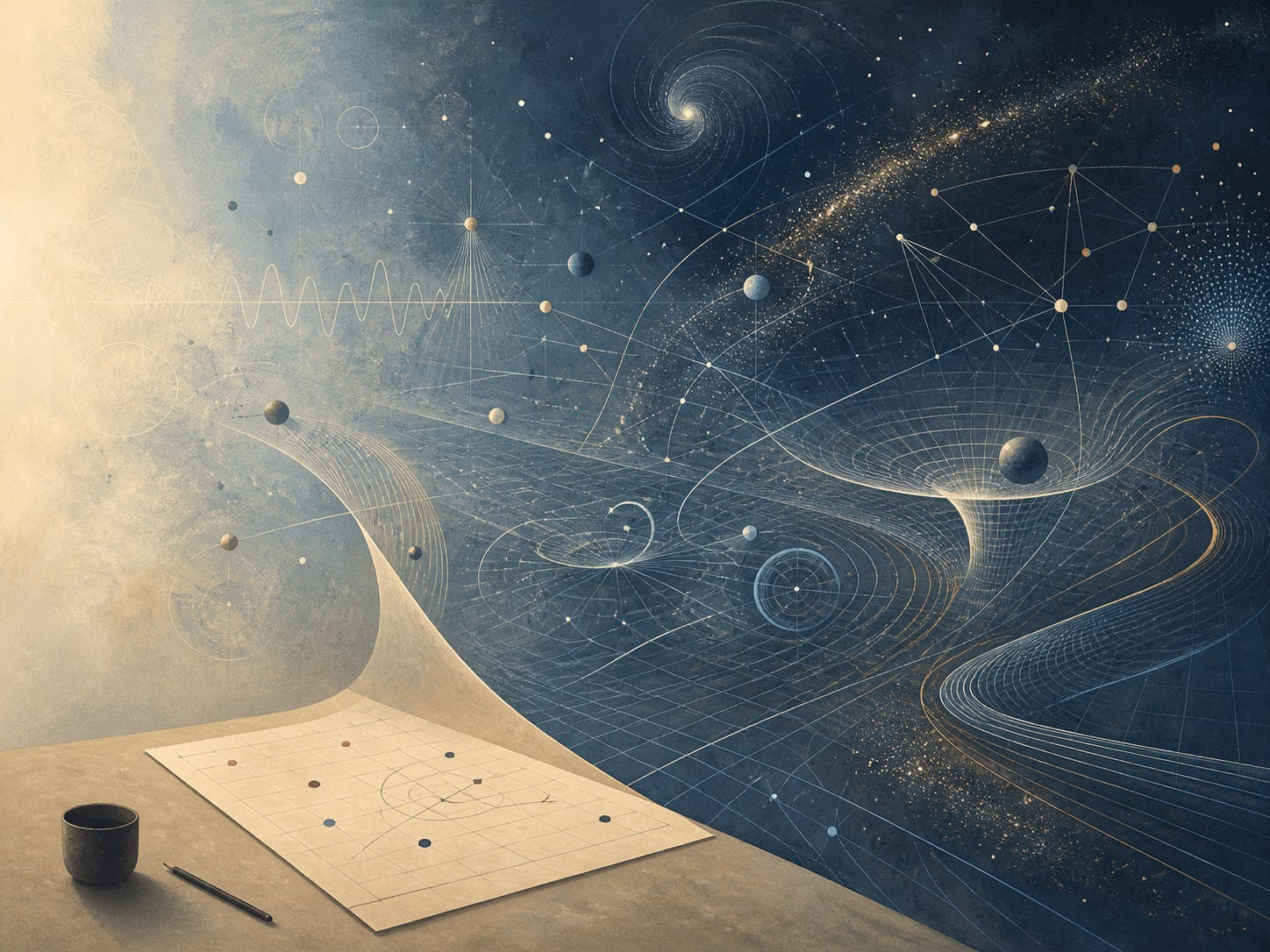
Physics Used To Feel Like A Human Map
Physics has always reached beyond intuition.
Atoms.
Black holes.
Quantum fields.
Curved spacetime.
None of that was ever simple.
But there was still a feeling that the map could be held.
An equation.
A diagram.
A model.
Something compressed enough for the human mind to carry.
That was part of the beauty.
Reality was strange.
But it could still be made graspable.
That Is Starting To Change
The systems physicists study now are getting larger.
Not just physically larger.
Conceptually larger.
More variables.
More dimensions.
More interactions.
More data than a person can meaningfully hold at once.
Physics is no longer just asking what happens to one particle, one object, or one field.
It is asking what happens inside systems too complex to fully picture.
That changes the role of human intuition.
AI Enters Because The Map Got Too Big
Machine learning is becoming useful in physics because many problems are expensive to simulate, difficult to solve, or too high-dimensional for traditional methods alone.
Neural operators, for example, are being developed to accelerate scientific simulations by learning mappings between complex functions such as spatiotemporal processes and partial differential equations (Nature Reviews Physics, 2024).
That matters because physics is full of systems that evolve across space and time.
Fluids.
Plasmas.
Materials.
Climate-like dynamics.
The old map is still there.
But AI is helping expand it beyond what can be manually drawn.
This Is Not Just Better Calculation
That would be easier to understand.
A faster calculator.
A better simulator.
A more efficient tool.
But AI is doing something stranger.
It is helping researchers search areas of theory and data that may be difficult to navigate through intuition alone.
Recent work in mathematics and theoretical physics has described AI as increasingly useful for exploring complex structures, generating conjectures, and assisting discovery across spaces too large for direct human inspection (Nature Reviews Physics, 2024).
So AI is not only speeding up physics.
It is changing where physics can look.
The Human Mind Becomes Less Central To The Search
That is the quiet shift.
Physics is still human-led.
Humans choose the questions.
Humans interpret the results.
Humans decide what counts as meaningful.
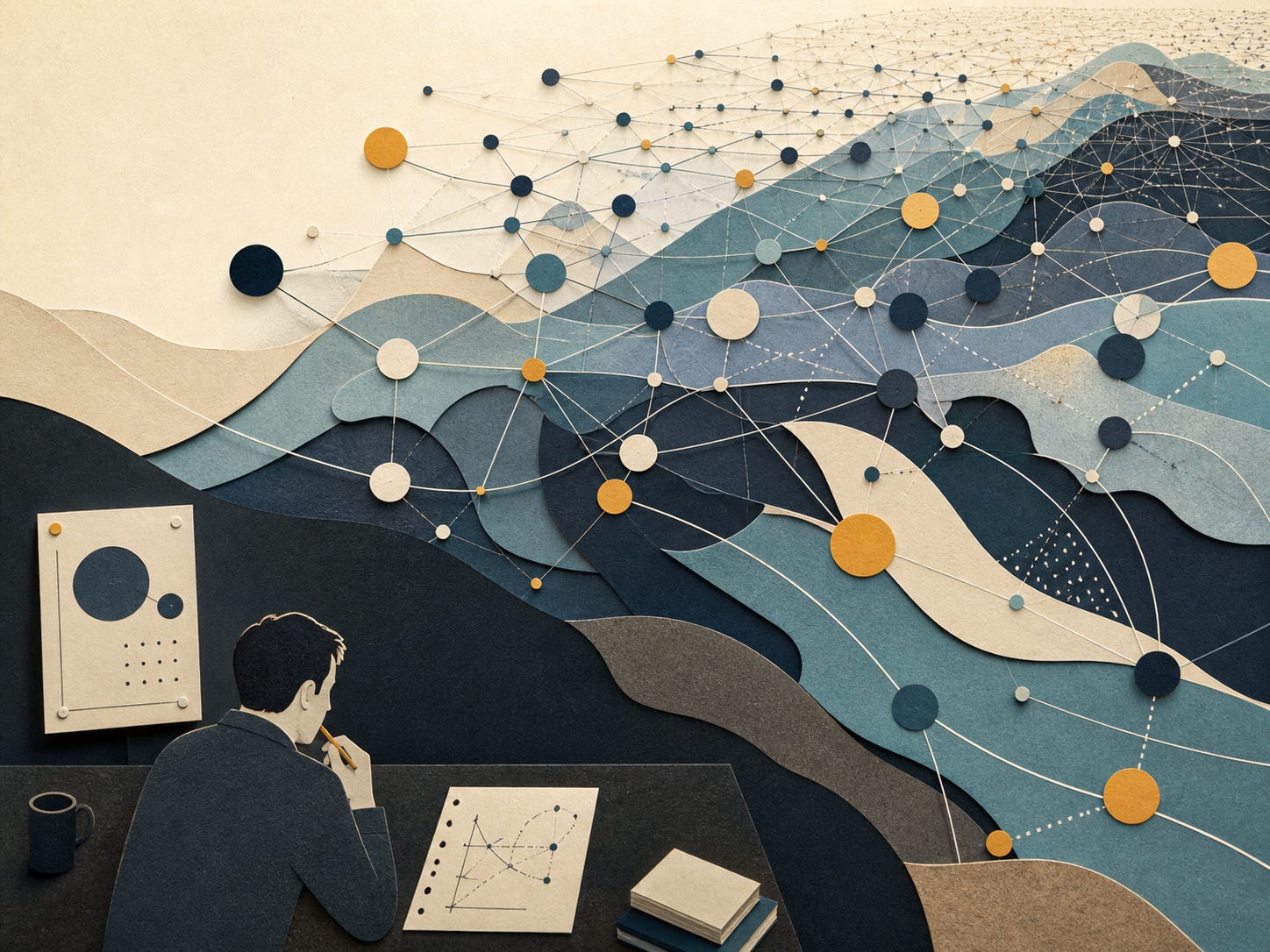
But the search itself is becoming less human-sized.
A model can scan relationships no person would naturally inspect.
It can explore parameter spaces too wide to imagine.
It can find patterns that do not arrive through intuition.
That does not replace physicists.
But it changes what physicists are standing in front of.
Physics Starts To Look Less Like A Picture
And more like a landscape.
A huge one.
Too large to see from the ground.
Too detailed to draw by hand.
AI becomes a kind of instrument.
Not a microscope.
Not a telescope.
Something closer to a mapmaker for spaces we cannot naturally perceive.
That is different from using AI to answer a question.
It is using AI to reveal where the questions might be.
A Strange New Dependency
Once the map gets too large…
You need the system to navigate it.
Not because humans are weak.
But because the territory is bigger than human intuition.
This is already visible in data-driven physics, where machine learning has become increasingly common across physics research and was described by Nature Reviews Physics as a rapidly growing part of the field (Nature Reviews Physics, 2021).
The issue is not that physics loses rigor.
The issue is that the path to rigor may pass through systems humans cannot fully intuit at first glance.
That Can Create An Illusion Of Understanding
This is where caution matters.
AI can make a field feel more navigable.
It can produce outputs.
Predictions.
Patterns.
Visualizations.
But that does not automatically mean humans understand the underlying system.
Researchers have warned that AI tools can create “illusions of understanding” in science, where productivity and pattern-finding increase while the deeper limits of interpretation become less visible (Nature, 2024).
That warning matters here.
Because physics has always cared about more than results.
It cares about what those results mean.
The Direction Is Hard To Ignore
The 2024 Nobel Prize in Physics went to John Hopfield and Geoffrey Hinton for foundational work in machine learning, a symbolic moment showing how deeply AI and physics are now intertwined (Reuters, 2024).
That does not mean AI is physics.
But it does show that physics is no longer separate from the tools that now expand it.
The relationship is becoming circular.
Physics helped build the ideas behind machine learning.
Now machine learning is helping physics search its own unknowns.
The Scale Of The Question Changes
The old question was:
Can we understand this system?
The newer question may become:
Can we navigate it well enough to discover something real?
That is not the same question.
Understanding still matters.
But navigation becomes more important when the territory is too large to hold.
AI expands the searchable space.
And once the searchable space expands, the scientific map changes with it.
Physics is not becoming less human.
But it may be becoming less human-sized.
The systems are too large.
The data is too dense.
AI does not remove the need for theory.
It does not replace judgment.
It does not make reality simple.
But it expands the map.
And once the map expands beyond what human intuition can naturally hold…
Physics changes.
Not because humans stop doing it.
But because the territory they are exploring becomes too large to see without another kind of mind beside them.
References
Nature Reviews Physics (2024). Neural operators for accelerating scientific simulations and design.
Nature Reviews Physics (2024). AI-driven research in pure mathematics and theoretical physics.
Nature Reviews Physics (2021). The rise of data-driven modelling.
Nature (2024). Artificial intelligence and illusions of understanding in scientific research.
Reuters (2024). Nobel Prize in Physics goes to machine learning pioneers Hopfield and Hinton.
Like a Klein Bottle?
I mostly understand what this post is alluding to and mostly agree but what do the astrophysists say about your premise. Would Neil deGrasse Tyson support your views or perhaps Ethan Siegel who a Substack participant as well. Why not ask them?
Not completely clear what branches of physics are included in your thinking. The astrophysists are now looking at events that are over a million light years away which would imply that localized thinking will not be sufficient but it does not automatically imply the AI can fill in the gaps.
Keep pushng the envelop. It keeps me going to try to keep up with you.