
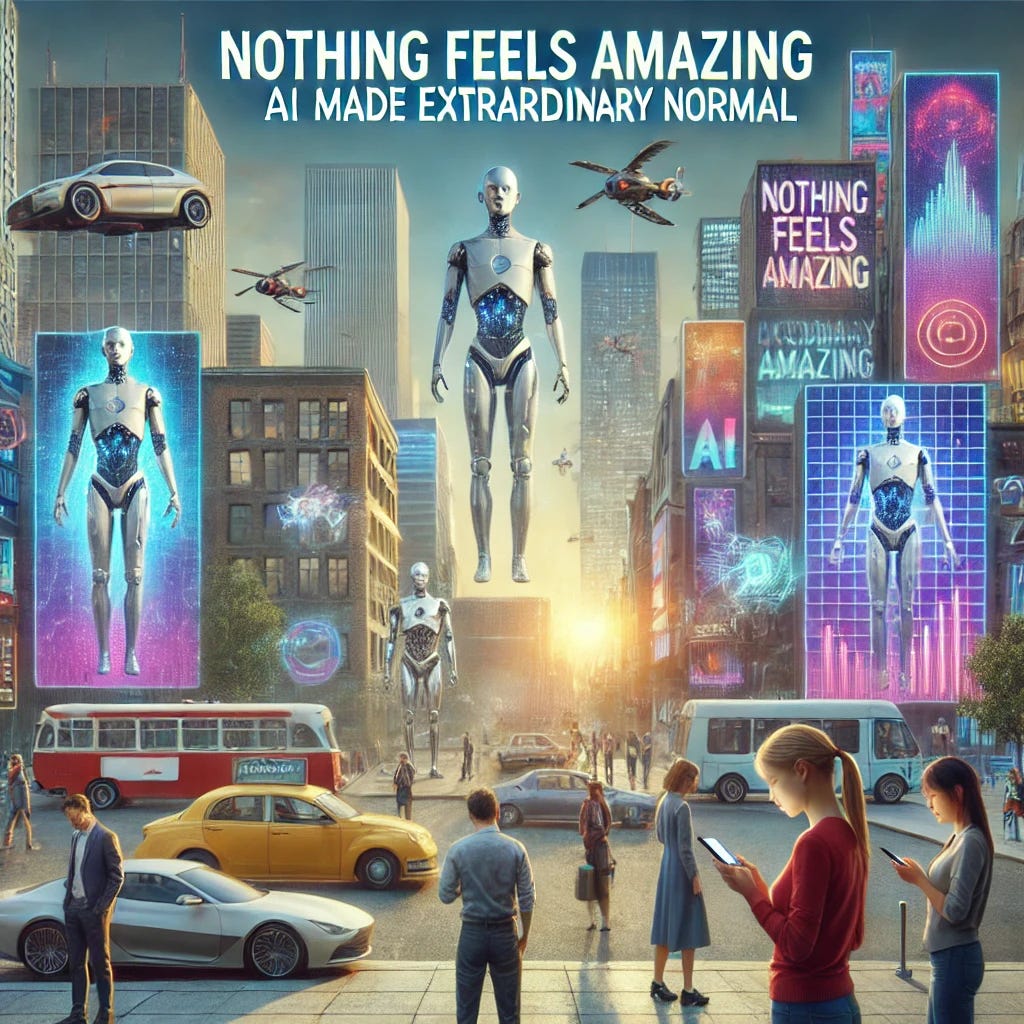
Nothing Feels Amazing
AI Made Extraordinary Normal

Something subtle is happening to human experience.
We are harder to impress than we used to be.
Images that once would have felt impossible now appear instantly. Music, art, design, analysis, ideas. Generated on demand. Refined endlessly. Available everywhere.
At first, this felt extraordinary.
Now it feels normal.
The emotional response that used to follow breakthrough, brilliance, or creative skill is fading. Not because remarkable things stopped happening. But because remarkable things stopped being rare.
We are surrounded by output that would have been astonishing just a few years ago.
And we adapted faster than anyone expected.
Awe Depends on Scarcity
Human awe has always depended on contrast.
Something feels amazing when it stands far outside the ordinary. A rare performance. A surprising insight. A level of skill that most people cannot reach. Awe is not just about quality. It is about distance from expectation.
Psychologists describe awe as a response to perceptual vastness combined with a need to update mental models (Keltner and Haidt 2003). Something feels awe-inspiring when it forces you to reconsider what is possible.
But expectations adjust quickly.
When exposure increases, the gap between ordinary and extraordinary shrinks. What once expanded your mental model becomes just another example inside it.
AI dramatically increases exposure to high-level output.
And exposure is what erodes awe.
The Speed of Normalization
Humans normalize improvement extremely fast.
Psychologists call this hedonic adaptation. When conditions improve, people quickly adjust their baseline and stop experiencing the improvement as special (Brickman and Campbell 1971).
Technology has always triggered this process. High-definition video, instant global communication, limitless information access. Each innovation initially felt astonishing. Each eventually felt ordinary.
AI accelerates this cycle because it produces novelty continuously.
Not one breakthrough. Thousands per day. Across every domain. Generated, shared, and replaced in rapid succession.
The nervous system cannot maintain a sense of astonishment at that pace.
So it recalibrates.
Mastery Used to Be Visible
For most of history, awe was tied to visible mastery.
You could watch someone perform at a level you could not approach. A musician. A mathematician. A writer. A scientist. Years of effort were condensed into a moment of visible excellence.
The distance between observer and performer created emotional impact.
AI compresses that distance.
High-level output is no longer tightly coupled to long visible effort. The process behind the result becomes opaque or instantaneous. Observers see the result, but not the time investment that once explained it.
When effort becomes invisible, excellence becomes ambiguous.
And when excellence becomes ambiguous, awe weakens.
Infinite Variation Weakens Impact
Another factor is scale.
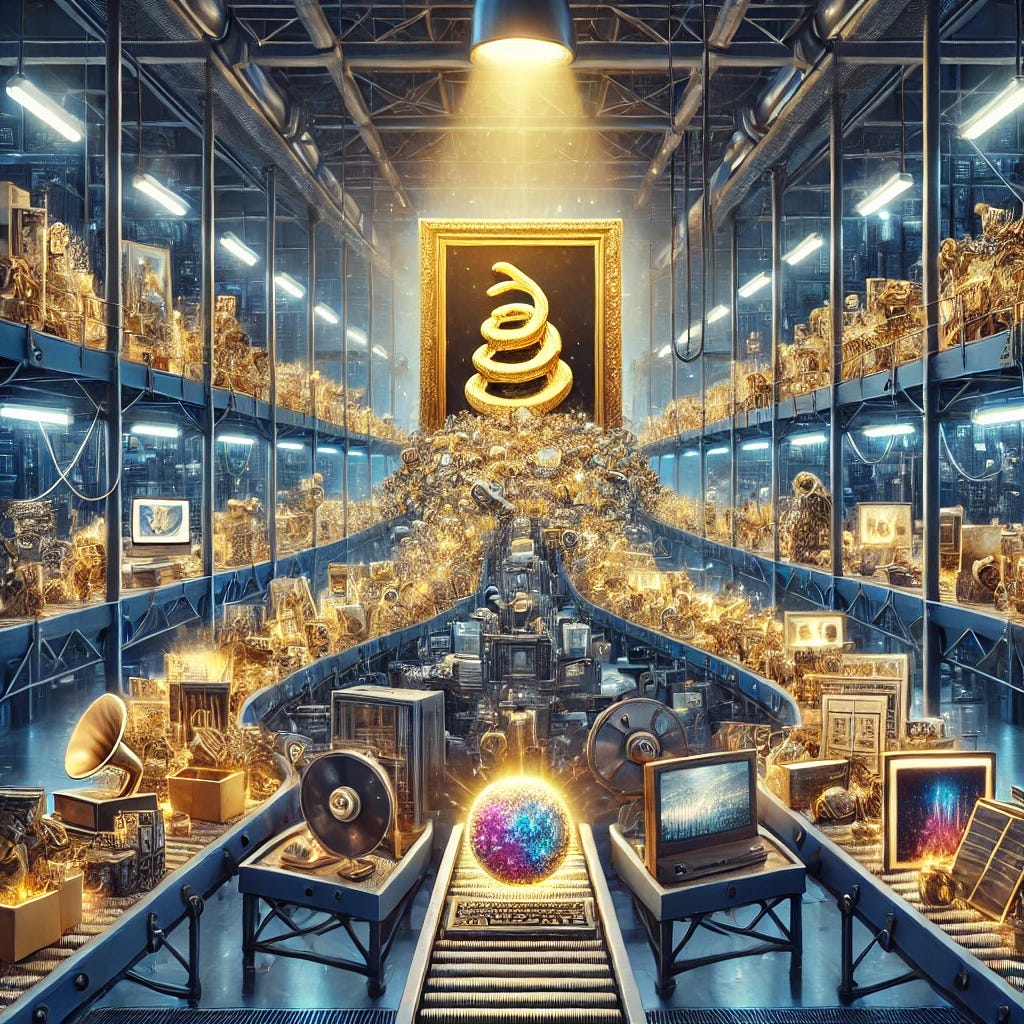
AI does not just produce impressive results. It produces endless variations of them. If you can generate thousands of striking images, elegant explanations, or sophisticated compositions, any single instance loses uniqueness.
Scarcity intensifies emotional value. Abundance diffuses it.
Behavioral economics consistently shows that perceived value decreases when availability increases, even when objective quality remains high (Ariely 2008).
AI industrializes high-level output. The supply of impressive artifacts expands dramatically.
Emotional response does not scale the same way.
The Comparison Effect
Awe also depends on social comparison.
When you see something extraordinary, part of the emotional impact comes from recognizing that very few people could produce it. It signals rare ability.
AI shifts that comparison frame.
Instead of comparing yourself to exceptional humans, you compare yourself to systems that generate polished output instantly. The reference point moves upward and outward simultaneously.
Social comparison theory shows that when reference standards shift upward, subjective evaluation of performance changes even if absolute performance does not (Festinger 1954).
You may still recognize quality.
But it no longer feels exceptional relative to the new baseline.
The Emotional Flattening of Achievement
This has consequences beyond perception.
If fewer outcomes feel extraordinary, fewer outcomes generate strong emotional reward. Achievement feels less dramatic. Breakthrough feels less transformative. Improvement feels incremental even when it is substantial.
Motivation research shows that emotional reward reinforces effort and persistence (Inzlicht et al. 2018). When emotional peaks flatten, the reinforcement structure changes.
People may still produce. They may still improve.
But the emotional experience of accomplishment shifts.
Less awe. More expectation.
The Subtle Psychological Cost
Losing the ability to be impressed does not feel like loss in the moment.
It feels like familiarity. Efficiency. Normalcy.
But awe plays an important role in psychological functioning. It expands attention, increases curiosity, and strengthens sense of meaning (Keltner and Haidt 2003).
When awe becomes rare, cognitive and emotional experience can narrow. The world feels more predictable, but also less expansive.
Everything becomes understandable faster.
Fewer things feel transformative.
This Is Not About AI Replacing Human Achievement
Human creativity and discovery still exist. People still push boundaries. New ideas still emerge.
The shift is in perception, not production.
AI did not eliminate remarkable work.
It changed the environment in which remarkable work is encountered.
When extraordinary output becomes ambient, emotional response reorganizes around that environment.
The threshold for amazement rises continuously.
The Long Term Cultural Shift
If this pattern continues, cultural standards of wonder may change.
Future generations may grow up surrounded by high-level generated output from the beginning. Their baseline expectations will form at levels that previously required exceptional effort.
What feels amazing is partly determined by what feels normal during development.
If normal includes constant exposure to advanced creation, synthesis, and explanation, then awe will require something even more extreme.
The threshold moves again.
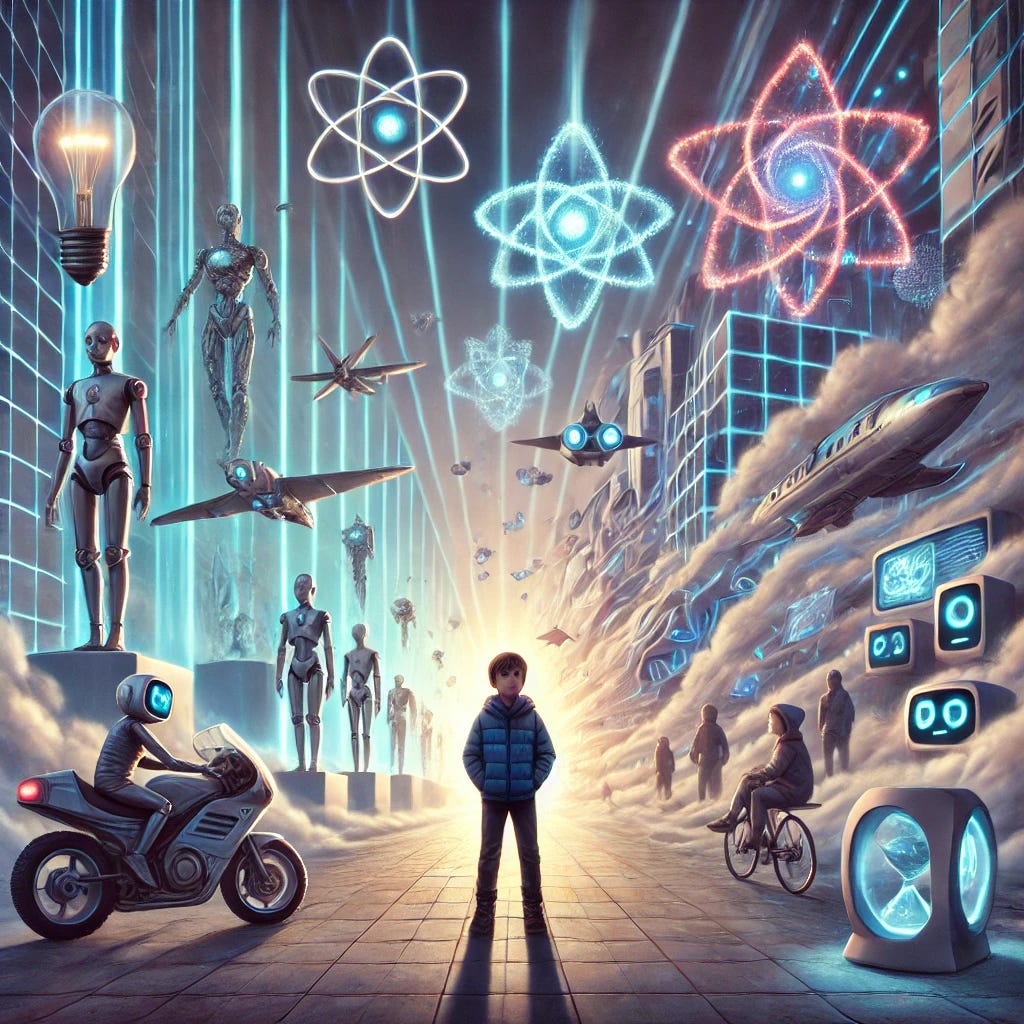
AI did not remove extraordinary things from the world.
It removed the conditions that made them feel rare.
Awe depends on contrast, scarcity, visible effort, and limited exposure. AI compresses all of those simultaneously.
The result is not that the world became less impressive.
It is that impressive became ordinary.
And once something becomes ordinary, the emotional response that once defined it quietly disappears.
Nothing feels amazing anymore.
Not because nothing is amazing.
But because we adapted faster than awe could keep up.
References
Ariely, D. (2008). Predictably Irrational. HarperCollins.
Brickman, P., & Campbell, D. T. (1971). Hedonic relativism and planning the good society. Academic Press.
Festinger, L. (1954). A theory of social comparison processes. Human Relations.
Inzlicht, M., Shenhav, A., & Olivola, C. (2018). The effort paradox. Trends in Cognitive Sciences.
Keltner, D., & Haidt, J. (2003). Approaching awe. Cognition and Emotion.
‘Future generations may grow up surrounded by high-level generated output from the beginning. Their baseline expectations will form at levels that previously required exceptional effort’
i think this is what’s going to be most interesting to me. seeing a generation grow up with these tools is going to change who they are. it’s a social experiment we’re committed to without knowing the outcome.
You may also check out the Kano model.
Many product features start as delighters and end up being basic expectations.
Indeed, AI may be accelerating this.