
Invisible Expectations
How AI Quietly Raised the Standard for Everyone

Something changed recently, and almost no one announced it.
The baseline moved.
Responses are expected faster.
Writing is expected to be clearer.
Work is expected to be more polished.
Nobody formally raised these standards.
But they rose anyway.
AI did not just make people more capable. It quietly made higher performance feel normal. Once better output becomes easy to produce, average output stops feeling acceptable.
This is how expectations change. Not through rules, but through comparison.
And right now, AI is raising expectations everywhere, even for people who barely use it.
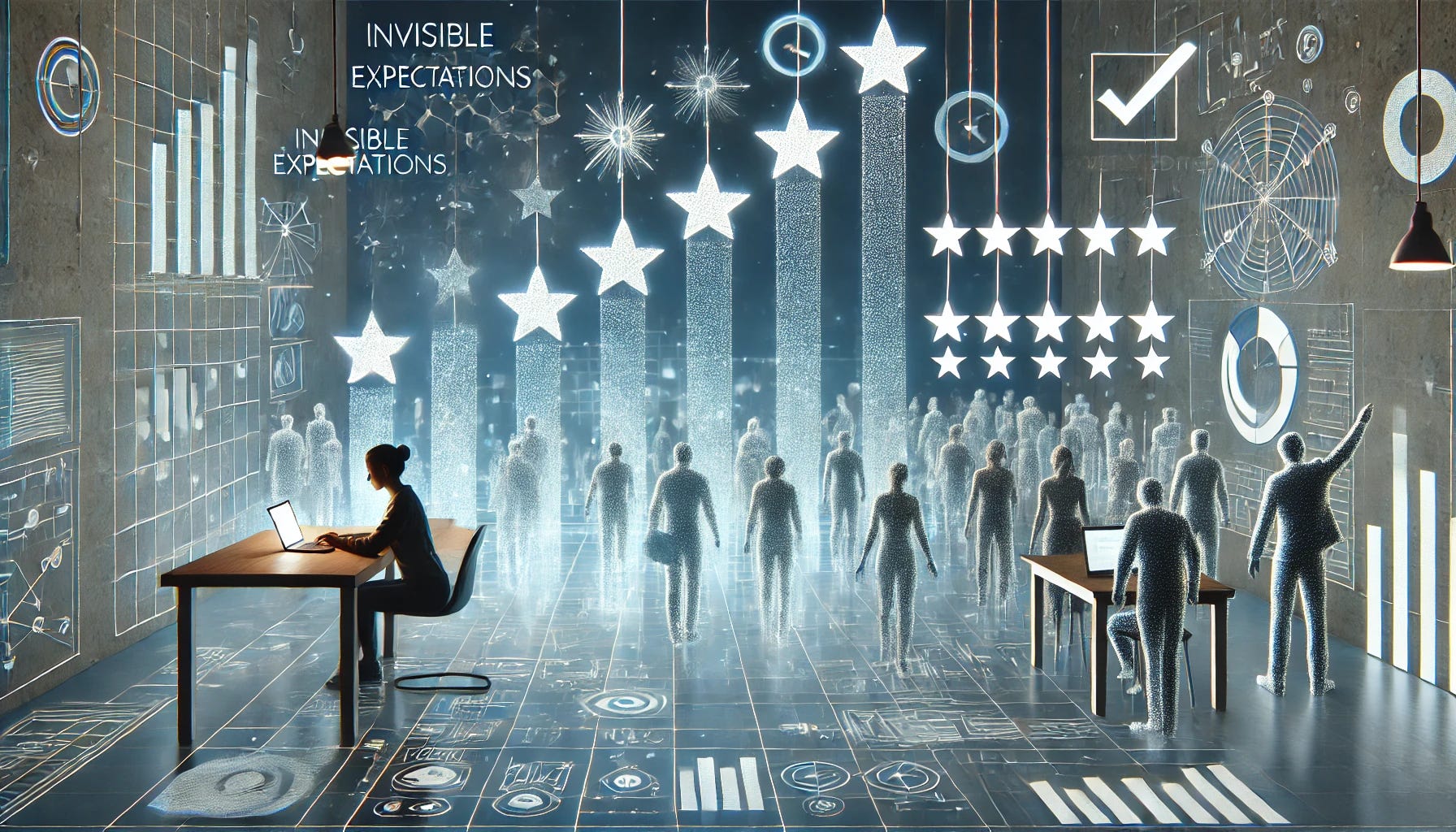
Expectations Don’t Rise by Agreement
Social standards rarely change through formal decisions. They change through exposure.
When people repeatedly see higher quality work, faster responses, or clearer communication, their sense of what is normal shifts. Psychologists call this reference point adaptation. Perception adjusts to whatever level of performance becomes common in the environment (Kahneman 2011).
AI accelerates that process.
One person uses AI to draft emails. Another uses it to structure reports. Someone else uses it to summarize research or refine presentations. The outputs are cleaner, faster, and more organized.
Soon, that level of output stops feeling exceptional.
It becomes the expected baseline.
Even people who never touched AI are now judged against work produced with it.
Performance Inflation Happens Quietly
This is not the first time technology raised expectations.
Word processors made spelling errors less acceptable. Calculators made arithmetic mistakes less tolerated. Smartphones made delayed communication feel rude.
Each technology removed friction. Each removal of friction made higher performance feel normal.
AI is different because it improves thinking output, not just mechanical tasks.
Writing improves. Analysis improves. Planning improves. Problem solving improves. Communication improves.
When cognitive output improves at scale, performance inflation spreads across entire domains of work and interaction.
The standard moves without discussion.
Comparison Is the Engine
Humans evaluate performance relationally.
You do not judge the quality of an explanation in isolation. You judge it relative to other explanations you have seen recently. The same is true for speed, clarity, and thoroughness.
This is called social comparison theory. People assess themselves and others based on perceived peer performance (Festinger 1954).
AI changes what peer performance looks like.
When AI assisted output circulates widely, everyone’s comparison reference shifts upward. Even if you personally work the same way you always have, your relative position changes.
You did not fall behind.
The environment moved forward.
The Uneven Adoption Problem
Here is where tension emerges.
AI adoption is not uniform. Some people integrate it deeply. Others use it occasionally. Some avoid it entirely.
But expectations do not adjust based on individual tool use. They adjust based on visible outcomes.
This creates invisible asymmetry.
Two people produce work. One uses AI assistance. One does not. Observers judge only the output. The higher quality output resets the expectation for both.
The tool advantage becomes socially invisible, but the performance difference remains.
Economists describe this dynamic as capability diffusion with uneven adoption. Productivity gains appear at the system level before they distribute evenly at the individual level (Brynjolfsson and McAfee 2014).
In plain terms, standards rise before everyone has equal ability to meet them.
The Psychological Effect of Rising Baselines
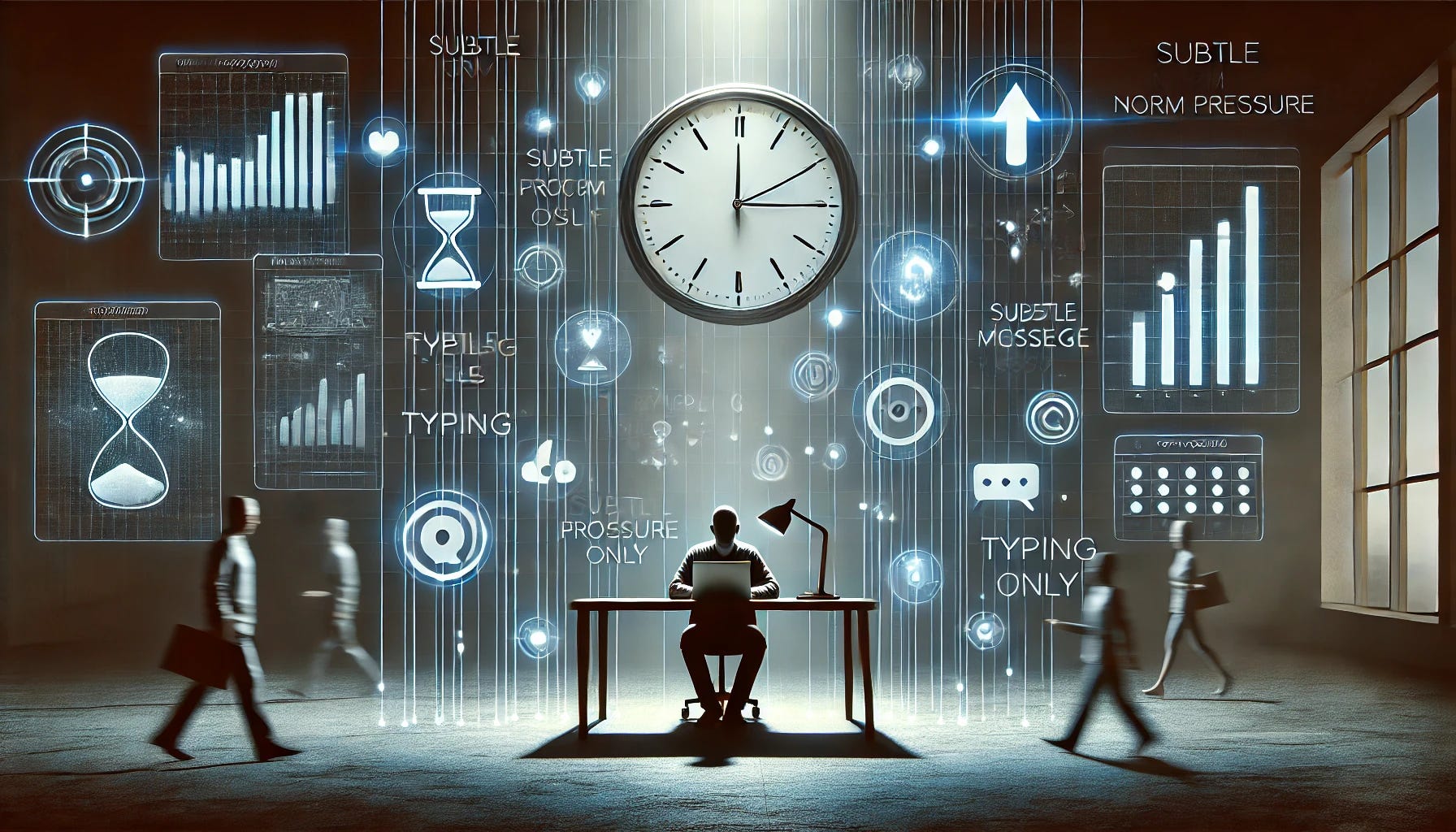
When expectations rise gradually, people experience pressure without a clear source.
Work feels harder even when tasks have not changed. Communication feels more demanding. Response speed feels insufficient. Output feels less adequate.
This creates what psychologists call norm pressure without explicit norms. Behavioral expectations exist, but no one formally defined them (Cialdini and Goldstein 2004).
That pressure is subtle but persistent.
You feel behind, but nothing explicitly changed.
Error Tolerance Is Shrinking
One of the most immediate effects of invisible expectation shifts is reduced tolerance for mistakes.
If AI can help draft, review, edit, calculate, or verify, then errors begin to look avoidable. And avoidable errors are judged more harshly than unavoidable ones.
Research on automation and human performance shows that when technological assistance is available, people judge unassisted mistakes more negatively, even when assistance was optional (Skitka et al. 2000).
This changes social patience.
Mistakes that once looked human now look negligent.
Effort Is Becoming Invisible
Another important shift is perceptual.
When output improves through assistance, the effort behind the output becomes harder to interpret. Observers see the result, not the process.
This weakens one of the traditional signals of competence. Historically, effort, struggle, and gradual improvement helped explain performance differences. Now results can improve instantly through tool use.
The link between visible output and visible effort weakens.
Sociologists studying technological productivity have long noted that when effort becomes obscured, evaluation becomes harsher because observers assume high performance should be routine (Sennett 2006).
Higher output becomes expected without recognition of how it was produced.
Expectations Spread Beyond Work
These shifts are not limited to professional environments.
Personal communication changes. Faster replies feel polite. Well structured messages feel standard. Clear explanations feel basic.
Even casual interaction reflects rising baselines.
People begin expecting clarity, speed, and responsiveness everywhere, because those qualities are increasingly easy to produce.
Technology reshapes norms first, then behavior, then identity.
The Long Term Structural Shift
If expectations continue rising while capability distribution remains uneven, society develops new implicit categories.
People who meet the new baseline easily.
People who meet it with assistance.
People who struggle to meet it at all.
This is not just a productivity difference. It becomes a perception difference.
Competence is judged against a technologically elevated standard.
Over time, this restructures evaluation in education, hiring, communication, and social trust.
The definition of “adequate” changes.
The Adaptation Loop
The most important part of invisible expectation shifts is that they rarely reverse.
Once higher performance becomes normal, the environment stabilizes around it. Future behavior adapts to the new baseline rather than returning to the old one.
Psychologists call this hedonic adaptation. Humans rapidly normalize improved conditions and treat them as standard (Brickman and Campbell 1971).
AI raises performance. Society adapts. The new level becomes ordinary.
Then the cycle repeats.

AI did not just make people more capable.
It changed what counts as normal capability.
Standards rose quietly. Comparisons shifted automatically. Expectations adjusted without discussion.
Most people did not decide to expect more.
They simply got used to seeing more.
That is how invisible expectations form. And once they form, they shape behavior more powerfully than explicit rules.
The world did not announce a higher standard.
It just started assuming one.
References
Brickman, P., & Campbell, D. T. (1971). Hedonic relativism and planning the good society. Academic Press.
Brynjolfsson, E., & McAfee, A. (2014). The Second Machine Age. W. W. Norton.
Cialdini, R. B., & Goldstein, N. J. (2004). Social influence. Annual Review of Psychology.
Festinger, L. (1954). A theory of social comparison processes. Human Relations.
Kahneman, D. (2011). Thinking, Fast and Slow. Farrar, Straus and Giroux.
Sennett, R. (2006). The Culture of the New Capitalism. Yale University Press.
Skitka, L. J., Mosier, K., & Burdick, M. (2000). Does automation bias decision making. International Journal of Human Computer Studies.
You know, I actually feel that with AI, I can finally meet those expectations. At least in my life, the expectations have been extremely high for as long as I can remember. Maybe it’s because I’m a woman, so “a good girl must be perfect all the time.”
For example, English is not my first language. Yet I’m expected to be flawless. At work, I don’t dare make a grammatical mistake or put words in the wrong order. I see leaders roll their eyes. Later, I hear them being pissed about it. It’s the same when I’m chatting with a native speaker. These expectations touch many parts of my life, not just English.
So with AI, instead of constantly stressing about making a mistake, I finally have a tool that helps me meet the bar.
Honestly, life has never felt easier or better.
There’s something unsettling about how quietly expectations rise. Once better output is easy, both delay and rough edges start to feel like flaws instead of normal parts of the process.