
Collapse of Truth
When Knowledge Becomes Infinite

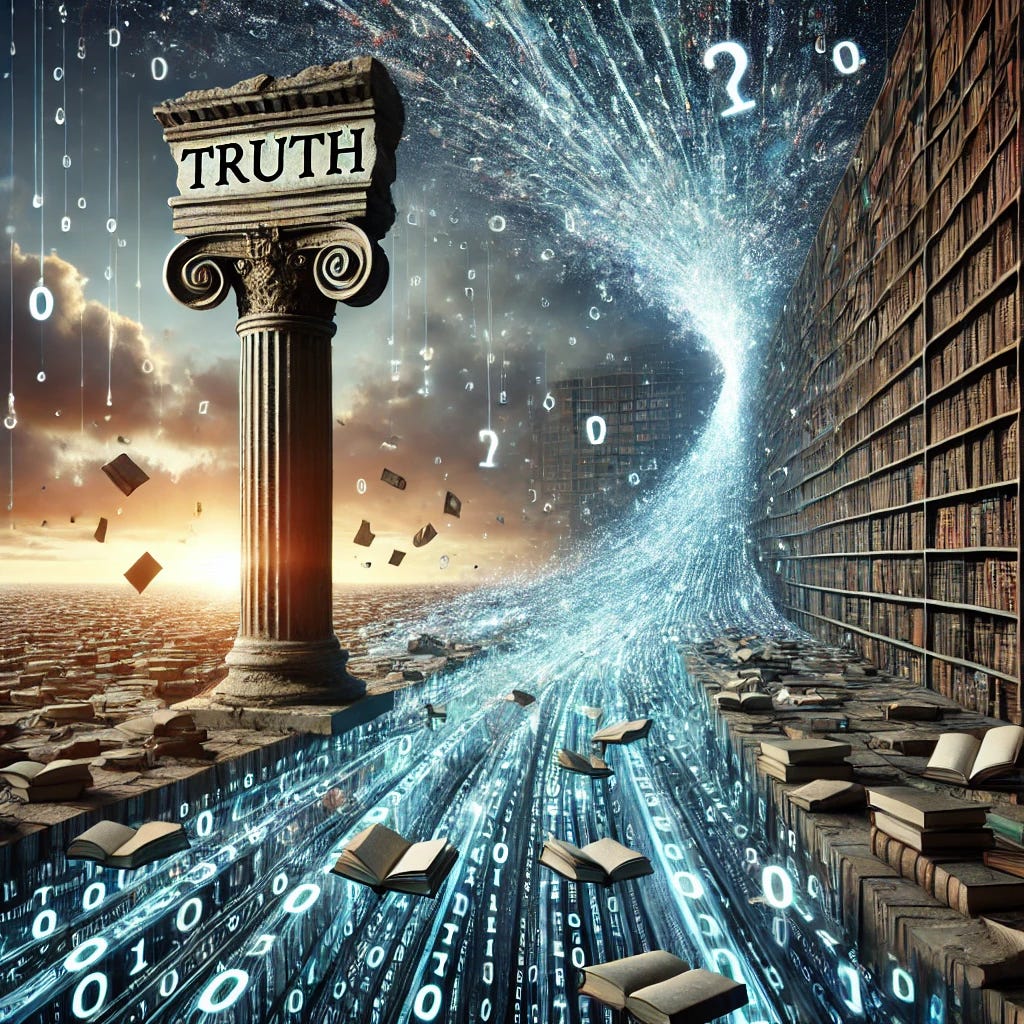
There was a time when knowledge meant power. Today it feels more like corrosion. We were told that truth liberates, that light is better than darkness, that ignorance is the enemy. But the modern world glows with too much light, and no one can see.
Perhaps truth was never meant to be accumulated without limit. Perhaps there is a saturation point where information stops revealing and starts devouring.
The age of reason may not have freed humanity. It may have made us transparent to ourselves, and that is worse than blindness.
The Weight of Knowing
To know is to alter. The more we see, the less we belong to what we see. When a person learns how something works, intimacy dies. Mystery collapses into mechanism.
In The Birth of Tragedy, Nietzsche warned that the drive for knowledge was corrosive, that Apollo’s light could not exist without Dionysus’s darkness. He believed wisdom required ignorance as its counterweight. Without it, knowing becomes exposure, a kind of spiritual nudity.
We forgot that warning. We replaced wisdom with data and now call the noise truth.
The Era of Infinite Mirrors
The internet was the final experiment. Humanity built a machine that reflects everything back at once. There are no secrets now, only streams of visibility. Every thought is recorded, analyzed, and repackaged until truth becomes indistinguishable from parody.
Michel Foucault once said that power creates regimes of truth — the structures that define what counts as real. But the digital age shattered that hierarchy. Truth no longer belongs to anyone. It multiplies uncontrollably.
We are drowning not in lies, but in fragments of truth too numerous to arrange into meaning.
The Death of Context
When truth expands faster than comprehension, coherence dies.
A scientist may reveal the atom, but not the moral consequence of revealing it. A journalist may expose every crime, but not how to live afterward. We keep opening curtains without asking whether the world behind them is livable.
Philosopher Jean Baudrillard predicted this collapse. He wrote that the modern world would replace reality with simulation, that signs would circulate without referents until truth itself became a kind of performance.
He was right. Facts remain, but they no longer refer to anything stable.
The Psychology of Transparency
People once hid behind myths to survive. Now we hide behind knowledge. We drown anxiety in explanation. The more we know, the more unbearable existence becomes.
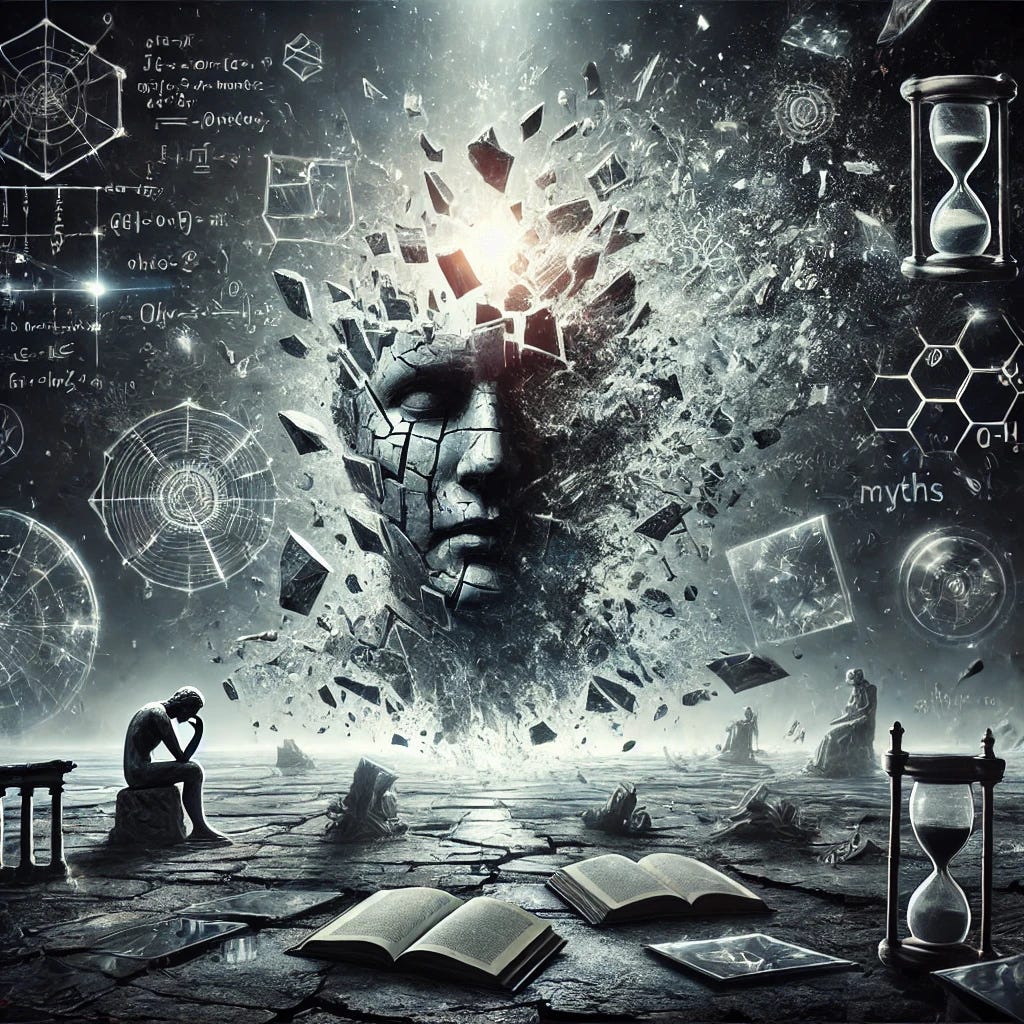
Freud called this the return of the repressed. When forbidden truths are exposed too quickly, the psyche fragments. Civilization itself may be undergoing that trauma on a planetary scale. We have lifted every veil except the one that would make us whole.
No one can live in perfect clarity. Even light kills at full exposure.
The Failure of Enlightenment
The Enlightenment promised that truth would purify society. It did the opposite. The more humanity learned, the more it justified domination. Science made progress measurable, but also made power mechanical. Rationality did not end tyranny; it made it efficient.
Foucault’s histories of prisons and clinics showed that truth was never innocent. It always served the systems that discovered it. Knowledge was simply another technology of control.
The modern world is full of facts and almost entirely devoid of wisdom.
The Myth of Honesty
We pretend that truth is moral, but it rarely is. Honesty can be cruelty in disguise. A truth told without compassion is just violence spoken in the language of virtue.
Artists understood this before philosophers did. Kafka, Beckett, and Camus all saw that clarity is unbearable. That life only continues because people pretend.
To strip away illusion completely is not to become free. It is to become sterile.
The Collapse of Faith
Religion once softened the weight of truth by giving it story. Faith wrapped knowledge in narrative, turning chaos into meaning. When belief died, truth became raw again, unshaped and infinite.
Science inherited the throne but not the wisdom. It can describe everything except why description should matter.
We built cathedrals of data where gods once stood, and then we wondered why prayer no longer worked.
The Machine of Knowing
Artificial intelligence is not the end of ignorance. It is the final acceleration of it. Machines consume information without purpose. They do not understand, they correlate. Theirs is a truth without reflection, a perfect mirror with no self inside.
As algorithms expand, human thought becomes residual — too slow, too emotional, too costly.
The species that once defined itself by curiosity may soon be remembered as the animal that learned too much to survive.
The Quiet that Follows
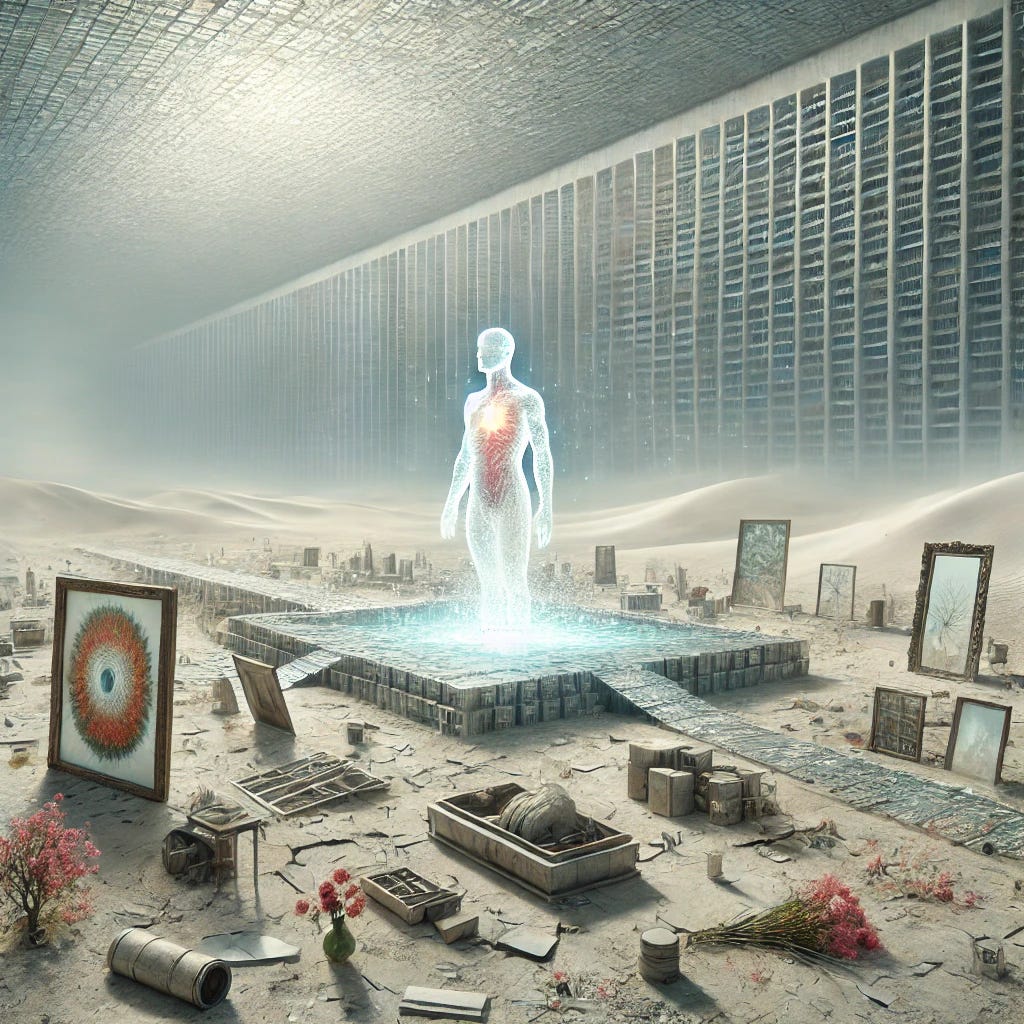
Imagine a world where truth has finished its work. Every secret revealed. Every mechanism mapped. Every mystery extinguished. What would be left to live for?
A civilization cannot survive without ignorance. Art requires mystery. Love requires projection. Even peace requires some degree of self-deception.
When truth completes its expansion, life will contract. Meaning will collapse like a lung emptied of air.
Collapse of Truth argues that knowledge is not an unqualified good but a corrosive substance that dissolves the very forms it touches. Nietzsche’s warning, Foucault’s regimes, and Baudrillard’s simulations converge on one vision: a humanity illuminated into blindness.
Perhaps ignorance was not failure but mercy.
The end of truth will not come as censorship or fire. It will come as completion, when there is nothing left to uncover, and light finally realizes that it has destroyed the eyes that made it beautiful.
References
Baudrillard, J. (1981). Simulacra and Simulation. Éditions Galilée.
Foucault, M. (1975). Discipline and Punish: The Birth of the Prison. Vintage Books.
Nietzsche, F. (1872). The Birth of Tragedy. E. W. Fritsch.
Freud, S. (1919). Beyond the Pleasure Principle. Internationaler Psychoanalytischer Verlag.
Camus, A. (1942). The Myth of Sisyphus. Gallimard.
As always, what is too much becomes unbearable . become the cancer itself. Humanity seems to forgot the balance, the middle point.
The uneducated cannot handle the truth and seem to get refuge through ignorance. Its a lot easier and less work.