
Wormhole: A Passage Through Space-Time
Exploring ChatGPT

A wormhole is a hypothetical passage through space-time that would allow matter to travel from one point in space to another point in space without crossing the space in between. The concept of a wormhole was first proposed by physicist Albert Einstein and mathematician Nathan Rosen in 1935, and it is often used in science fiction as a means of faster-than-light travel.
The basic idea of a wormhole is that it is a tunnel-like structure that connects two different points in space-time. The two points, known as the "mouths" of the wormhole, are connected by a "throat," which is a narrow region of space-time where the gravitational pull is extremely strong. Matter that enters one mouth of the wormhole would be able to travel through the throat and emerge at the other end.
In order for a wormhole to exist, it would require the presence of negative energy density and large amounts of exotic matter with negative energy density to hold the wormhole open. Exotic matter is a hypothetical form of matter that possesses properties that are not currently known to exist in our universe.
The idea of wormholes is still purely theoretical and there is no experimental evidence for the existence of wormholes. However, scientists have proposed various methods for detecting wormholes, such as looking for distortions in the fabric of space-time caused by the presence of a wormhole, or searching for the characteristic radiation that would be emitted by a wormhole.
It is important to note that wormholes are purely hypothetical, and their existence has yet to be proven. If they do exist, they would be extremely difficult to detect and study due to the extremely large amount of exotic matter required to keep them open and the unstable nature of their structure.
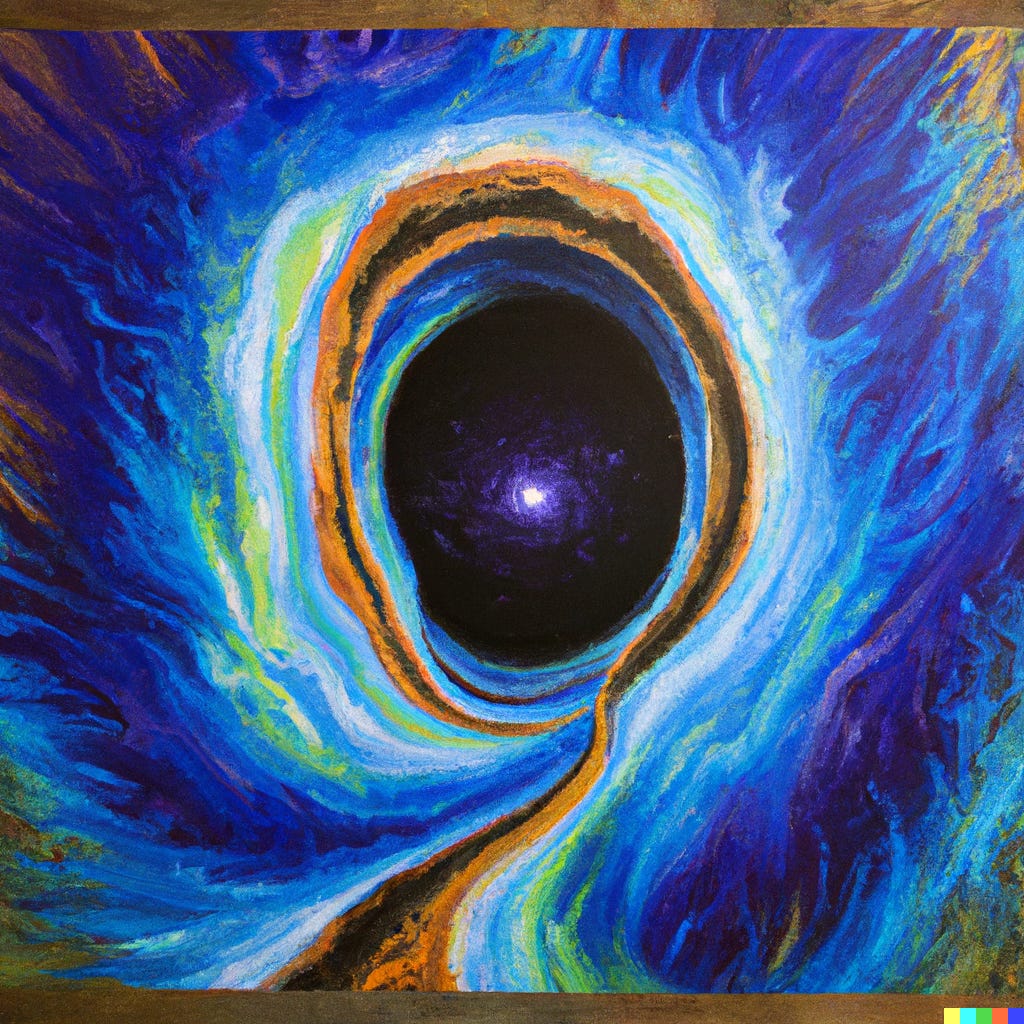
A black hole and a wormhole are two distinct and separate concepts in physics, but they are related in certain ways.
A black hole is a region in space-time where the gravitational pull is so strong that nothing, including light, can escape from it. They form when massive stars die and their cores collapse under the force of gravity. Black holes are defined by their event horizon, which is a boundary beyond which the gravitational pull is so strong that nothing can escape.
While a black hole is a one-way passage to oblivion, a wormhole is a two-way passage that connects two different points in space-time and it could potentially be used as a means of faster-than-light travel.
It is possible that a black hole could be the "mouth" of a wormhole, meaning that anything that enters the black hole's event horizon would be sucked into the wormhole's "throat" and potentially emerge at another point in space-time. However, this is purely speculative and currently there is no experimental evidence to support this idea.