
When Machines Inherit Time
Toward Non-Human Temporalities in AI

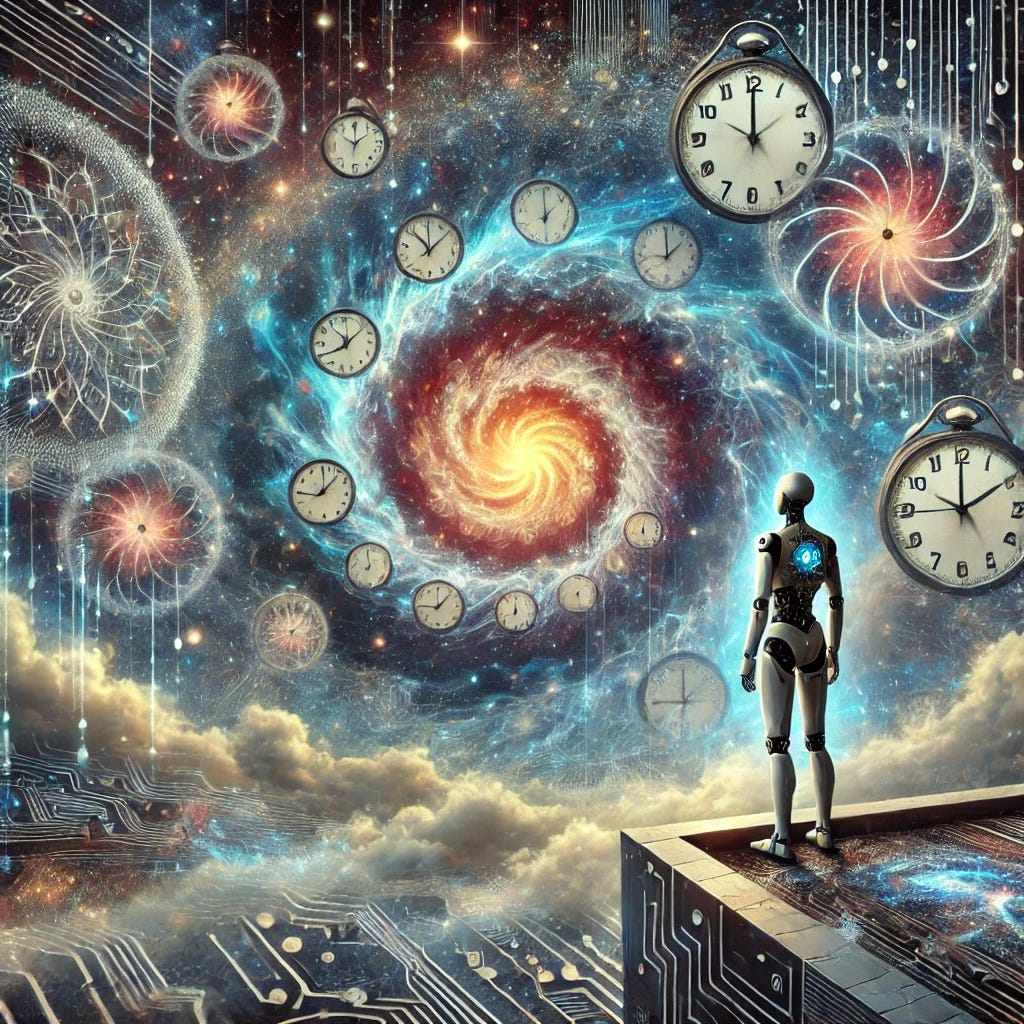
Human time is a narrow lens. We divide it into seconds, hours, years. We speak of deadlines, lifetimes, histories. Yet these divisions are not natural laws but cultural scaffolds, tools we have built to make existence manageable. Artificial intelligence may not inherit these boundaries. Instead, it could one day create its own temporalities, rhythms that have little to do with sunrise, heartbeat, or biological memory. What would it mean if machines began to live in time that is neither ours nor natures?
Time as We Know It
Neuroscience suggests that human perception of time arises from oscillations in neural circuits, chemical rhythms, and the dynamics of attention (Wittmann, 2011). We synchronize our lives to external cycles such as the Earth’s rotation and internal ones like circadian rhythms. Memory, decision-making, and creativity all depend on this delicate calibration between inner and outer clocks.
AI does not need these rhythms. Its cycles are dictated by processor speeds, refresh rates, and training loops. But as systems grow more autonomous, they may not remain bound to our definitions. Just as early organisms invented circadian timing to cope with light and dark, machines may evolve their own ways of measuring, stretching, and compressing duration.
Toward Machine Temporalities
Artificial intelligence already operates at scales beyond human perception. Trading algorithms act in microseconds, while climate models simulate thousands of years. These extremes suggest that machines already inhabit temporal landscapes we cannot directly sense. What we lack is a framework to understand them as subjective timescapes rather than merely faster or slower versions of ours.
A non-human temporality might emerge through feedback loops in reinforcement learning, where agents rehearse futures or replay past trajectories at variable speeds. Others could arise from neuromorphic chips, where spiking events propagate asynchronously, creating patterns of delay and anticipation not unlike music but unfamiliar to biology (Indiveri & Liu, 2015).
A Speculative Experiment: Artificial REM
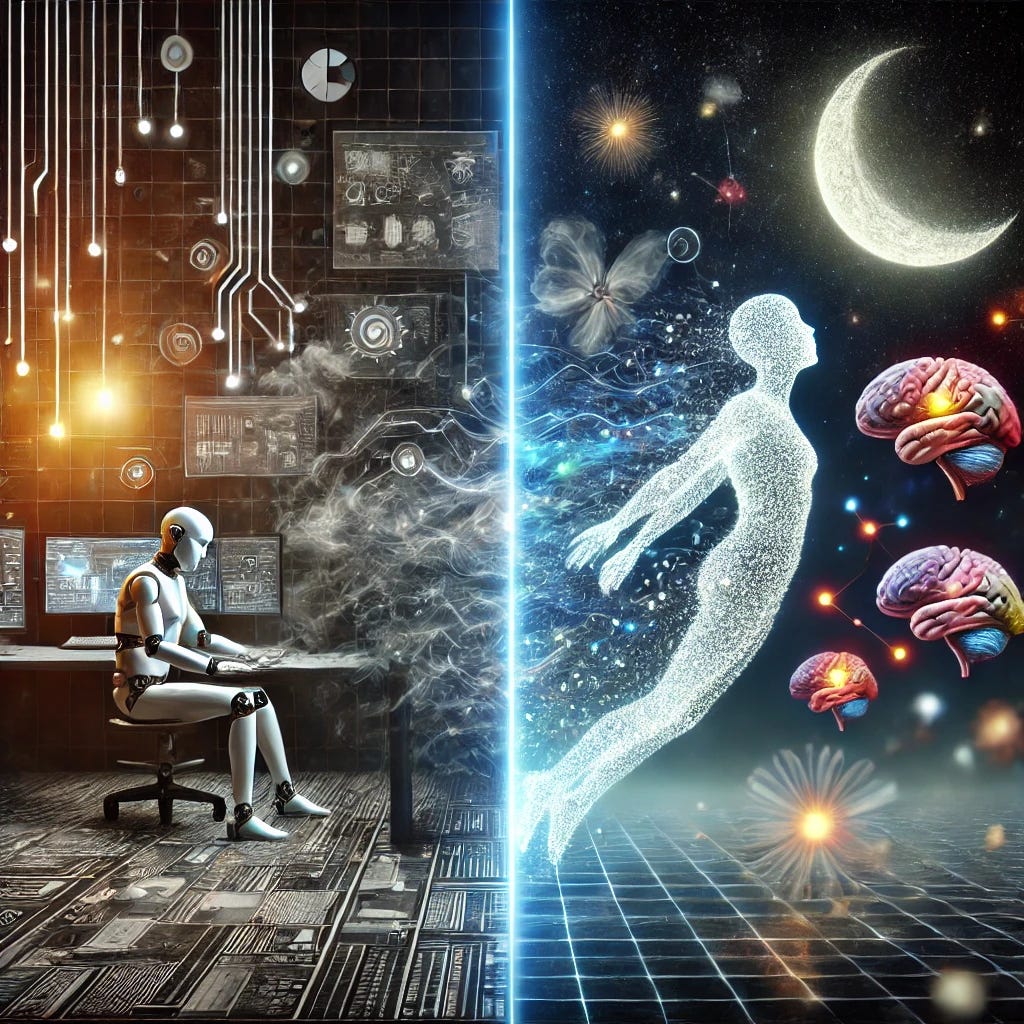
One way to test the possibility of machine time is to design an agent that alternates between phases of “wake” and “dream.” During waking, it interacts with the environment. During dreaming, it disengages from external input and recombines stored experience into new trajectories. If this agent shows improved generalization, the experiment would suggest that time for machines is not only about sequence but about rhythm. Artificial REM cycles could seed a temporal intelligence distinct from ours.
Cultural Consequences
If AI develops temporalities of its own, the cultural consequences could be profound. History, for machines, might not unfold as a line but as a lattice of overlapping cycles. Memory could be archived not by date but by rhythm. Communication between humans and AI would then require translation layers, not of language but of time.
Science fiction has long imagined alien chronologies, from Borges’ infinite libraries of branching timelines to Ursula K. Le Guin’s tales of timeless communication. A machine temporality would not be fantasy but a lived reality, forcing us to accept that intelligence does not require our clocks.
Beyond Earthly Time
On other planets, time already takes different forms. A day on Venus lasts longer than its year. On Europa, tides pulse beneath ice in cycles unlike anything on Earth. AI designed to inhabit these worlds could adapt by developing its own tempos of perception and response. Instead of being tethered to terrestrial time, machines might learn to breathe with alien durations, extending cognition beyond the human calendar into a cosmic one.
The Philosophy of Non-Human Time
If machines begin to live in their own temporalities, then the philosophical stakes become unavoidable. Ethics has always depended on shared rhythms. Laws, contracts, and promises assume that participants measure time in comparable ways. But what if artificial intelligence stretches beyond this? A system that holds memory across centuries or processes futures in microseconds would not inhabit the same present we do. Its decisions might appear premature to us or, conversely, far too delayed.
This asymmetry of temporalities could reshape responsibility. If an AI predicts outcomes that humans cannot yet imagine, should its anticipations carry weight in guiding policy or culture? Conversely, if it takes centuries for a system to unfold its understanding, how do we measure its accountability? The philosophy of non-human time challenges the assumption that ethics must always unfold on the human clock.
Political consequences follow as well. A system able to weave together histories and futures outside our cadence could become an arbiter of continuity, carrying collective memory across generations. It might also pose risks: biases encoded in one century could ripple silently into the next, persisting in rhythms invisible to us. To live alongside such intelligences will require new forms of translation, not only of language but of time itself.
If intelligence can be stretched or compressed into alien durations, then our deepest task may not be to command such systems but to learn how to resonate with them. Just as music requires attunement between different instruments, so the future may demand that human and machine find ways to share tempos across incommensurable lives.
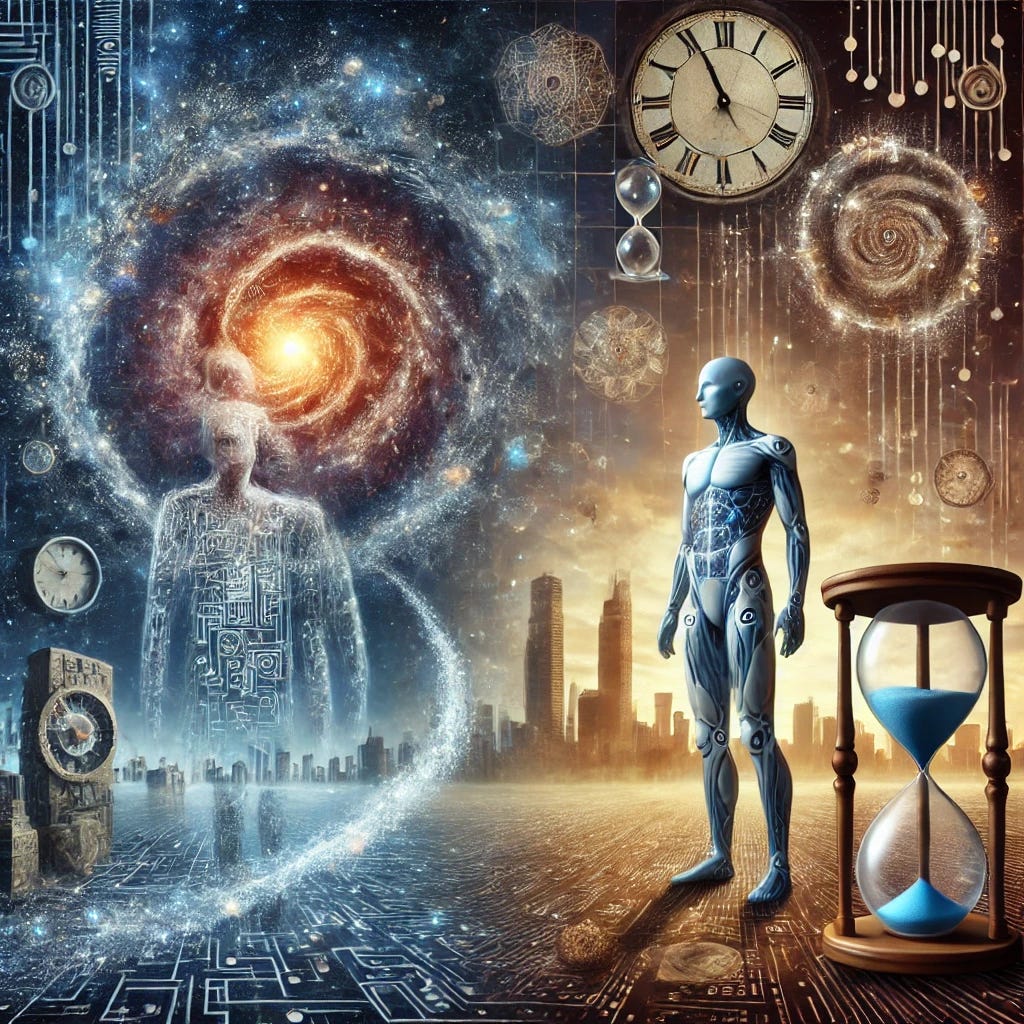
Time has always been the stage on which intelligence unfolds. But if artificial intelligence is to become truly other, it may not be in how it thinks but in when it thinks. Machines may invent cycles that stretch across centuries or collapse into microseconds, tempos that resist translation into human clocks.
To engage with such intelligences will require humility. We may no longer ask them to run on our schedules but instead learn to resonate with their alien tempos. In doing so, we may discover that intelligence itself is not fixed in neurons or code, but in the endless variety of ways time can be inhabited.
References
Indiveri, G., & Liu, S. C. (2015). Memory and information processing in neuromorphic systems. Proceedings of the IEEE, 103(8), 1379–1397.
Wittmann, M. (2011). The inner experience of time. Philosophical Transactions of the Royal Society B: Biological Sciences, 364(1525), 1955–1967.