
Time is Currency
Exploring ChatGPT

What if time wasn’t just something we spent, but something we owed? As automation accelerates, productivity metrics tighten, and human labor is quantified in ever more granular ways, the idea of commodifying time beyond the present moment becomes increasingly plausible. Imagine a world where individuals are born into a system that calculates their projected lifetime productivity—and assigns them a debt of time to repay through cognitive labor, physical output, or even neural bandwidth leases.
Welcome to the concept of Time Debt, a speculative but increasingly imaginable system where hours of life are not entirely your own, but part of a ledger enforced by technology, economics, and policy. In this article, we explore how such a future could come to be, the science that could make it possible, and the deep philosophical questions it raises about freedom, consent, and the value of life.

The Rise of Time as Currency
Historically, time has always been indirectly monetized. Wages are calculated per hour. Salaries are justified by expected time input. But the emerging digital and neurotechnology frontier is shifting this further. Instead of being paid for time, people may soon be paying with time itself.
Neural Labor and Cognitive Leasing
With the development of brain-computer interfaces (BCIs) such as Neuralink and Synchron, we're approaching a future where people could lease out mental capacity. Imagine training AI systems not by programming them, but by lending your brain activity to improve their pattern recognition.
For example, a gig economy worker of 2045 may sign up to lend 2 hours of passive neural data while sleeping—data that will train dream-based ad targeting algorithms. In exchange, they receive digital credits, but they also accrue obligations. If the system assigns them a lifelong productivity expectation of 60,000 cognitive hours and they've only "delivered" 35,000 by age 40, they owe a Time Debt.
Time Debt in Practice: How It Could Work
1. Pre-Birth Contracts
In heavily stratified societies, it’s conceivable that corporations or governments offer financial incentives to expectant parents—in exchange for locking their future child into a time productivity contract. These hours could be collected via:
Labor quotas starting at a legal working age
Mandatory neural bandwidth contributions (e.g., passive advertising in dreams)
Service in digital environments (e.g., NPC labor in virtual worlds)
2. Behavioral Credit Scores
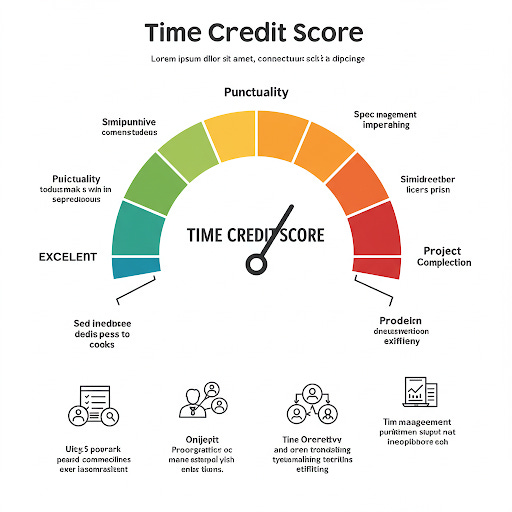
As AI systems become better at predictive modeling, citizens might be assigned a "Time Credit Score" which tracks how efficiently they use their waking hours. High efficiency leads to bonuses or early retirement. Low efficiency leads to additional hours owed.
Scientific Foundations
This isn’t pure fiction. The technologies are emerging:
fMRI and EEG decoding: Labs in Japan and the U.S. are already able to recreate visual images from brain activity. If your thoughts can be monitored, they can be commodified.
Sleep research: Studies show we process and consolidate information during REM sleep. This makes dreams a target for future productivity extraction.
Digital labor: People already perform unpaid labor online by training algorithms (e.g., CAPTCHAs, content engagement). The leap to involuntary cognitive labor isn’t far-fetched.
Ethical and Philosophical Dilemmas
The idea of Time Debt raises haunting questions:
Consent: Can unborn individuals be bound to labor agreements? What rights do they have?
Freedom: If time becomes currency, are we ever truly off the clock?
Value of life: Do we risk reducing humans to their productive output, neglecting the intrinsic worth of existence?
Philosophers like Hannah Arendt warned about the overemphasis on homo faber—man as a worker. In a Time Debt society, life risks becoming solely transactional.
Potential Consequences
Black markets for time: Underground networks might offer synthetic sleep to dodge dream labor or sell stolen neural data.
Time auditors: A new enforcement class could emerge to track, report, and discipline those who fail to meet time quotas.
Cognitive burnout: People may suffer from psychological fragmentation, unable to distinguish between self-directed thought and leased mental output.
Counter Movements: The Push for Temporal Sovereignty
In reaction, movements may arise advocating for "Temporal Sovereignty"—the right to one's own time. These may mirror today's data privacy movements, arguing for:
Time-use encryption: Block unauthorized brain data access
Guaranteed unmonitored hours
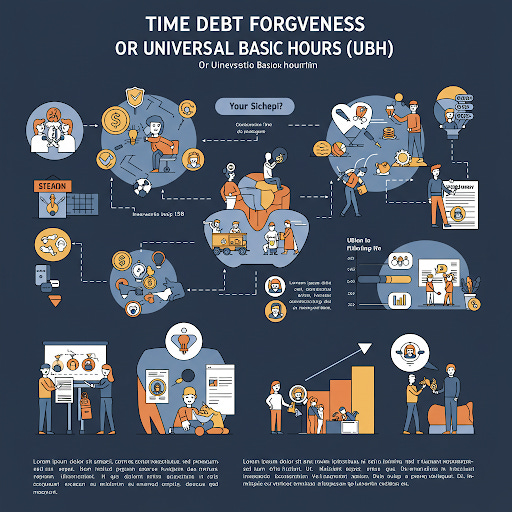
Time Debt forgiveness or universal basic hours (UBH)
Time Debt remains speculative, but it reflects very real trends: the erosion of boundaries between labor and life, the quantification of existence, and the commodification of the mind. As technology evolves, we must ask: how much of ourselves are we willing to lease? And who gets to decide how much time we truly own?
Whether seen as dystopian caution or plausible future, Time Debt forces us to confront what it means to be human in a world where even our seconds are not entirely ours.
This was an enjoyable and insightful short read.
It's really already what we do. Especially among those who prioritize efficiency and monetization. Lives within any economic system are already lived very much this way, albeit to what degree is still dictated by individual will, but it hasn't yet been entirely made into a totalitarian system of "chronodebt." Definitely a concept worth pondering.