
There Is No AI Bubble
This Is Structural

There is no AI bubble.
Bubbles are fueled by belief.
This shift is fueled by replacement.
Most bubbles inflate around stories.
AI is inflating around cost removal.
That difference matters.
Companies are not adopting AI because it sounds futuristic.
They are adopting it because it works.
Not in theory.
In payroll.
In headcount.
In margins.
In throughput.
Economic history shows that automation waves driven by labor substitution tend to persist even after hype cycles fade (Acemoglu & Restrepo 2020).
This is not about hype.
It is about a new class of systems quietly absorbing work that used to require people.
And once work starts disappearing into software, it does not come back in the same form.

Why This Doesn’t Look Like Past Bubbles
Past bubbles were speculative.
Dot-com.
Crypto.
Housing.
Prices ran far ahead of utility.
Capital chased narratives.
Reality eventually caught up.
AI is inverted.
Utility is running ahead of narrative.
Most deployments are mundane.
Customer support automation.
Internal copilots.
Code generation.
Document processing.
Data analysis.
Surveys of enterprise AI adoption show that cost reduction and productivity gains are now the primary drivers of deployment (McKinsey 2023).
These systems do not make headlines.
They remove labor.
That makes them sticky.
Replacement Happens Quietly
Technological displacement rarely arrives as a single shock.
More often it arrives through gradual labor substitution and declining hiring intensity (Autor 2015).
Hiring slows.
Roles disappear through attrition.
Open positions are never refilled.
Workers manage systems instead of performing tasks.
No single moment feels catastrophic.
But opportunity narrows.
The Economy Is Thinning, Not Collapsing
Recessions are sharp.
They spike.
They crash.
They recover.
AI-driven disruption is smooth.
Like erosion.
Productivity can rise while labor share falls.
This pattern has been observed repeatedly during major automation waves (OECD 2019).
GDP looks healthy.
Corporate profits look healthy.
Households feel stuck.
This disconnect delays policy response.
Why “New Jobs Will Appear” Is Not a Comforting Answer
Historically, new technologies do create new occupations.
But they often polarize labor markets, expanding high-skill and low-skill work while hollowing out the middle (Autor 2015).
AI accelerates this dynamic.
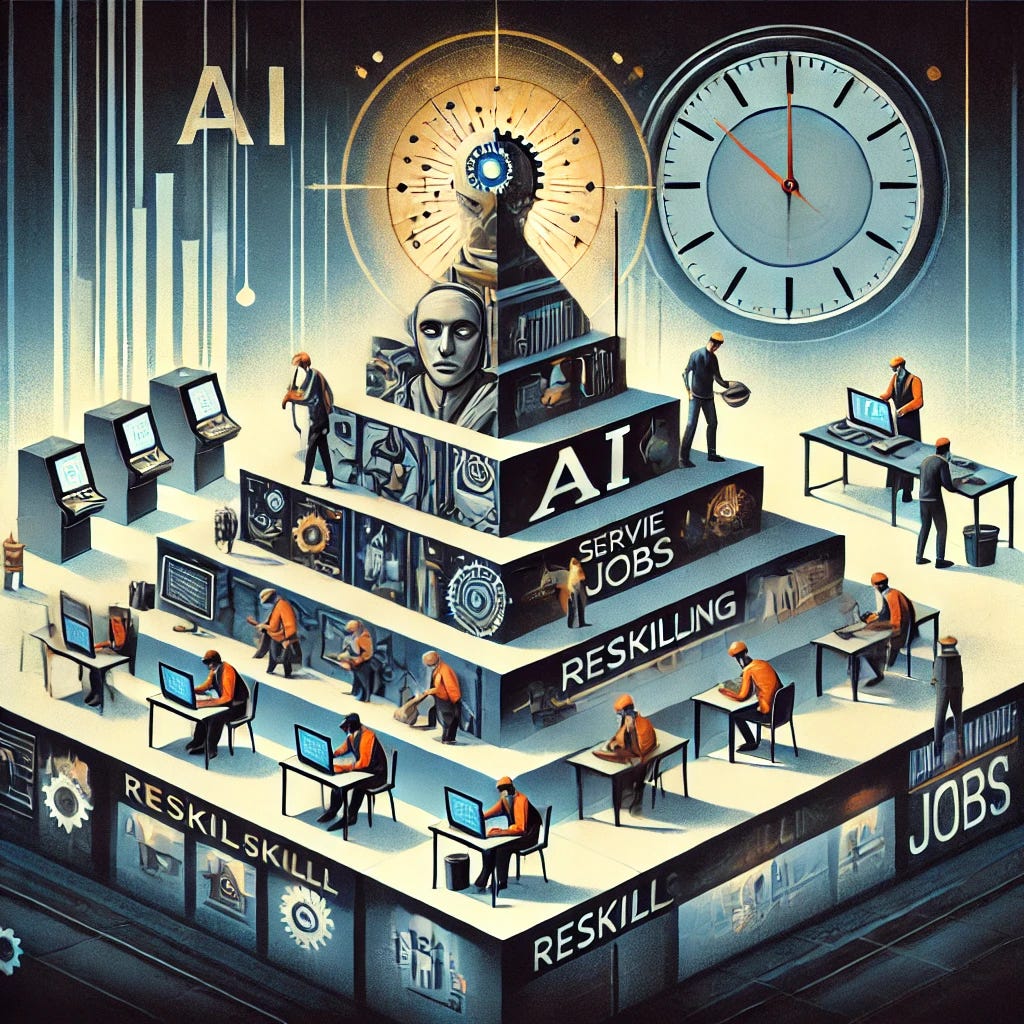
Reskilling is possible.
Absorption is uncertain.
Timing matters.
Capital Loves Labor-Free Growth
Once a model exists, marginal output approaches zero cost.
This creates a powerful incentive to scale without hiring.
Economists describe this as capital-biased technological change, where returns accrue disproportionately to owners of capital rather than labor (Piketty 2014).
Firms that refuse automation lose competitiveness.
Adoption becomes compulsory.
Why This Feels Like a Bubble Anyway
Rising valuations signal expectations.
In AI, those expectations are tied to future labor displacement rather than speculative consumer adoption.
Markets are pricing how much human work can be replaced.
Not how cool the technology is.
This aligns with research showing that automation expectations drive investment even during uncertain macro conditions (IMF 2023).
The Political Lag
Economic change outpaces political adaptation.
Always.
When productivity decouples from employment, wage-based distribution weakens.
This is why serious policy discussions increasingly include UBI, shorter workweeks, and public AI infrastructure (Standing 2017).
These ideas are emerging from structural pressure.
Not ideology.
Who Benefits First
Infrastructure owners.
Compute providers.
Model developers.
Platform firms.
Power concentrates around those who control deployment channels.
Historical analysis of platform economies shows strong winner-take-most dynamics (Khan 2017).
What Individuals Feel
Stagnation.
Confusion.
A sense that effort maps less cleanly to reward.
Surveys show declining worker confidence in long-term career stability even as overall productivity rises (World Economic Forum 2023).
People are not imagining it.
Why Calling This a Bubble Is Comfortable
Bubbles imply reversal.
Structural shifts imply permanence.
Calling AI a bubble postpones acceptance.
Acceptance demands adaptation.
Not patience.
There is no AI bubble.
Bubbles pop.
This is replacement.
Slow.
Distributed.
Economically rational.
Once large portions of human labor move into software, the economy does not snap back.
It reorganizes.
Quietly.
Unevenly.
Permanently.
The most dangerous part is not collapse.
It is normalization.
Because by the time everyone agrees this was structural, the structure will already be in place.
And there will be no rewind button.
References
Acemoglu, D., & Restrepo, P. (2020). Artificial intelligence and jobs. Journal of Economic Perspectives, 34(3), 30–50.
Autor, D. (2015). Why are there still so many jobs? Journal of Economic Perspectives, 29(3), 3–30.
IMF. (2023). AI and the Future of Work. International Monetary Fund Report.
Khan, L. M. (2017). Amazon’s antitrust paradox. Yale Law Journal, 126(3), 710–805.
McKinsey & Company. (2023). The State of AI in 2023. McKinsey Global Institute.
OECD. (2019). The Future of Work. OECD Publishing.
Piketty, T. (2014). Capital in the Twenty-First Century. Harvard University Press.
Standing, G. (2017). Basic Income: And How We Can Make It Happen. Pelican Books.
World Economic Forum. (2023). Future of Jobs Report. WEF.
I mostly agree, but with a caveat: there's no bubble in AI capability, but there's absolutely a bubble in AI adoption narratives. The technology is real and structural. The "every company will have 50 AI agents by Q3" hype is nonsense. What I've noticed is a massive gap between people who use AI daily and people who tried ChatGPT once and gave up. That divide is widening, not shrinking.
The labor replacement you mention is happening, but it's concentrated in specific domains (coding, content, customer support) and nowhere near as broad as the investor pitch decks suggest. I wrote about living inside this bubble and how weird it feels to see two completely different realities: https://thoughts.jock.pl/p/ai-bubble-living-inside
Love how you flipped the bubble framing. The point about utility running ahead of narrative instead of the reverse is spot on. I've seen this firsthand in enterprise settings where AI adoption happens bcause of Q3 margin pressure, not because execs read a thinkpiece. That erosion analogy captures somethng most coverage misses about the pace being smooth rather than catastrophic.