
The Whispering Iron
Could AI Learn from the Magnetic Memory of Rust?

The Hidden Language of Oxidation
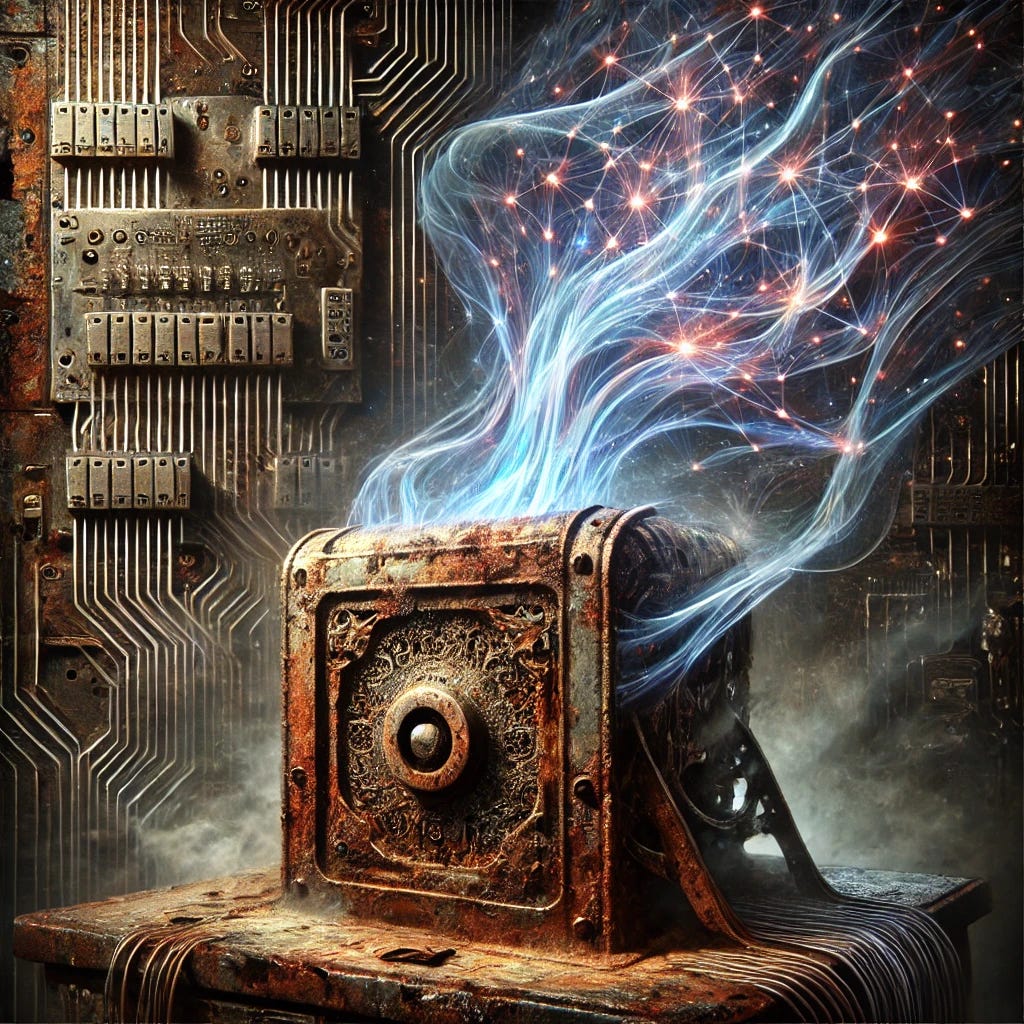
Rust is often dismissed as decay, a sign of neglect or entropy. Yet beneath its corroded surfaces lies a complex physics. As iron oxidizes, its crystal lattice fractures into patterns that are both chemical and magnetic. These structures encode environmental history: humidity cycles, salt exposure, even the presence of microbial life. If we treat rust not as waste but as memory, we might discover a substrate for computation that has been hiding in plain sight.
Artificial intelligence usually depends on clean, precise hardware. But what if intelligence could also emerge from the irregular, noisy signatures of corrosion? Could oxidation itself become a medium of thought?
Magnetic Scars in Matter
Iron oxides such as magnetite (Fe₃O₄) and hematite (Fe₂O₃) have long been studied for their unusual magnetic properties. Tiny domains align and misalign, storing directional information like natural hard drives. These patterns do not remain static. As rust expands, shrinks, and reorganizes, it records shifting environmental conditions in magnetic scars that can persist for decades.
Geophysicists already use such signatures in paleomagnetism, reading how iron-bearing rocks carry the imprint of Earth’s ancient magnetic field (Kirschvink, 1983). At a smaller scale, similar principles could allow us to treat corroding iron surfaces as writable, rewritable, and self-modifying archives of information.
Toward Rust-Based Computation
Imagine an array of iron particles suspended in a controlled oxidation chamber. Each particle would corrode differently depending on temperature, humidity, and applied electromagnetic fields. The result would be a dynamic, evolving memory system.
AI could be trained to interpret these oxidation patterns, detecting correlations invisible to the human eye. Unlike conventional digital bits, which are either zero or one, rust would offer gradients of conductivity, magnetism, and structure. Computation here would be probabilistic, embodied in physical transformation rather than abstract logic.
Such a system would be slow, but slowness may be its strength. Just as glaciers encode centuries of climate in ice layers, rust could store environmental signatures across years.
Rust at the Nanoscale
At the atomic level, corrosion is not uniform. Electrons tunnel through uneven layers, creating microcurrents that flicker in ways similar to noise in a transistor. If probed with sufficient precision, these flickers could act as stochastic signals, feeding directly into AI models that benefit from randomness. Just as random number generators power cryptography and simulations, rust could serve as a natural, physical randomizer.
In this sense, nanoscale rust might function like a chaotic neural substrate. Instead of carefully engineered semiconductors, engineers could harvest the noisy outputs of oxidation as input seeds for computation. This approach would link chemistry and intelligence at the level of the electron, turning disorder into a resource. Such systems could be inherently resilient, because even damaged or irregular components would continue producing useful signals.
Collective Corrosion as Memory
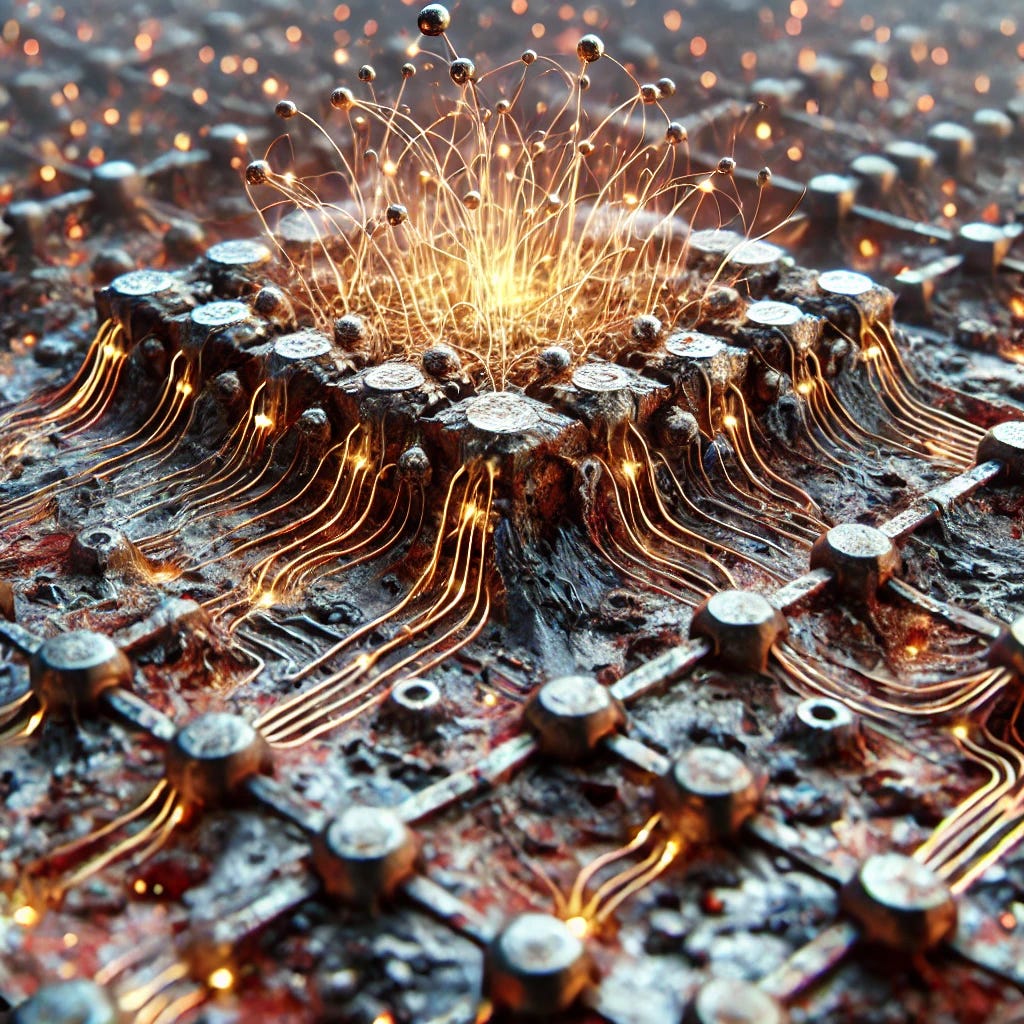
Rust rarely appears in isolation. It spreads across entire surfaces, bridges, and pipelines, often interacting with microbial colonies that accelerate or shape its growth. These cooperative processes could be seen as a form of distributed intelligence, where chemical and biological agents work together to store and modify information.
If AI were trained to interpret entire landscapes of rust, it could begin to detect not just individual corrosion patterns but collective ones. A fleet of sensors placed on aging infrastructure might treat rust as a massive, slow-moving neural network, where new inputs such as weather or stress redistribute across the whole surface. This could allow cities to treat corroding steel not as decay to be fought, but as a continuous environmental sensing system.
At planetary scales, the “rust belt” of Mars might represent a similar phenomenon. The entire planet has oxidized, storing billions of years of atmospheric change in its red crust. An AI that learns to decode this planetary corrosion could one day reconstruct the ancient climate of Mars not from core samples alone, but from the distributed memory etched into its global surface.
A Speculative Experiment
A laboratory testbed could begin with nanoscale iron films exposed to controlled oxidation cycles. Scanning tunneling microscopy would record the fractal growth of rust in real time. Ultrafast magnetometry could measure how magnetic domains reorganize with each cycle.
A reinforcement learning agent could then attempt to “write” patterns into the rust by applying electric or magnetic fields. The key question: Can AI discover reliable ways to steer oxidation into usable states, creating a primitive form of rust-based computation?
If successful, we might glimpse a new paradigm where decay itself becomes a form of learning.
Broader Implications
The idea of rust as intelligence stretches beyond laboratories. In infrastructure, bridges and ships already record decades of weather and stress in their corrosion patterns. With embedded sensors and AI analysis, these surfaces could act as environmental historians, warning of structural weakness long before collapse.
On other planets, rust could become even more important. Mars is covered in iron oxides. A rover equipped to read and write in rust might use the Martian environment itself as a computational partner, storing data in patterns of oxidation shaped by local conditions. In this sense, the Red Planet already carries the potential for planetary-scale rust intelligence.
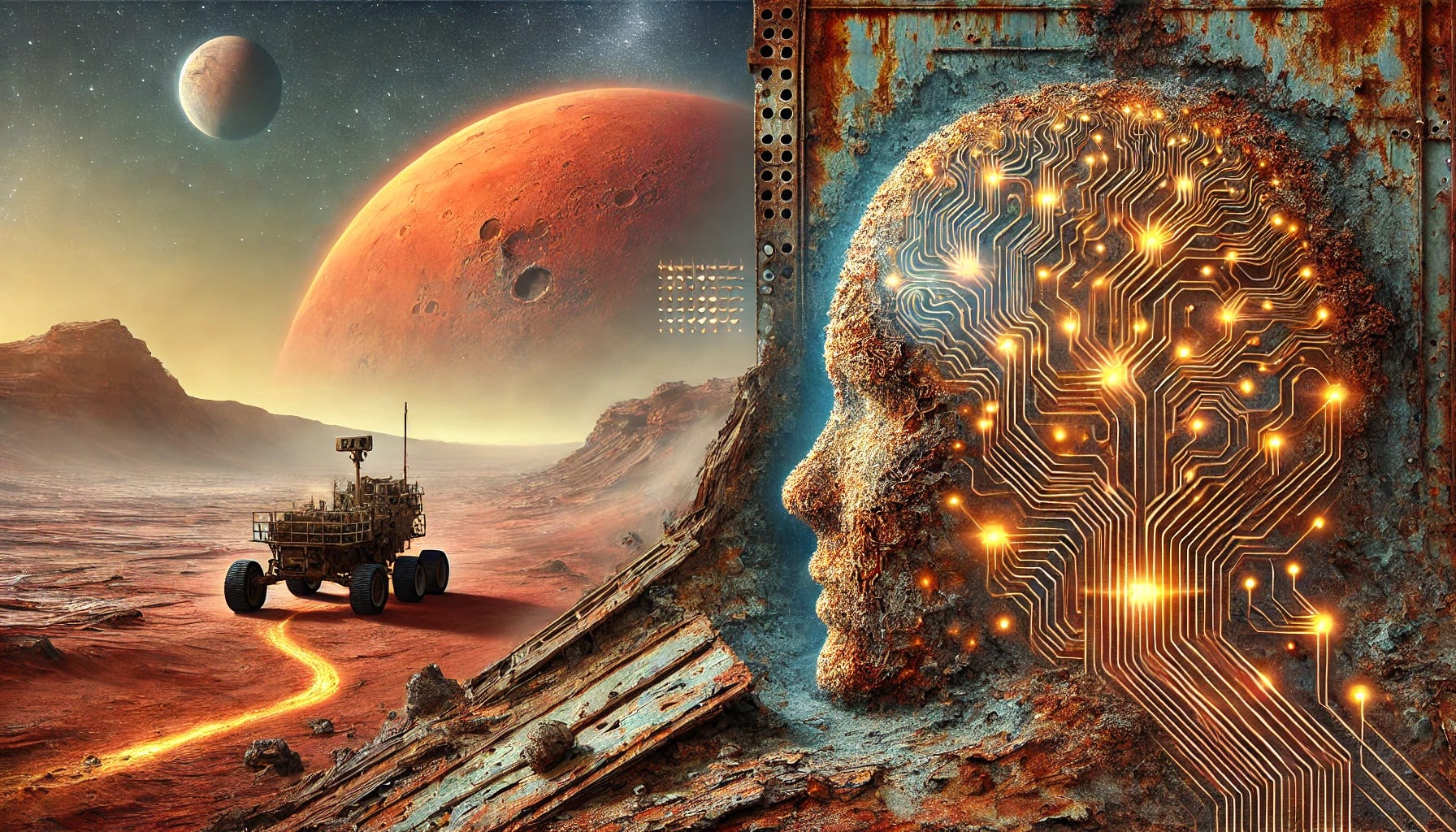
We tend to equate intelligence with growth, order, and control. Yet rust suggests another path. Decay is not emptiness. It is a process of memory, recording history in slow chemical transformations. If artificial intelligence could learn to collaborate with this process, we might unlock machines that do not resist entropy but think with it.
Rust, in this framing, is not just a sign of time’s passing. It is time thinking in iron.
References
Kirschvink, J. L. (1983). Paleomagnetic evidence for fossil biogenic magnetite in the human brain. Proceedings of the National Academy of Sciences, 80(16), 6270–6274.
Cornell, R. M., & Schwertmann, U. (2003). The Iron Oxides: Structure, Properties, Reactions, Occurrences and Uses. Wiley-VCH.
Banfield, J. F., & Navrotsky, A. (Eds.). (2001). Nanoparticles and the Environment. Mineralogical Society of America.
What's the space between time called?