
The Silent Aurora Hypothesis
Could Magnetic Storms Sculpt Temporary Neural States in Humans?

Introduction: Thinking Under the Sky’s Currents
When the aurora borealis paints the night sky with green and violet ribbons, it’s easy to see it as purely visual, a spectacular play of solar particles colliding with Earth’s atmosphere. But the same solar storms that power these lights also flood our planet with dynamic geomagnetic fluctuations. For decades, there have been scattered reports of mood changes, unusual dreams, or bursts of creative insight coinciding with geomagnetic disturbances. What if these aren’t coincidences? Could the human brain, an electrochemical organ exquisitely sensitive to weak fields, be subtly sculpted by magnetic storms?
This is the essence of the Silent Aurora Hypothesis: that rapid fluctuations in the geomagnetic field during intense auroral events may induce transient shifts in neural excitability, perception, or even cognitive style, producing states of mind that only occur under certain planetary conditions.
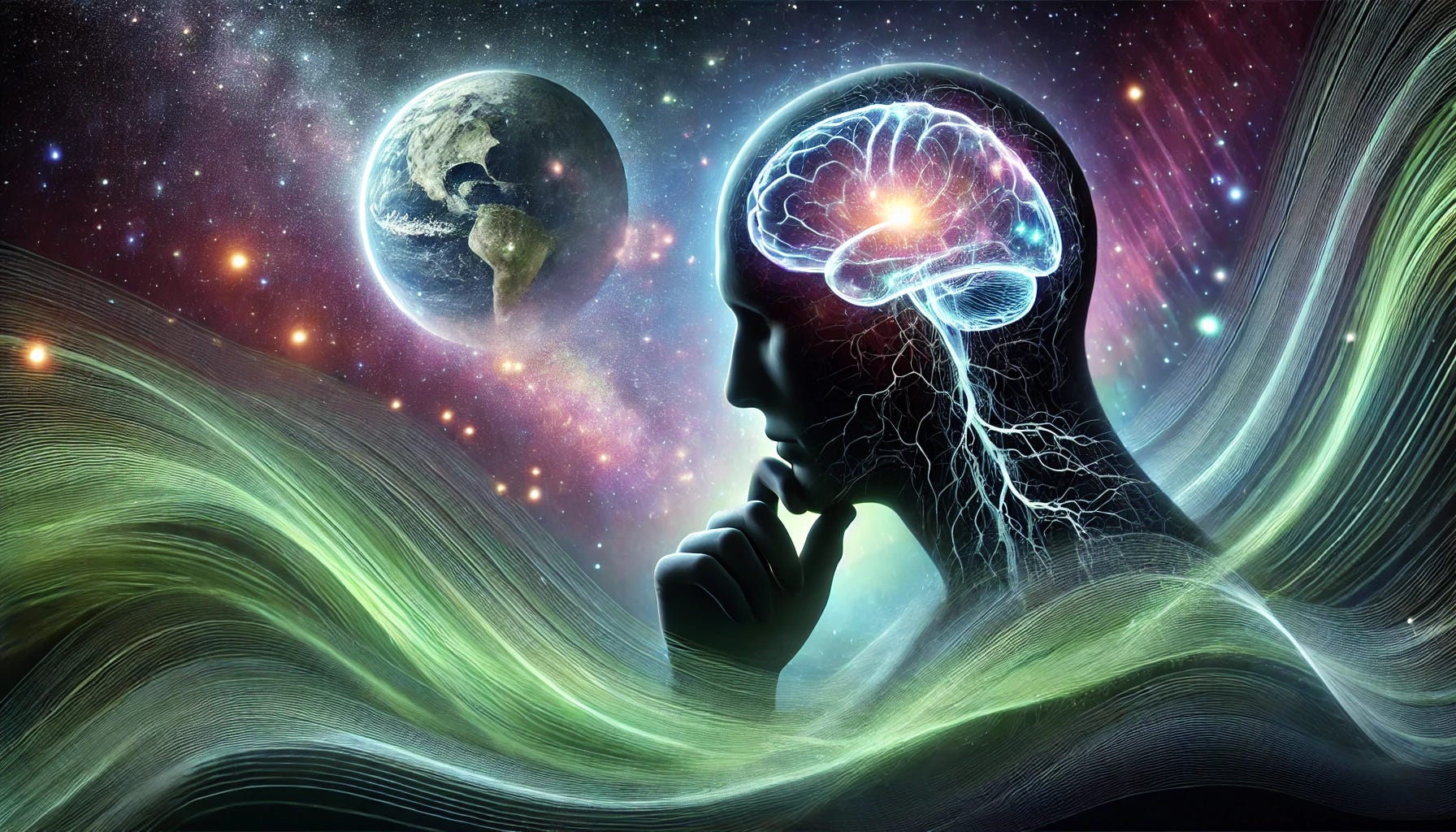
Geomagnetism and the Brain: The Overlooked Coupling
The human brain operates in the millivolt range, with oscillatory rhythms in the 1–100 Hz spectrum. Earth’s magnetic field strength is on the order of 50 μT, seemingly weak compared to internal neural signals, but the fluctuations during geomagnetic storms can reach hundreds of nanotesla in seconds. Studies have shown that certain animals, including migratory birds and sea turtles, use magnetoreception to navigate (Wiltschko & Wiltschko, 2005; Lohmann et al., 2008). Evidence for a similar latent sense in humans is emerging. Kirschvink et al. (2019) demonstrated that alpha brainwave activity can be modulated by changes in Earth-strength magnetic fields, suggesting the human brain can, at least in principle, register geomagnetic variation.
If so, intense solar storms, when auroras are most vivid, could represent natural experiments in large-scale neural field modulation.
Mechanisms: From Magnetoreception to Cognitive Modulation
There are two plausible mechanisms for geomagnetic effects on brain states. The first involves cryptochromes, blue-light-sensitive flavoproteins in the retina implicated in magnetic sensing in birds (Maeda et al., 2012). If cryptochromes in humans retain some magnetosensitivity, geomagnetic fluctuations could alter their redox states or signaling cascades, influencing circadian or mood-related pathways.
The second mechanism is more direct: field induction in neural tissue. Time-varying magnetic fields can induce microvolt-scale electric currents in conductive tissue according to Faraday’s law. While far weaker than currents used in transcranial magnetic stimulation (TMS), these induced fields could still nudge neural oscillators toward synchrony or desynchronization, particularly in networks already near a critical threshold, an idea supported by the stochastic resonance model of neural noise-benefiting systems (McDonnell & Ward, 2011).
A Planetary-Scale Neuro-Lab
If this coupling exists, auroral storms would act as unpredictable but global-scale “neural interventions,” delivering noninvasive stimulation to entire populations simultaneously. This leads to testable predictions: Regions experiencing high Kp-index auroras should show small but measurable changes in EEG phase coherence, creativity task performance, or even collective behavioral trends such as voting patterns or social mood in online discourse.
Satellite and ground magnetometer data could be paired with EEG recordings from volunteers in auroral zones to look for transient shifts in alpha/theta ratios. Controlled experiments might involve magnetically shielded rooms with artificially replayed auroral magnetic waveforms, testing their capacity to reproduce aurora-associated cognitive states.
Cultural and Evolutionary Implications
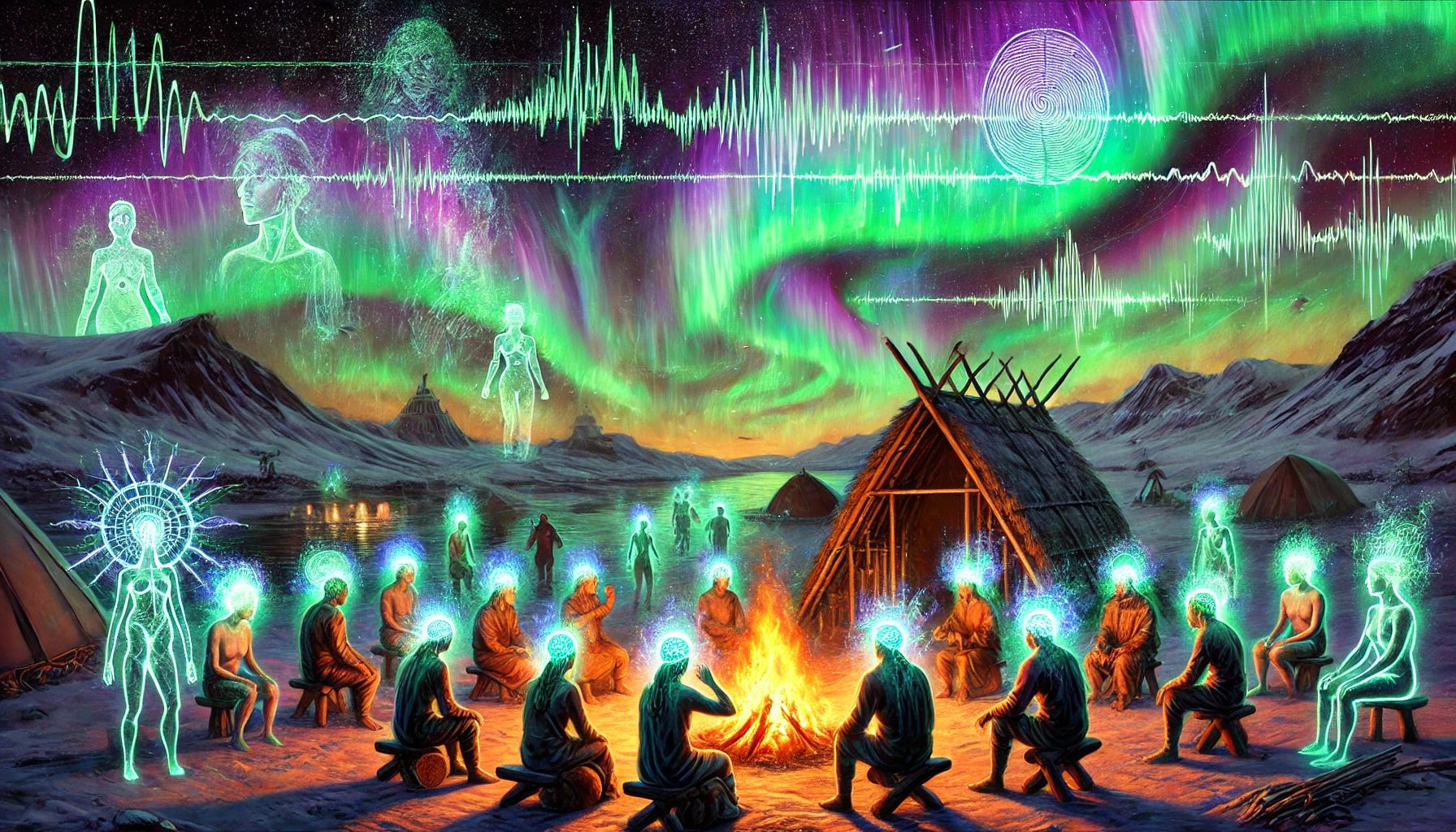
If humans possess a latent magnetosensory channel that occasionally modulates cognition, it could have shaped both cultural myths and evolutionary strategies. Ancient populations living under frequent auroras may have associated these lights not just with visual spectacle but with altered states of consciousness, perhaps seeing them as divine visions, or times when prophecy or creativity was heightened.
It is tempting to speculate that geomagnetic storms could synchronize certain mental states across entire communities, subtly influencing the arc of human culture in ways long forgotten.
Field Experiment: Do Auroral Geomagnetic Fluctuations Modulate Human Brain States?
Overview
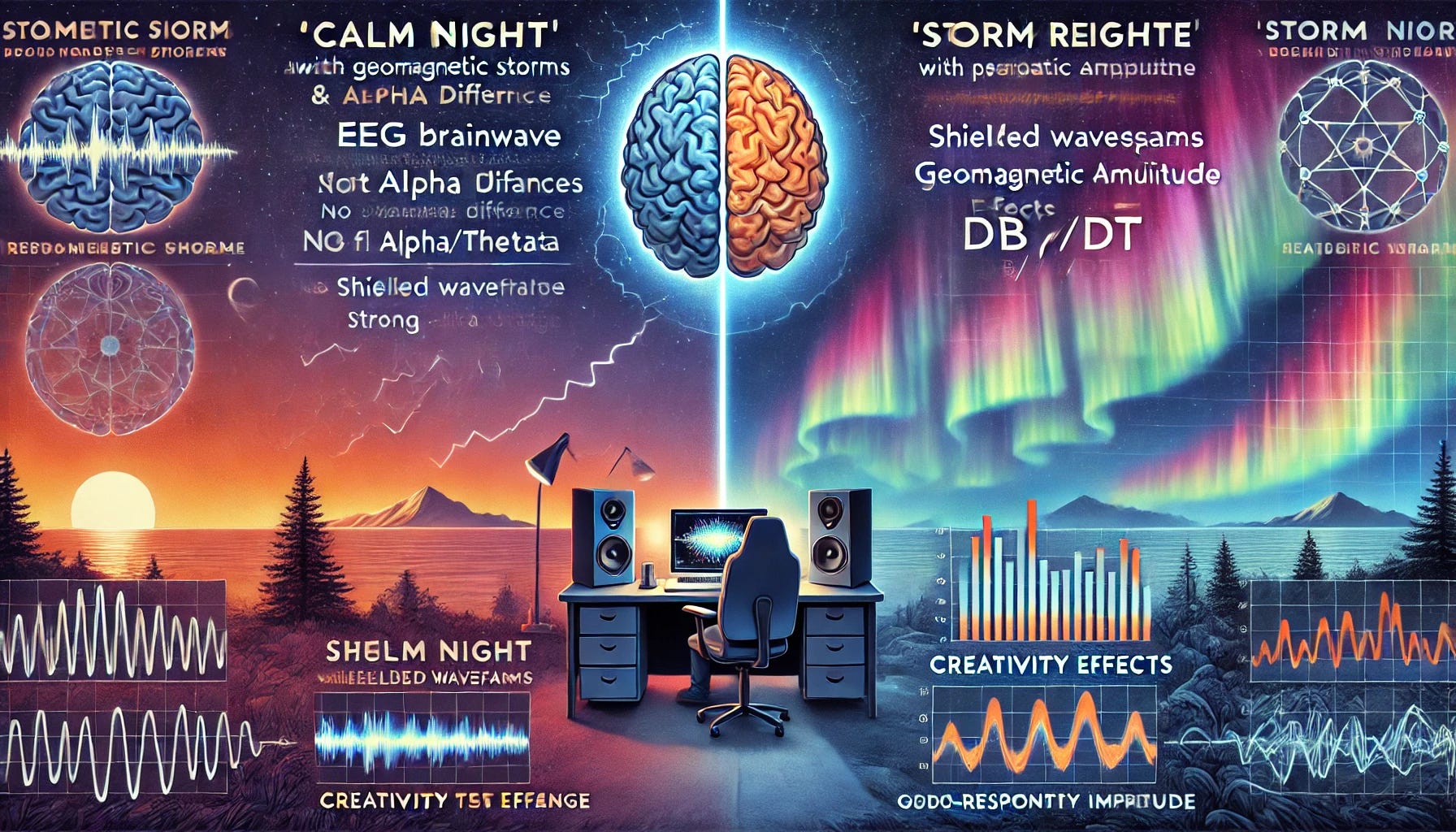
Recruit healthy adults living within and just outside the auroral oval (e.g., northern Scandinavia, Alaska, northern Canada). Follow them for six to eight weeks spanning at least two moderate geomagnetic storm windows. The study combines (1) naturalistic recordings during real auroras, (2) tightly matched calm-space-weather control nights, and (3) a lab-based “replay” condition in a magnetically shielded room that reproduces auroral magnetic waveforms to test causality.
Participants and Sites
Aim for 120–160 participants split across two to three sites at different geomagnetic latitudes to exploit natural variance in storm intensity. Exclude neurological disorders, psychoactive medication use, recent jet lag, and shift work. Screen for sleep quality and chronotype so circadian factors can be modeled rather than confounded.
Instrumentation
Outdoors and at-home: 16–32 channel mobile EEG headsets capable of clean alpha–theta power estimation; photoplethysmography for heart-rate variability; actigraphy for sleep/wake; low-light salivary melatonin sampling kits; phone-based ecological momentary assessment (EMA) for mood, dream vividness, and creativity prompts. Environment: local fluxgate magnetometers sampling ≥1–10 Hz; access to regional magnetometer arrays (INTERMAGNET), Kp/AE indices, and riometer data for ionospheric absorption. Lab replay: magnetically shielded room (mu-metal or active compensation) with tri-axial coils to reproduce recorded storm waveforms at Earth-strength amplitudes, plus dim light control for cryptochrome pathways.
Protocol
Naturalistic phase: Each participant completes three evening sessions per week, 20:00–01:00 local time. On storm nights (Kp ≥ 5 or site-specific AE thresholds), they wear EEG and HRV sensors, complete standardized creativity tasks (Alternate Uses Task; Remote Associates), a probabilistic learning task to probe exploration/exploitation, and resting-state eyes-closed/eyes-open EEG blocks time-locked to local magnetic fluctuations. They repeat the identical protocol on matched non-storm nights (same weekday, similar temperature/light exposure, sunspot lag). Overnight, a subset wears sleep EEG headbands and provides pre-sleep and morning saliva for melatonin and cortisol.
Replay phase: In the shielded room, present three 20-minute magnetic-field conditions in counterbalanced order: recorded storm waveform from that participant’s site (band-limited to the natural spectrum), a spectrally matched sham waveform with phase-scrambled controls, and a quiescent baseline. Keep light at scotopic levels and ban visual aurora content so any effect can’t be chalked up to scenery. Repeat the behavioral and resting-state blocks identically.
Outcomes
Primary neural outcomes are changes in alpha power (8–12 Hz) and alpha–theta coupling, plus phase–amplitude coupling and long-range phase coherence across frontal–parietal leads, analyzed in windows aligned to sharp geomagnetic derivatives (dB/dt) and AE bursts. Secondary physiological outcomes include HRV (RMSSD, HF power) and melatonin phase angle. Behavioral outcomes cover creativity fluency/originality scores, reaction-time variability, and exploration metrics. EMA yields mood valence/arousal and dream recall the following morning.
Analysis Plan
Use linear mixed-effects models with by-participant random intercepts and slopes, predicting neural and behavioral outcomes from local magnetic predictors (instantaneous B, dB/dt, band-limited power in Schumann-like ranges), light exposure, temperature, time awake, chronotype, and site. Time–frequency analyses will align sliding windows to geomagnetic transients and test for transient shifts in alpha/theta power and connectivity. Correct for multiple comparisons with cluster-based permutation tests across time–frequency–sensor space. In replay sessions, run within-subject contrasts (storm vs sham vs baseline). Power analysis: with N≈140 and ≥6 usable storm–control pairs per person, simulations suggest >80% power to detect very small effects (Cohen’s d≈0.15–0.20) in alpha power and creativity scores after mixed-model pooling.
Confounds and Controls
Disentangle visual awe by including non-auroral sites and by replaying fields in darkness. Control for weather, temperature, and social context via EMA and covariates. Minimize RF noise by using shielded EEG cables and notch/bandstop filters; log any local power-grid disturbances. Circadian influences are handled by repeated measures, fixed session windows, melatonin assays, and inclusion of chronotype. Expectancy effects are reduced with masked notifications (“session tonight”) that don’t reveal storm status; debrief after data lock.
Ethics, Data, and Preregistration
Register hypotheses (alpha suppression and connectivity shifts during storms; enhanced creativity scores; partial replication under replay) and the full analysis plan on OSF before data collection. Obtain ethics approval for at-home biosampling, and ensure GDPR/PHI compliance. Share de-identified datasets plus magnetometer streams and analysis code upon publication to enable independent replication.
Falsification and Success Criteria
The hypothesis is weakened if no within-subject differences appear between storm and calm nights after controlling for light and sleep, if replayed waveforms in the shielded room produce no neural changes, or if effects track visible aurora intensity rather than geomagnetic indices. It’s strengthened if alpha/theta dynamics and creativity scores covary with dB/dt in both naturalistic and replay conditions, ideally with dose–response by geomagnetic amplitude.
Listening to the Sky’s Pulse
The Silent Aurora Hypothesis reframes auroras not just as a spectacle for the eyes, but as possible participants in human neurodynamics. If verified, this coupling between space weather and brain state would reveal that cognition is not entirely self-contained but faintly tethered to the solar wind, our thoughts occasionally tuned, however slightly, by the silent pulse of the planet’s magnetic breath.
References
Kirschvink, J. L., et al. (2019). Transduction of the geomagnetic field as evidenced from alpha-band activity in the human brain. eNeuro, 6(2), ENEURO.0483-18.2019. https://doi.org/10.1523/ENEURO.0483-18.2019
Lohmann, K. J., et al. (2008). Geomagnetic imprinting: A unifying hypothesis of long-distance natal homing in salmon and sea turtles. PNAS, 105(49), 19096–19101.
Maeda, K., et al. (2012). Magnetically sensitive light-induced reactions in cryptochrome are consistent with its proposed role as a magnetoreceptor. PNAS, 109(13), 4774–4779.
McDonnell, M. D., & Ward, L. M. (2011). The benefits of noise in neural systems: Bridging theory and experiment. Nature Reviews Neuroscience, 12(7), 415–426.
Wiltschko, W., & Wiltschko, R. (2005). Magnetic orientation and magnetoreception in birds and other animals. Journal of Comparative Physiology A, 191(8), 675–693.