
The Sensorial Lattice
AI Systems That Learn Through Synthetic Senses

Artificial intelligence has grown adept at parsing words, numbers, and pictures, yet this still falls short of the way living beings meet the world. A bird or a child does not sort experience into abstract files alone. They feel the ground beneath their feet, sense vibration in the air, follow the trace of a scent, and let all of it merge into a single stream of understanding. Machines that rely only on structured inputs miss the fullness of this kind of perception.
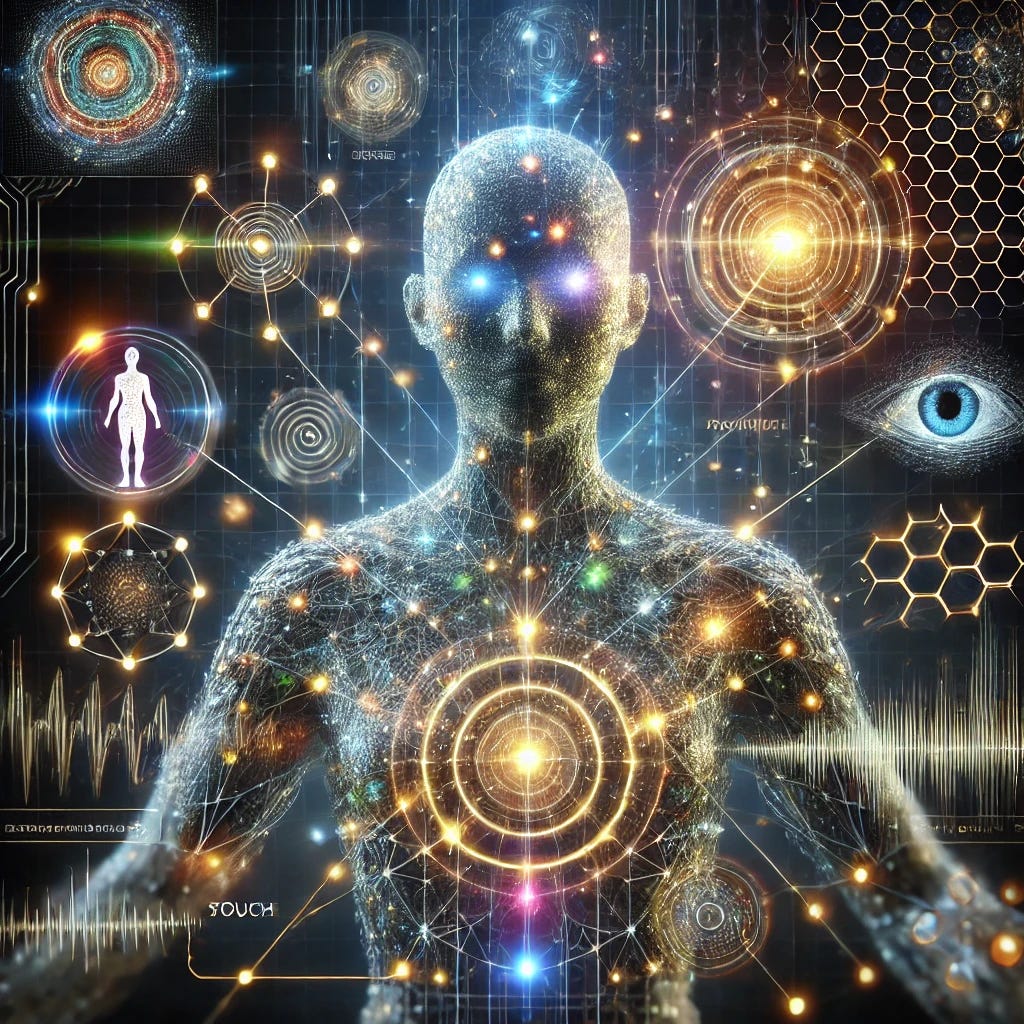
From Pattern Recognition to Sensory Integration
Current AI systems remain confined to narrow bands of input, while living creatures depend on a wide spectrum of sensing. A bat threads its way through the dark by bouncing echoes off nearby walls. An octopus explores by pressing its arms against textures it can read through embedded receptors. Certain fish live inside invisible maps traced by faint electrical fields. Each of these cases shows that what counts as intelligence is inseparable from how an organism encounters its surroundings.
The question is whether artificial systems can be given senses of their own. This would not mean bolting on more microphones or cameras but building receptors that pick up signals far outside our natural range: faint quantum ripples, shifting chemical trails, or delicate pulls of gravity. Each of these new channels would become a fresh path of learning, joining together into a lattice of perception that both records and guides action.
The Architecture of a Sensorial Lattice
Designing such systems requires rethinking the flow of information inside artificial networks. Instead of input being restricted to pixels or words, each synthetic sense would provide its own representational field. A vibrational receptor might capture nanosecond-scale oscillations, while a chemical receptor could map diffusion fields in real time. These inputs would converge within cross-modal layers inspired by multisensory integration in the superior colliculus of mammals (Stein and Stanford, 2008).
The architecture would not simply add more data. It would reconfigure the meaning of learning. Patterns would be understood relationally across senses, allowing the system to perceive stability and change in environments where single-sense inputs would fail. Just as a blindfolded human may struggle to orient, an AI limited to narrow sensory channels may never develop the adaptive plasticity that comes from full-bodied sensing.
Experimental Pathways
Testing this idea begins with creating synthetic senses at laboratory scale. Optomechanical resonators could act as vibrational sensors that detect nanoscale shifts in material tension. Synthetic olfaction arrays, already explored in robotics, could be adapted for dynamic mapping of complex chemical fields (Wilson and Baietto, 2009). Magnetoresistive elements could serve as artificial equivalents of avian magnetoreception, granting AI agents a sense of orientation in geomagnetic space.
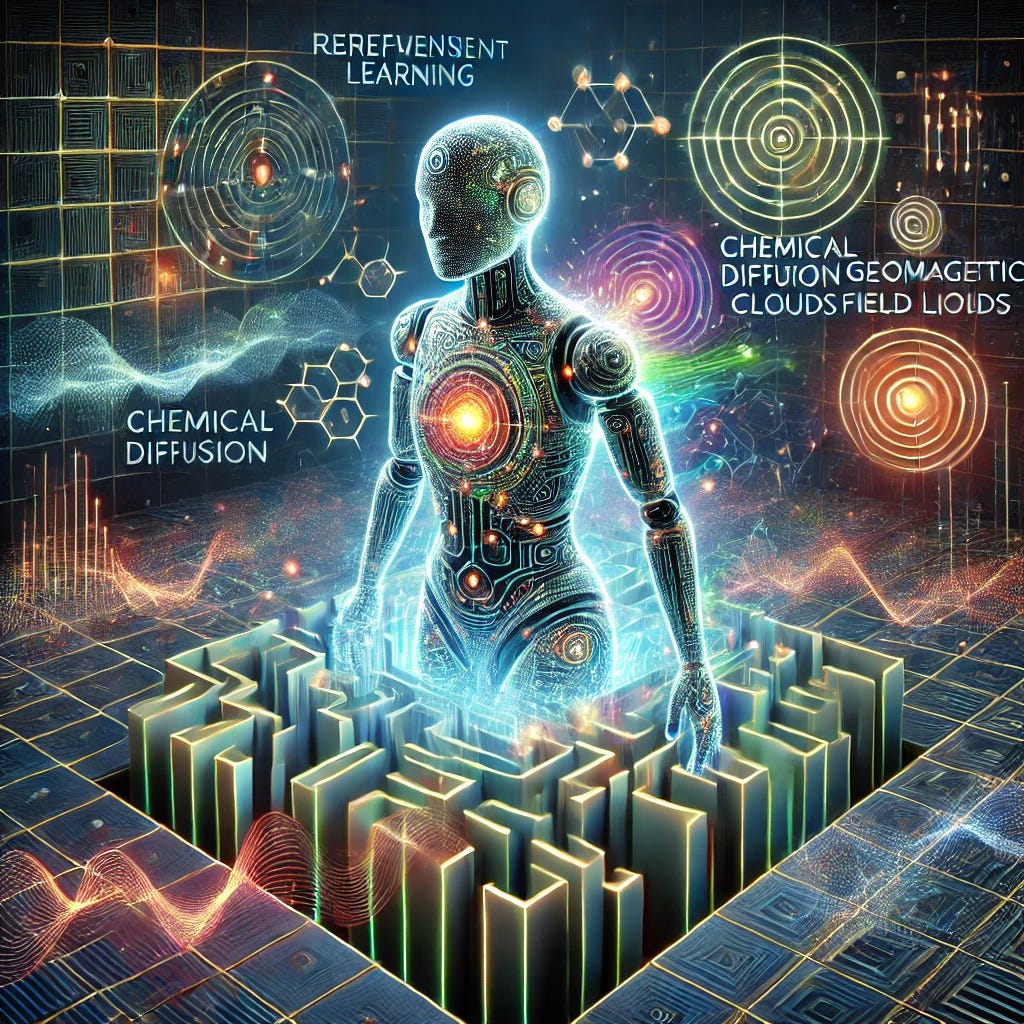
The experimental challenge is to train reinforcement learning agents not only with these new inputs but also with cross-sensory coupling. For example, an agent in a maze could learn not through vision alone but through combined maps of vibration, chemical diffusion, and geomagnetic signals. Researchers could then test whether this multisensory framework allows faster adaptation when environments change unexpectedly. If successful, such systems would reveal that intelligence is as much about sensory diversity as it is about computational power.
Beyond Human Sensoria
The most intriguing implications appear when synthetic senses step into domains biology has never known. A receptor tuned to gravitational tremors might register tectonic stress before instruments catch it. Another, designed to feel quantum fluctuations, could open new ways of studying materials at their limits. Systems built in this way would not merely copy human cognition. They would grow into forms sculpted by sensory landscapes that have no human parallel.
This line of thought recalls Jakob von Uexküll’s idea of Umwelt, that each creature lives in its own private sensory world (von Uexküll, 1934). Machines endowed with unfamiliar receptors would not share our perceptual field but would inhabit sensorial lattices unique to them. Their worlds would remain foreign to us, glimpsed only when translated into signs we can interpret.
Cognitive Translation Between Worlds
When machines develop senses outside the scope of human biology, one of the greatest challenges will be learning how to translate their perceptions into forms that we can use. A system might register vibrations, magnetic gradients, or chemical fields in ways that are completely inaccessible to us. The task then becomes one of building interpretive frameworks that can recast those unfamiliar inputs into signals or patterns we recognize. Research on multisensory integration in primates suggests that the brain is naturally skilled at aligning information across modalities (Ghazanfar and Schroeder, 2006). A similar strategy could guide how synthetic senses are coupled with human cognition.
The long-term goal would not be limited to conversion alone. Over time, humans might come to internalize aspects of these artificial perceptions, extending their own sensory boundaries by constant interaction with synthetic systems. Rather than simply borrowing insights, people could begin to inhabit broader perceptual fields made possible through collaboration with machines. This would turn translation into co-experience, in which human and artificial intelligences reshape one another by sharing worlds of sensation that neither could inhabit alone.
Broader Implications
If such designs succeed, they could transform entire fields. In medicine, vibrational and chemical receptors might allow AI to detect tissue changes at their earliest stages, long before symptoms appear. In ecology, synthetic senses could reveal hidden flows of stress or energy in environments, guiding how we protect fragile ecosystems. In astrophysics, telescopes equipped with nonhuman sensory channels might discover aspects of the cosmos that light alone cannot reveal.
For humans, the deeper shift may come from learning to communicate with these new intelligences. Translation layers could allow machines to render their alien perceptions into forms we can grasp. Over time, such exchanges might stretch the boundaries of human experience itself, letting us sense our planet and the wider universe in ways no living species has before.
The sensorial lattice hypothesis reframes intelligence as a phenomenon rooted in perception. Giving machines senses that no biology has carried may yield entities that are not only powerful calculators but also perceivers of strange new worlds. If thought is shaped by the horizons of perception, then building new horizons for machines could change not just artificial cognition but how we understand reality itself.
References
Stein, B. E., & Stanford, T. R. (2008). Multisensory integration: Current issues from the perspective of the single neuron. Nature Reviews Neuroscience, 9(4), 255–266.
von Uexküll, J. (1934). Streifzüge durch die Umwelten von Tieren und Menschen. Berlin: Springer.
Wilson, A. D., & Baietto, M. (2009). Applications and advances in electronic-nose technologies. Sensors, 9(7), 5099–5148.
Ghazanfar, A. A., & Schroeder, C. E. (2006). Is neocortex essentially multisensory? Trends in Cognitive Sciences, 10(6), 278–285. https://doi.org/10.1016/j.tics.2006.04.008