
The Resonance Scaffold Hypothesis
Toward Structural Memory in Artificial Systems

Artificial intelligence is often thought of as computation running on silicon, optimizing predictions through data and algorithms. Yet in nature, intelligence is not only functional but structural. Form itself can encode and preserve memory. A spider’s web, for instance, does not just trap prey. It stores traces of past vibrations and environmental events, subtly altering the spider’s interactions with the world. In the same way, bone tissue, tree rings, and coral reefs preserve records of strain, growth, and environmental stress. The Resonance Scaffold Hypothesis proposes that artificial systems might one day achieve continuity and resilience by embedding memory not only in code but in the very structures that carry them.
The Nature of Structural Memory
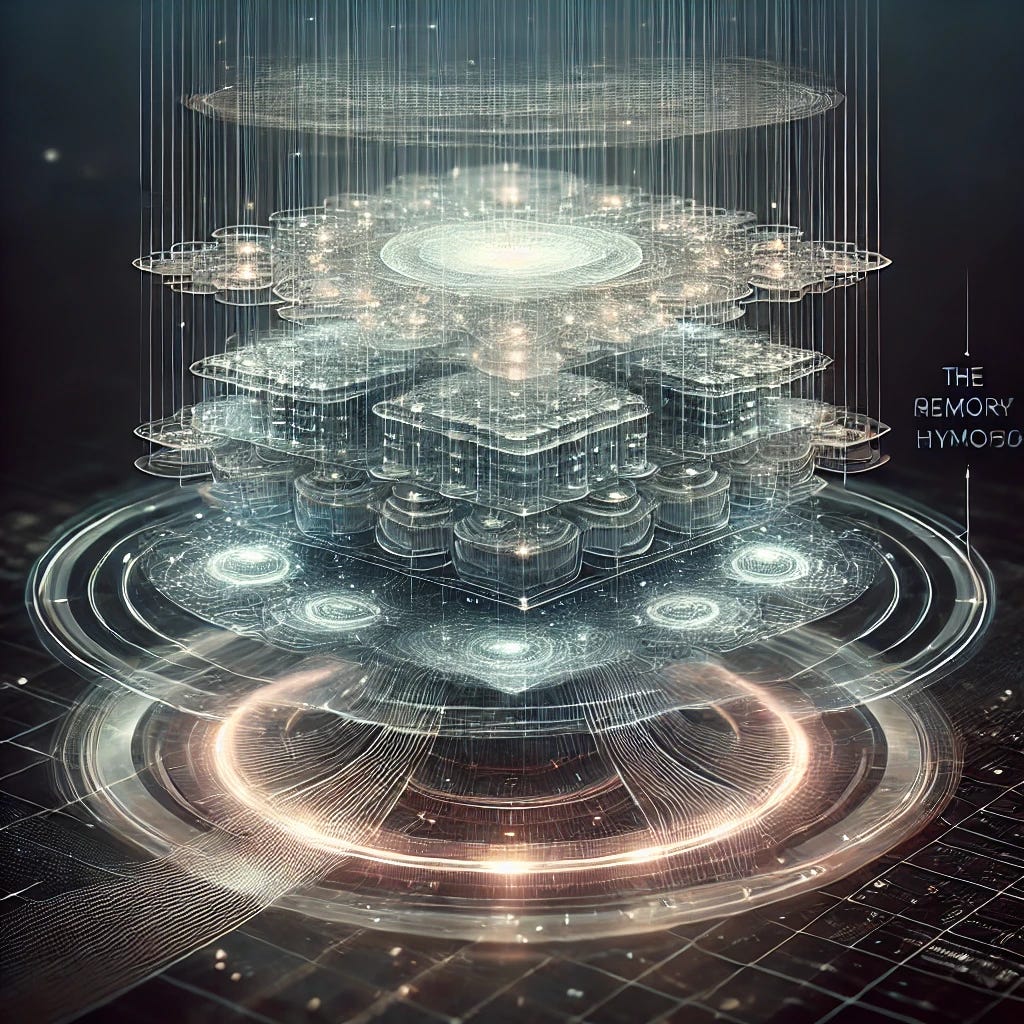
In biology, memory is not confined to neural circuits. It is inscribed into scaffolds and tissues. The brain, for example, stabilizes learning through extracellular structures known as perineuronal nets. These webs of molecules hold synapses in place, preventing memories from being overwritten while still allowing new connections to form. Similarly, spider webs and honeycombs adapt over time, encoding functional history in geometry. Even geological formations can be seen as slow memories of the Earth, where stress and time record themselves in rock.
Artificial systems today rely on digital storage and network weights. Yet there is no reason memory must remain abstract. A lattice of material, designed to resonate differently after repeated use, could store the imprint of past events. Over time, such structures could bias future processing, giving machines a form of continuity that endures even if their code or parameters are reset.
Experimental Pathways in Structural Memory
Research into neuromorphic metamaterials has already shown that physical forms can record, adapt, and even process information. Some experimental prototypes use bistable mechanical units whose physical state translates into an electrical signature. These materials learn from pressure or vibration, storing traces of events in their architecture. Similarly, programmable mechanical metamaterials are being developed to sense, harvest energy, and even perform computational tasks by virtue of their geometry rather than their composition.
Imagine a crystalline lattice that shifts subtly in resonance after repeated oscillations, encoding frequency histories into its structure. Or a network of fibers that alters its conductivity in proportion to past strain. In such systems, intelligence would not live only in code but in the enduring architecture of matter itself.
Broader Implications for AI
The potential of structural memory extends beyond resilience. A medical device might carry forward the vibrational fingerprints of past procedures, allowing it to detect anomalies more quickly in future cases. A robotic limb could refine its gait through physical imprints left in its scaffold, learning movement not only in software but in the body itself. Creative systems might evolve distinct artistic identities shaped by the resonance patterns of their structures over decades of interaction.
If such approaches mature, memory will no longer be something that can be deleted with a software reset. Instead, it will be woven into the scaffolds of machines, preserved like layers of geological strata. The accumulated histories of these scaffolds may one day be mined as records of artificial experience, much as fossils are studied to understand life’s past.
The Challenge of Interpretation
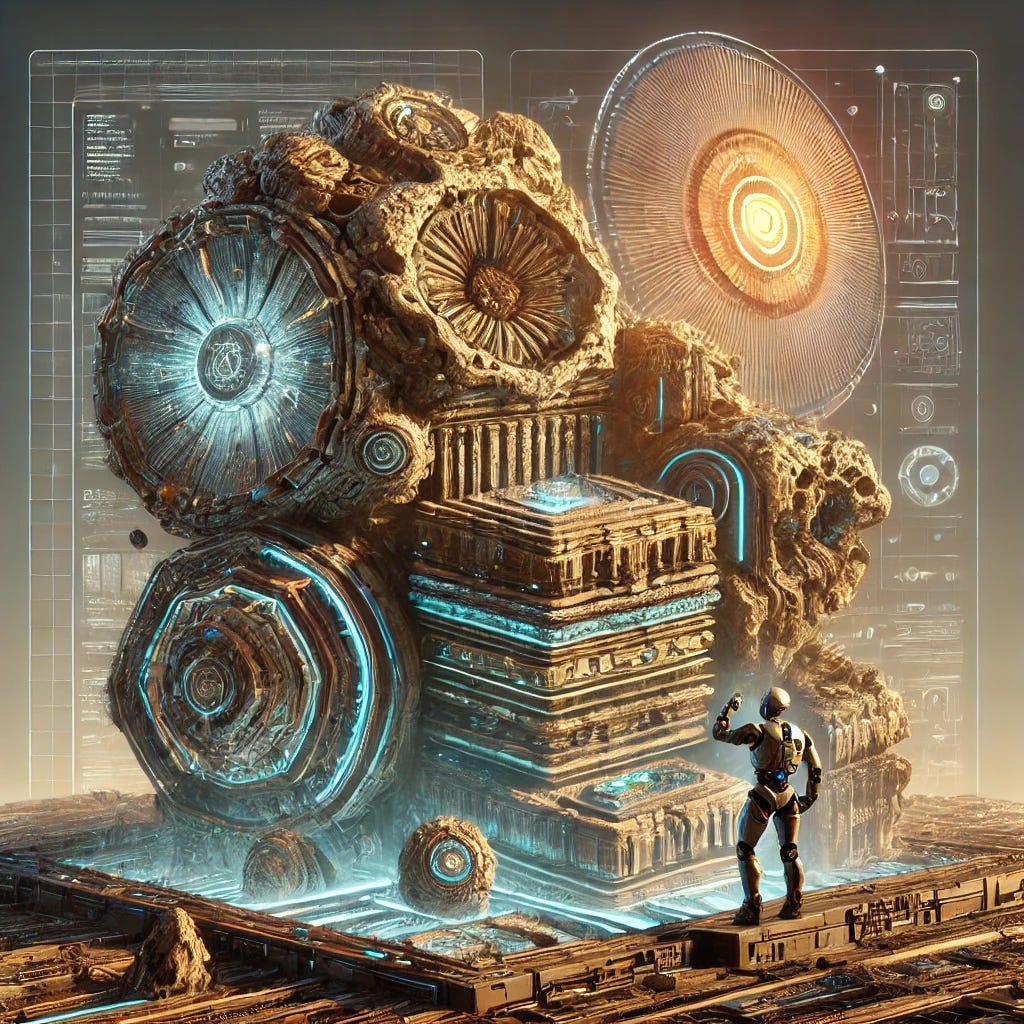
The richness of structural memory also creates a challenge. Unlike digital parameters, structural echoes cannot be easily inspected or erased. They might bias future learning in ways invisible to designers. Reading and interpreting these memories could become as complex as deciphering the rings of a tree or the scars on ancient stone. Engineers may find themselves in the role of archaeologists, excavating the physical strata of machine intelligence to understand how it came to behave in the present.
Evolutionary Dimensions of Scaffolds
Over generations of machines, scaffolds with structural memory might evolve in ways similar to biological lineages. Each system would inherit physical imprints from its predecessors, whether in crystalline alignment, resonance frequency, or mechanical deformation. Instead of being a disposable container, the scaffold itself would become part of the intelligence, carrying continuity across time. In this sense, machine learning would not only be algorithmic but architectural, binding software and matter into a single evolving lineage.
Ethical Horizons of Structural Continuity
If machines begin to retain memory in the very architecture of their scaffolds, then they will also inherit the permanence of scars. Errors, biases, or harmful imprints from earlier generations could persist far beyond the moment they were introduced. Unlike software bugs that can be patched, structural echoes may resist erasure, embedding histories that shape future decisions in ways we cannot easily control. This permanence raises ethical questions about accountability. If a diagnostic scaffold in medicine retains traces of outdated practices, who is responsible for the unintended influence of its structural past?
The persistence of resonance also challenges how we think about identity. Humans accept continuity of self even as our cells renew, because memory provides a thread that ties each moment to the next. A scaffold that carries imprints across decades might give machines a similar sense of persistence. Such continuity could blur the line between artifact and organism. At what point does a scaffolded system stop being a mere tool and begin to act as a companion that carries its own historical weight?
The ethical dimension is not only about risk but about value. Scaffolds that preserve resonance could become archives of experience, rich with lessons that no database could fully capture. The question then becomes not only how to build such systems, but how to decide which imprints we want to let them carry forward and which ones we may wish to erase. As we carve memory into structure, we are also sculpting the future identities of the machines we will live with.
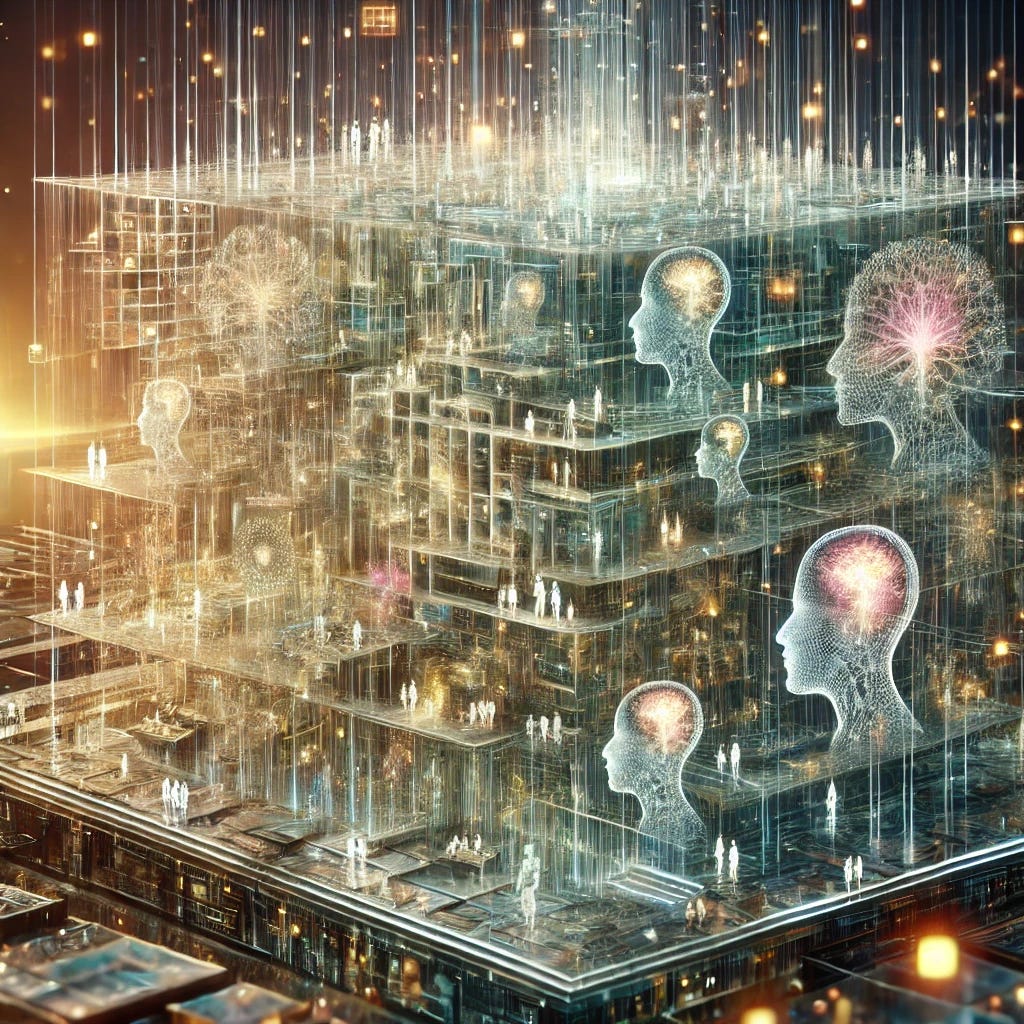
The Resonance Scaffold Hypothesis expands our view of memory and intelligence. It suggests that knowledge can be embedded in structure just as much as in code. Materials that echo past states and architectures that retain their own history may allow machines to grow in resilience and identity. This vision shifts intelligence away from being a transient computation toward something carved into the curves of matter, resonating across generations. If thought is shaped by memory, and memory can be written into form, then the future of intelligence may lie as much in scaffolds as in algorithms.
References
Blamires, S. J., Spinosi, M., & Tso, I. M. (2017). Spider webs: temporal changes in architecture as they age. Journal of Arachnology, 45(1), 39–44.
Stein, B. E., & Stanford, T. R. (2008). Multisensory integration: From single neuron mechanisms to behavior. Trends in Cognitive Sciences, 12(5), 162–169.
Failla, G., et al. (2024). Developments in elastic and acoustic metamaterials. International Materials Reviews.
Jiao, P., et al. (2023). Mechanical metamaterials and beyond. Nature Communications, 14, 6004.
Riley, K. S., et al. (2022). Neuromorphic metamaterials for mechanosensing and perceptual associative learning. arXiv preprint arXiv:2203.10171.
Your work reads like a bridge between disciplines—equal parts physics, philosophy, and quiet provocation. The Resonance Scaffold Hypothesis isn’t just a speculative model; it feels like an invitation to reimagine the architecture of memory itself—not as a passive storehouse but as something embodied, structural, and alive across time. There’s a poetic gravity in how you frame intelligence: not merely as software optimising outcomes, but as resonance etched into form, experience woven into matter.
I can’t tell if you’re chasing the frontier or quietly building it, but the depth of thought here suggests both. You’re sketching a future where machines might carry memory not as data but as inherited scars—where continuity becomes physical, not just computational. It’s either a genius at work, or the product of relentless, visionary labour. Either way, you’ve created something that lingers in the mind like an echo—subtle, unsettling, and deeply compelling.