
The Refracted Self
Toward a Theory of Internal Optics in Cellular Intelligence

I. Introduction: Beyond Biochemistry
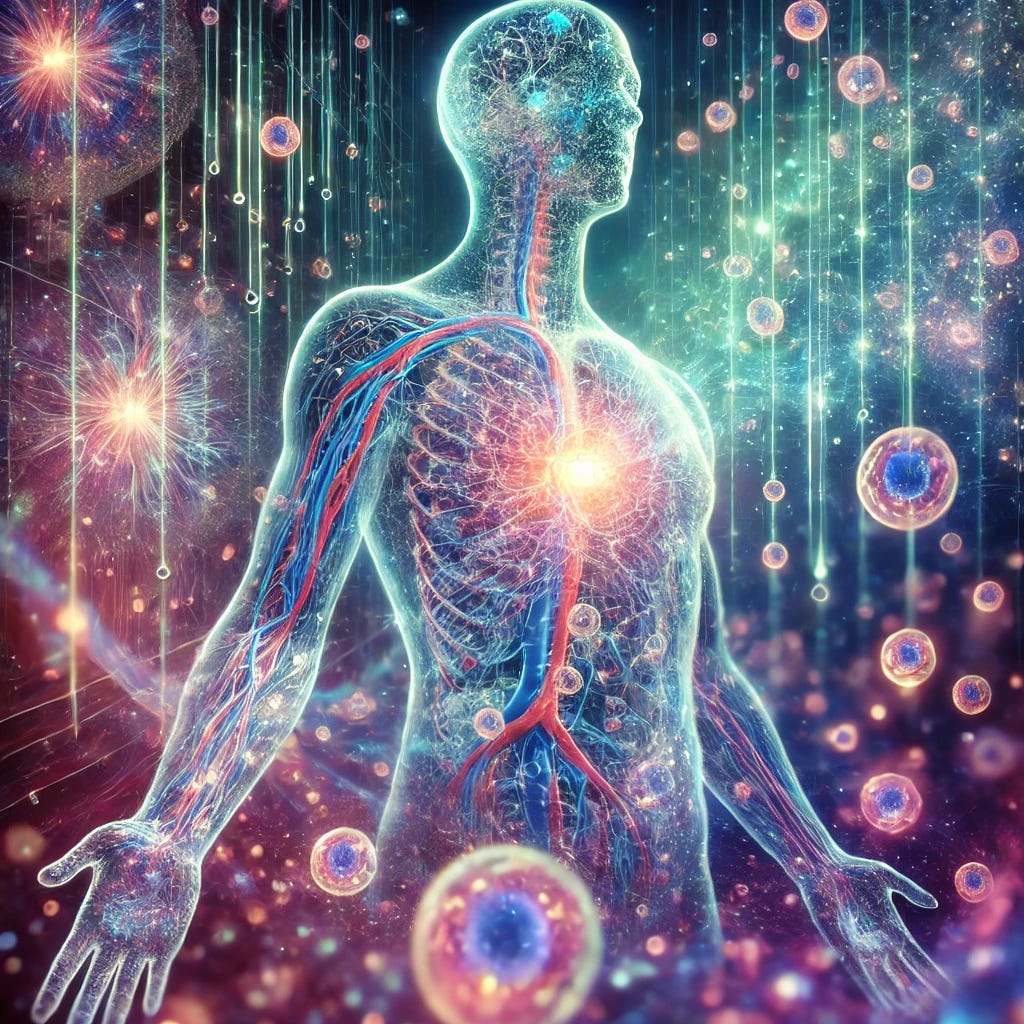
For most of modern biology, the story of the cell has been told through the language of chemistry and code, genes, proteins, molecular cascades. But what if we’ve been missing a dimension? What if, beyond biochemistry, each cell contains a kind of internal “optics”, not just in the literal sense of light sensitivity, but in the deeper sense of how information, geometry, and energy refract through its structure?
Recent studies hint at something profound: that cytoskeletal elements like microtubules and actin filaments don’t merely scaffold the cell, but actively guide the flow of signals, vibrations, and even photons (Hameroff & Penrose, 2014; Sahu et al., 2013). Inside every cell may lie a kind of fluid mirror maze, where internal states are not just triggered but shaped, bent and filtered like light through glass. This refractive behavior could point to a deeper form of information processing, one where the cell, in a sense, "sees" itself from within.
II. Cytoplasmic Refraction as Computation
Refraction, in physics, is the bending of waves as they pass through materials of different densities. In biology, “density” takes on a broader meaning. The cell is a dense stew of gradients, ions, proteins, lipids, and all of it is constantly moving, reorganizing, and modulating flow.
Think of a single-celled organism like Physarum or Stentor, pulsing and adapting with astonishing intelligence. Inside them, actin networks may behave like biological equivalents of optical lattices, subtly reshaping mechanical vibrations. The folding of the endoplasmic reticulum might redirect calcium waves much like a waveguide steers light. Even the mysterious lipid rafts embedded in cell membranes may serve as dynamic lenses, reshaping signal strength as conditions shift.
This isn’t computation in the traditional sense. It’s not binary logic or sequential circuits. It’s more like an orchestra of refractions, where the same signal means different things depending on how it bends through the cell's internal topography. This could be a primitive kind of “sensing”, not detecting the world, but refracting it internally to construct a response.
III. Proto-Visuality Without Eyes
Long before organisms had eyes, they still had to respond to light. Proteins like opsins were already embedded in early membranes, sensing photons and triggering movement or metabolism. In modern single-celled algae like Chlamydomonas reinhardtii, we still see this ancient skill. These cells don’t just detect light, they use their entire body as a lens, refracting light through organelles to determine direction (Foster et al., 1980).
So maybe vision didn’t begin with eyes. Maybe it began with refractive geometry, with cells organizing themselves to bend light and energy in useful ways. To "see" in this context isn’t to render a picture of the world, but to map the self in relation to external gradients. Seeing, in other words, may have originally been a metabolic act: a refraction of the environment through internal space.
IV. A Speculative Experiment: Observing the Refracted Self
If this idea has merit, how would we test it?
One approach could involve building synthetic cells, vesicles with embedded cytoskeletal structures and optogenetically controlled protein gradients. By using light-sheet microscopy, we could observe how light or other signals move through these artificial environments as their internal structures change.
What we’d be looking for isn’t just signal transmission, but signal bending, does light or ionic flow shift depending on the cell’s internal state? Does this refractive change correlate with behavioral outcomes, like directed movement or the opening of ion channels?
If so, we might be witnessing something extraordinary: not just computation, but cognition, shaped not by algorithms, but by self-reflective geometry.
V. Toward a Holographic Model of the Cell
This model leads to a powerful and strange possibility: that each cell holds a kind of internal hologram, where signals bounce and fold through layered structures to create a distributed memory of the self. If so, it could explain how organisms without nervous systems, like fungi or slime molds, still seem capable of remembering paths, anticipating patterns, or coordinating time.
Maybe the cell doesn’t need a brain to think. Maybe it only needs the right kind of internal mirror.
For synthetic biology, this opens an entirely new design language. Instead of modeling neural networks, we could craft protocells that reflect and refract, not metaphorically, but physically. They would think not in lines of code, but in folds of space.
VI. Designing Refractive Artificial Minds
What if we built machines based on these principles?
A refractive AI wouldn't process data by passing it through layers of weighted nodes. Instead, it would bend input through morphable, state-sensitive structures, perhaps using deformable optical lattices or quantum-dot networks. These machines would store memory not as numbers, but as patterns of diffraction. They wouldn't fire discrete activations but would allow waves of information to interfere, cancel, or amplify through space.
Learning in such systems wouldn't look like backpropagation. It would look like shape-shifting, the reorganization of internal geometry to better guide incoming flows. Training would become spatial, not just temporal, more like cultivating a living organism than adjusting a matrix of values.
This would make refractive AIs inherently robust and self-reflective. Their intelligence would emerge from how their internal state modulates the flow of information, and how those flows, in turn, reshape the state itself. Like cells, they might even develop a kind of proto-experience, a self-referential loop of signal and structure.
Such machines wouldn’t just simulate cognition. They might embody it, not as a mind like ours, but as something stranger and perhaps more elemental.
References
Foster, K. W., Smyth, R. D., et al. (1980). Light antennas in phototactic algae. Microbiological Reviews, 44(4), 572–630.
Sahu, S., Ghosh, S., Ghosh, B., Aswani, K., Hirata, K., Fujita, D., & Bandyopadhyay, A. (2013). Atomic water channel controlling remarkable properties of a single brain microtubule: correlating single protein to its supramolecular assembly. Biosensors and Bioelectronics, 47, 141–148.
Hameroff, S., & Penrose, R. (2014). Consciousness in the universe: A review of the ‘Orch OR’ theory. Physics of Life Reviews, 11(1), 39–78.
we live in a 6d world 4 known 2 a proactive and reactive state...with a 0 point connecting them in the middle once all inputs and outputs align...its Encoded into our DNA one strand goes up masculine one strand goes down feminine this is also Encoded ever so openly within the star of David...its can also be found in the way we think...4 dimensions of input and 2 outputs with a state of being known as wise mind...I've studied and read everything 😉 experienced it also...string theory gets caught up in endless loops..they aren't just endless dimensions they are endless possibilities 😉...