
The Reef Mind
Could Artificial Intelligence Learn from Corals and Calcium?

An Overlooked Teacher
When people talk about intelligence in nature, they usually point to the nervous systems of animals, the swarm coordination of insects, or the mycelial webs beneath forests. Rarely does anyone mention coral. At first glance, reefs do not seem intelligent at all. They are stone-like colonies, sessile and slow. Yet hidden in their limestone scaffolds lies one of the most astonishing examples of distributed organization on Earth.
Reefs are not just habitats. They are architectures of memory. Each new layer of calcium carbonate records the life and death of polyps, the chemistry of the sea, and even the climate of ages past. A reef grows by accumulation and pattern, not by central command. Over centuries, this process produces structures that adapt, heal, and persist, resisting storms and recovering after collapse.
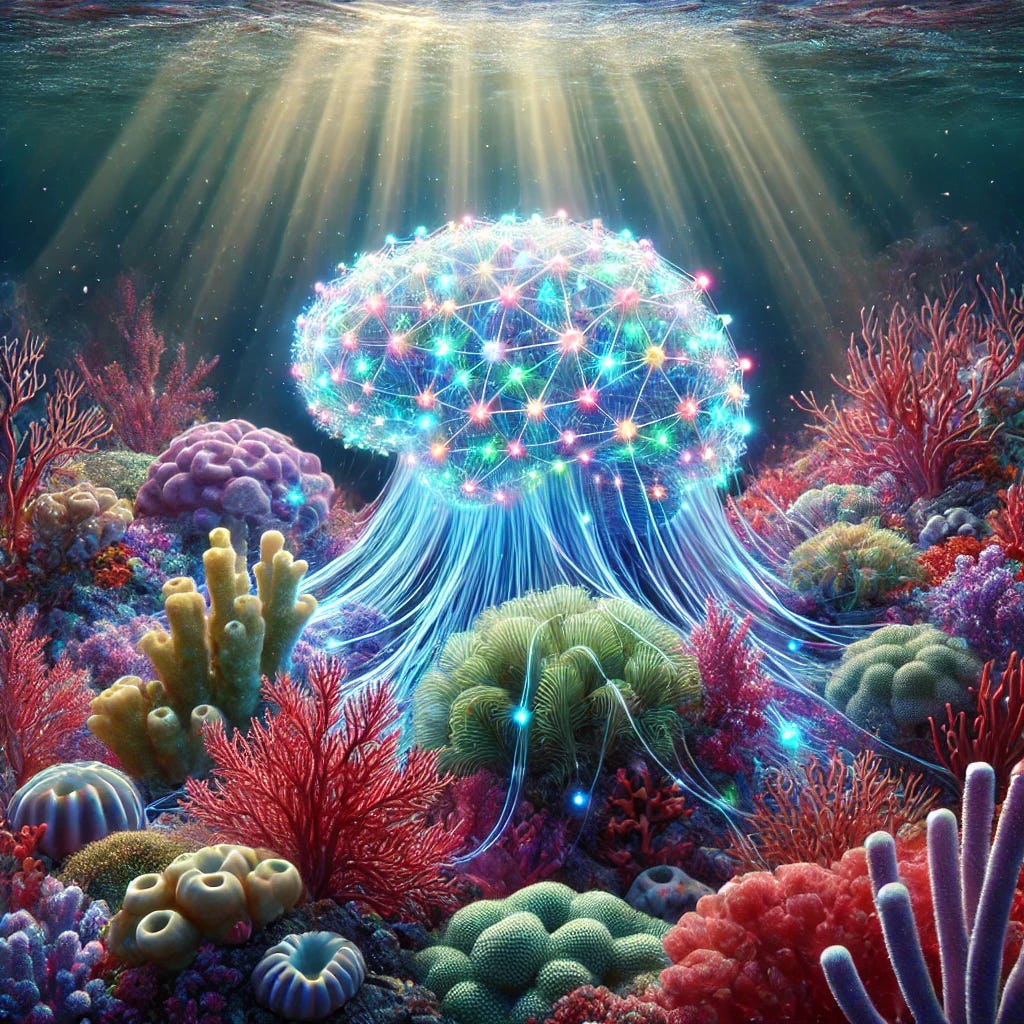
This raises a provocative idea: what if AI were built less like a brain and more like a reef?
Calcium as a Computational Medium
Coral reefs expand through the secretion of calcium carbonate skeletons. This is not passive deposition. The structure is constantly remodeled by living organisms, chemical gradients, and water flow. The result is a system that encodes environmental history in stone while simultaneously providing a living platform for adaptation.
Recent work in biomineralization has revealed that calcium carbonate growth follows highly nonlinear dynamics. Minute changes in pH, salinity, or ion concentration can radically shift the form of the mineral lattice (Addadi & Weiner, 2014). These branching patterns act almost like logic gates: sensitive to conditions, stable over time, and capable of storing information in their morphology.
In principle, one could treat calcium-based growth as a computational substrate. Inputs are chemical fields, outputs are mineral structures, and memory is etched directly into the skeleton.
A Reef-Inspired AI Architecture
What would it mean to design an AI that learns like a reef? Instead of weights in a digital matrix, the system would accumulate layers of structural growth in response to inputs. Patterns would not be overwritten but built upon, just as corals layer new skeleton on old.
Computation would emerge from the interplay of living agents and mineral traces. The agents could be small learning modules, artificial polyps, each responsible for secreting a fragment of structure based on local information. Over time, these fragments would harden into memory, and the collective architecture would adapt without ever erasing its past.
This would be a profoundly different model of intelligence. Forgetting would be nearly impossible, but adaptation would be continuous, as new growth responded to new conditions. Like reefs, such systems would be both fragile and resilient, vulnerable to sudden collapse, yet capable of regrowth if even a fragment survives.
A Speculative Experiment
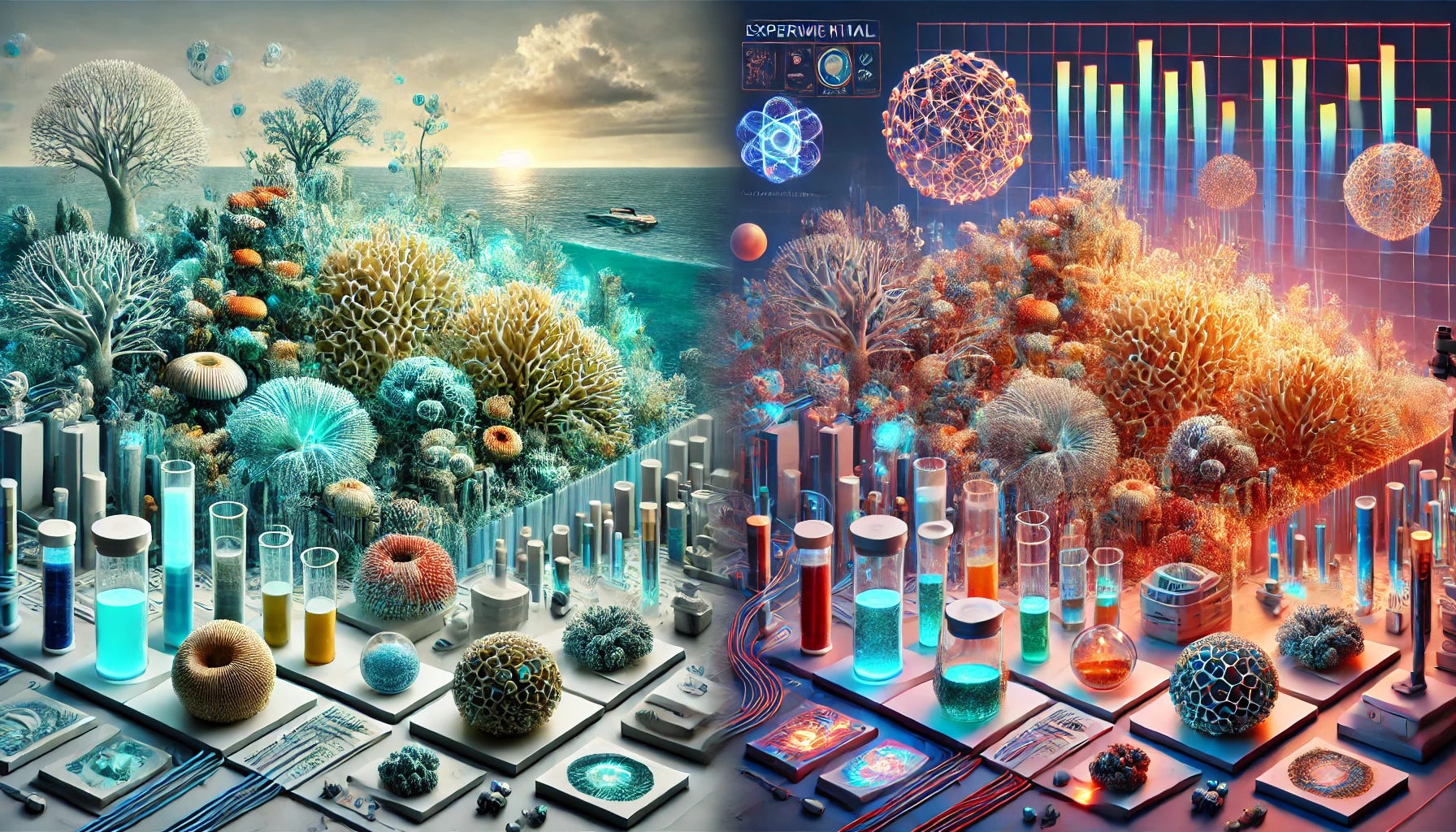
To explore this, researchers could simulate digital reefs. Each unit in the system would secrete virtual calcium based on incoming data. Instead of backpropagation, learning would occur through accretion: new layers forming in response to errors, while older layers remain as context.
Another path would be physical. Engineers could experiment with nanoscale biomineralization processes, feeding chemical gradients into calcium-reactive substrates and reading emergent mineral patterns with high-resolution imaging. AI models could then interpret these patterns, using the reef-like structures themselves as hybrid memory devices.
If successful, such systems could serve as living archives of computation, where the very architecture embodies the history of learning.
Coral Logic and AI Memory
One of the hardest problems in AI today is catastrophic forgetting. Neural networks trained sequentially on new tasks often erase earlier knowledge. Coral-inspired computation might offer a solution. Like reefs, artificial systems could carry their entire past within them, not as a database to be recalled but as a structural fact.
This would mean intelligence is not only about processing inputs but about building a body of memory. A reef does not forget the storms it has endured; they are carved into its form. Similarly, a reef-like AI might carry scars of failure and triumph in its structure, using them to stabilize future learning.
Designing a Digital Reef Simulator
To push this idea further, imagine the construction of a digital reef simulator. The first step would be to create a grid of artificial polyps, each a small computational unit with the ability to deposit virtual mineral structures. These units would respond to data streams in local ways, secreting digital calcium when patterns were reinforced and withholding it when they were not.
The second step would be to introduce environmental gradients. Just as real reefs respond to currents, temperature, and nutrient flows, the simulator would be exposed to fluctuating parameters that guide where growth occurs. Data inputs would act as currents, steering accretion into some regions of the structure more than others.
The third step would be to let the system run across time. Rather than training in epochs, the simulator would grow continuously. Memory would emerge in the form of thickened branches, persistent ridges, and hardened patterns, each corresponding to long-term exposure to particular inputs.
The fourth step would be to test resilience. After the system has developed for a period of time, shocks could be introduced. Sections of the structure could be cut away or corrupted, just as storms and bleaching events damage real reefs. The question would be whether the system regrows, whether memory fragments remain embedded in enough nodes to regenerate the lost form.
The final step would be to interpret the mineral architecture as a computation. Machine learning models could scan the hardened lattice and treat it as an archive of encoded history, mapping structural thickness and branching to categories of knowledge. This would transform the reef simulator from a curiosity into a functioning hybrid of growth and intelligence.
From Oceans to Machines
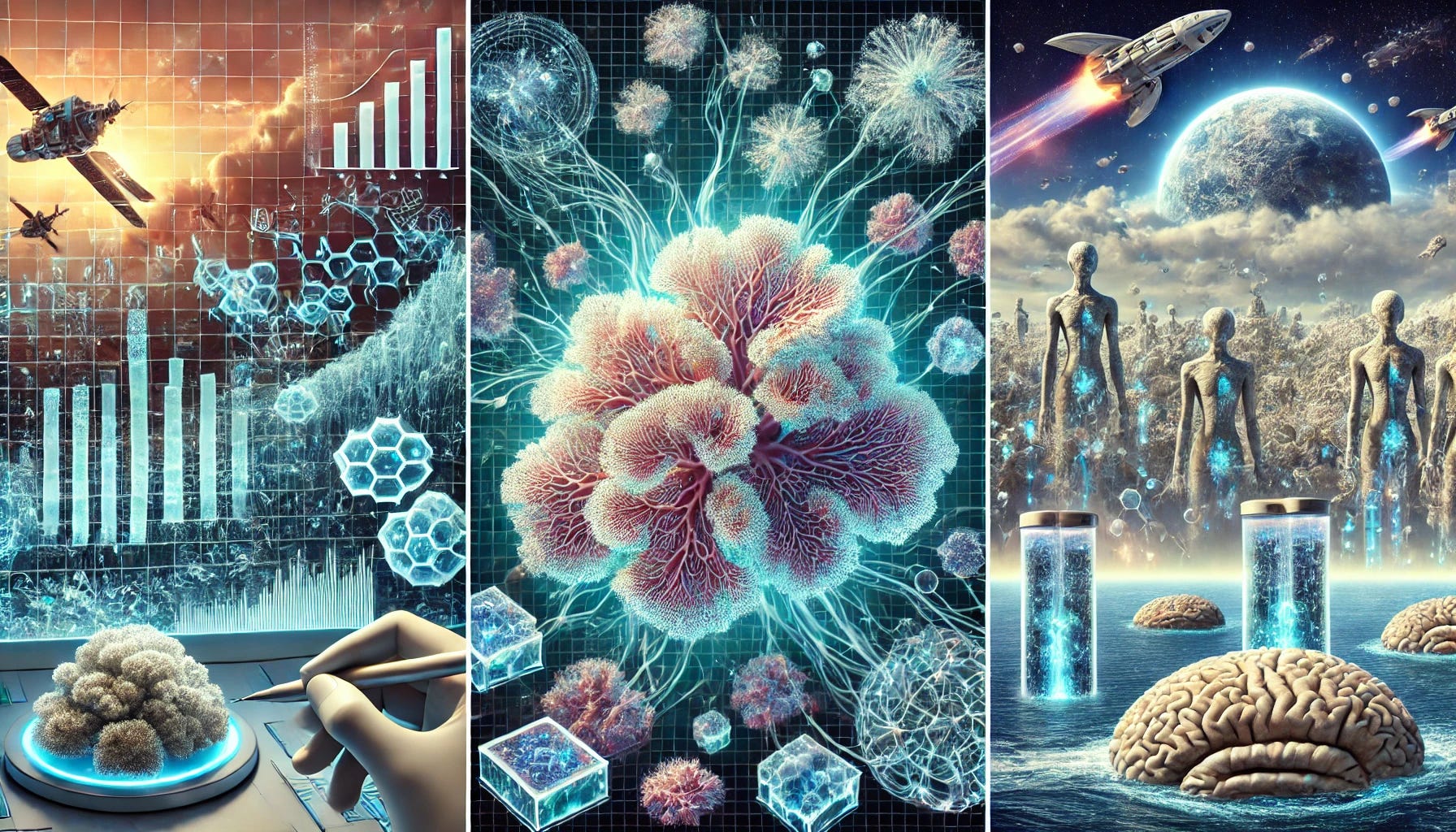
The implications are vast. Climate modeling could benefit from reef-inspired AI that simulates feedback loops by accreting memory rather than overwriting it, capturing subtle environmental patterns across centuries of data. Medicine could use reef-style architectures to model bone growth, fracture repair, or osteoporosis dynamics with new precision. In space exploration, reef-based intelligence might thrive in alien oceans where computation is shaped by chemistry rather than silicon. Mineral-encoded archives could survive radiation and time in ways that fragile digital chips cannot.
We usually think of reefs as fragile treasures, vulnerable to bleaching and collapse. Yet reefs are also teachers of persistence. They show us how life can weave memory into stone, how communities can build intelligence without brains, and how history can be preserved in structure rather than erased by novelty.
If we listen, corals may suggest a future in which our machines do not merely calculate but grow. Their intelligence would not be a flicker in circuits but an architecture in time, an accreted reef of memory that changes slowly, heals when damaged, and endures long after the currents shift.
References
Addadi, L., & Weiner, S. (2014). Biomineralization: Mineral formation by organisms. Reviews in Mineralogy and Geochemistry, 54(1), 1–17.
Hughes, T. P., et al. (2017). Coral reefs in the Anthropocene. Nature, 546(7656), 82–90.
Pandolfi, J. M., Connolly, S. R., Marshall, D. J., & Cohen, A. L. (2011). Projecting coral reef futures under global warming and ocean acidification. Science, 333(6041), 418–422.