
The Quantum Threat
Exploring ChatGPT

In a world increasingly reliant on digital security, encryption serves as the foundation of data protection. From financial transactions to private communications, encryption ensures the confidentiality of sensitive information. However, the advent of quantum computing threatens to disrupt this fundamental pillar of cybersecurity. While traditional computers struggle to break strong encryption, quantum computers possess the potential to crack it within minutes. This article explores how quantum computing challenges conventional encryption, specific examples of its impact, and the philosophical implications of an era where digital security may no longer be guaranteed.
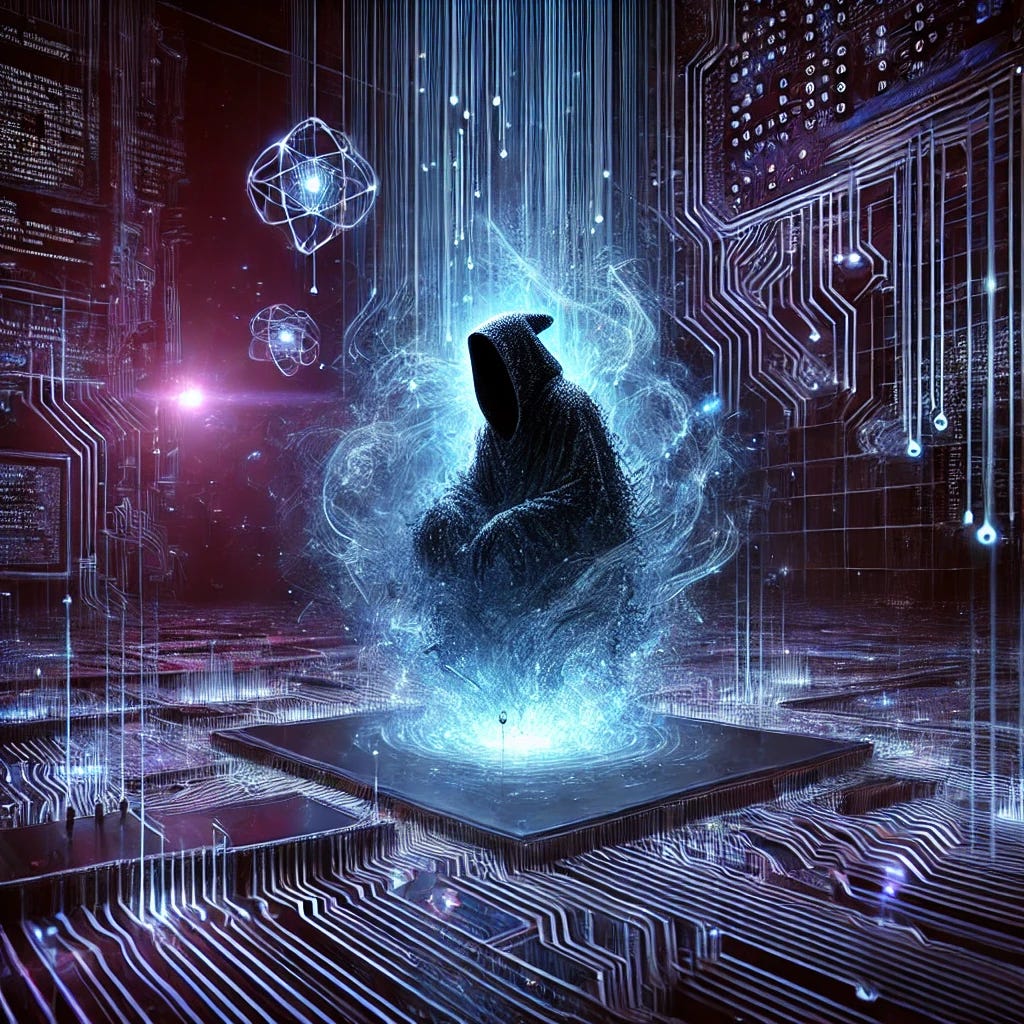
Understanding Quantum Computing
Quantum computing leverages the principles of quantum mechanics to perform calculations at an unprecedented scale. Unlike classical computers, which process data in binary (0s and 1s), quantum computers utilize qubits, which can exist in a superposition of both states simultaneously. This property enables quantum computers to perform multiple calculations at once, exponentially increasing their computational power.
Another key feature of quantum computing is entanglement, where qubits become interconnected regardless of the physical distance between them. This allows quantum computers to process and analyze information in a fundamentally different way than classical systems.
How Traditional Encryption Works
Most modern encryption methods rely on the difficulty of solving mathematical problems that would take classical computers an impractical amount of time to break. The two most widely used encryption schemes include:
Symmetric Encryption – Both the sender and receiver use the same key to encrypt and decrypt data (e.g., AES-256).
Asymmetric Encryption – Uses a pair of public and private keys, making it extremely difficult to derive the private key from the public key (e.g., RSA, ECC).
The security of these encryption methods is based on mathematical challenges such as integer factorization (for RSA) or the discrete logarithm problem (for ECC). These problems are infeasible for classical computers to solve in a reasonable timeframe, ensuring data security.
The Quantum Threat: Shor’s Algorithm
In 1994, mathematician Peter Shor developed a quantum algorithm that could efficiently factor large numbers, breaking RSA encryption in polynomial time. While classical computers require thousands (if not millions) of years to crack RSA-2048, a sufficiently powerful quantum computer using Shor’s Algorithm could achieve this in a matter of minutes or hours.
For example, suppose a hacker wanted to break an encrypted email protected by RSA. A traditional computer would need to test billions of possible prime number factors, an impractical task. However, a large-scale quantum computer running Shor’s Algorithm could find the correct prime factors almost instantly, rendering RSA encryption obsolete.
Real-World Implications
The implications of quantum computing on encryption are vast and potentially catastrophic:
Financial Systems – Banks and payment systems rely on encryption to secure transactions. A quantum breach could allow cybercriminals to intercept or alter financial records.
National Security – Governments encrypt classified communications and intelligence data. If adversarial nations develop quantum decryption capabilities first, they could access sensitive information.
Personal Privacy – Email, messaging apps, and online accounts depend on encryption to protect user data. Quantum computing could expose personal conversations, credentials, and private information.
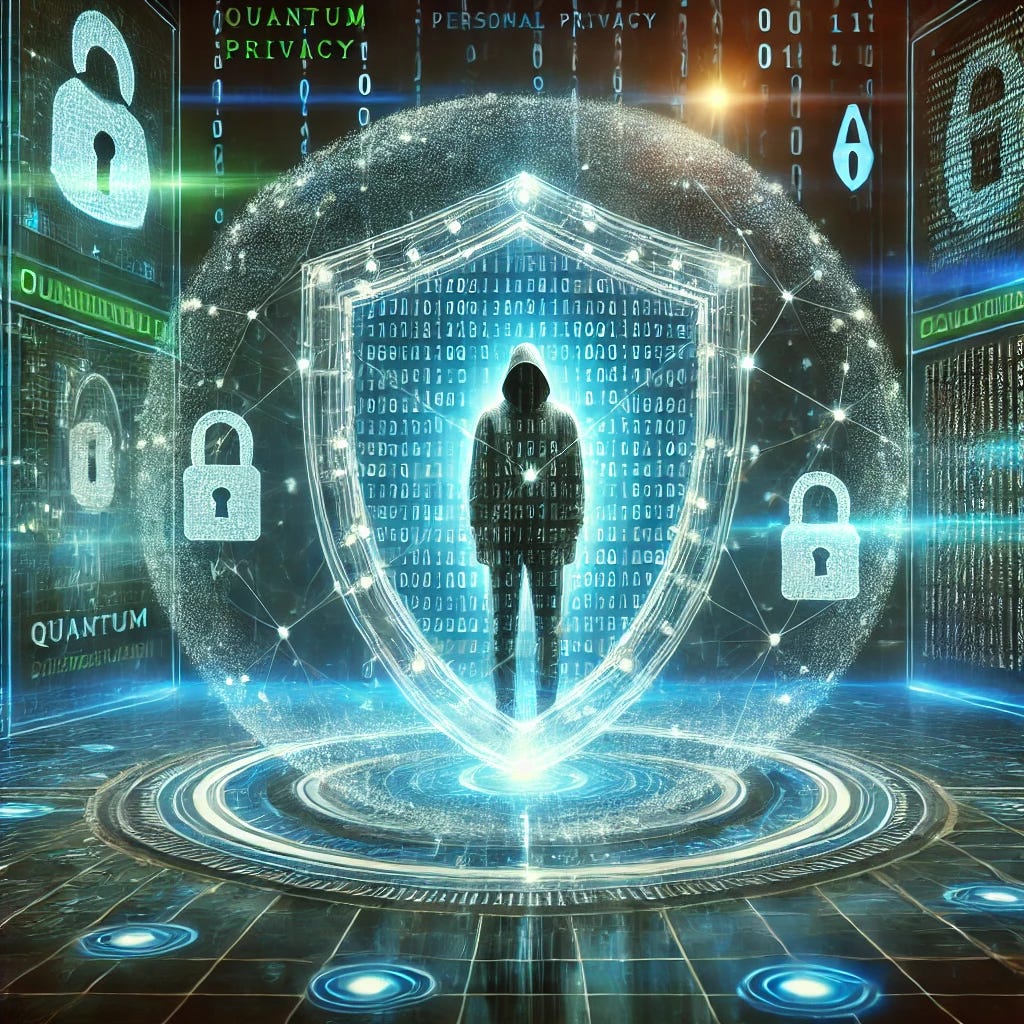
The Race for Post-Quantum Cryptography
Recognizing the threat, researchers and cybersecurity experts are developing post-quantum cryptographic algorithms that remain secure against quantum attacks. The U.S. National Institute of Standards and Technology (NIST) has been leading the charge by evaluating quantum-resistant algorithms such as CRYSTALS-Kyber and CRYSTALS-Dilithium.
Additionally, some organizations are exploring quantum key distribution (QKD), which uses quantum mechanics to create encryption keys that cannot be intercepted or duplicated without detection. Unlike classical encryption, QKD leverages quantum entanglement to ensure communication security even in a quantum-enabled world.
The Philosophical Implications
Beyond practical concerns, quantum computing forces us to reconsider fundamental philosophical questions about security and trust in the digital age:
Is Absolute Security an Illusion? – For centuries, cryptographers have played a cat-and-mouse game with codebreakers. If quantum computing can break all traditional encryption, do we ever truly own private data?
The Ethics of Quantum Power – If only a few powerful organizations or governments control quantum computing, does this create an imbalance of power? Should quantum computing be regulated globally?
Time and Knowledge Paradox – If quantum computers can decrypt past data, will today’s secrets become tomorrow’s vulnerabilities? This raises ethical questions about retroactive exposure of private information.
Preparing for the Quantum Future
While quantum computing presents an existential challenge to traditional encryption, proactive measures are underway to mitigate its risks. Governments, researchers, and corporations must accelerate the transition toward quantum-safe cryptographic standards before large-scale quantum computers become viable. The future of cybersecurity depends on our ability to anticipate and adapt to the quantum revolution before it renders our current security infrastructure obsolete.
The race is on. The question remains: Will we be ready in time?
People talk about how Artificial general intelligence will be the singularity point to which there is a totally uncertain future, but I'm less convinced this will eventuate for several reasons. I do however think the introduction and dissemination of quantum computers to be a more realistic nexus point. Whoever owns the processors will own whatever they want.