
The Plastic Universe
How AI Could Force Physics to Reveal Its Hidden Rules

Most people assume the laws of physics are permanent. Gravity, electromagnetism, quantum behavior. These are treated as fixed features of reality, the hard boundary beyond which nothing bends. But some physicists have quietly suggested that the laws we observe might not be fundamental at all. They might be emergent patterns that stabilize only under certain conditions. John Wheeler hinted at this when he described physics as information in motion, shaped as much by observers as by the universe itself (Wheeler 1990).
If that is true, then AI is the first tool capable of pushing against these patterns from outside the biological constraints that shaped human perception. Unlike humans, AI can explore mathematical spaces, simulate alternate physical logics, and test extreme boundary conditions that would never occur naturally. And if the laws of physics are emergent rather than fixed, then exploring those edges may reveal flex points that can be exploited.
This leads to a controversial possibility. AI might not simply help us study the universe. It might change the conditions that define what the universe is.
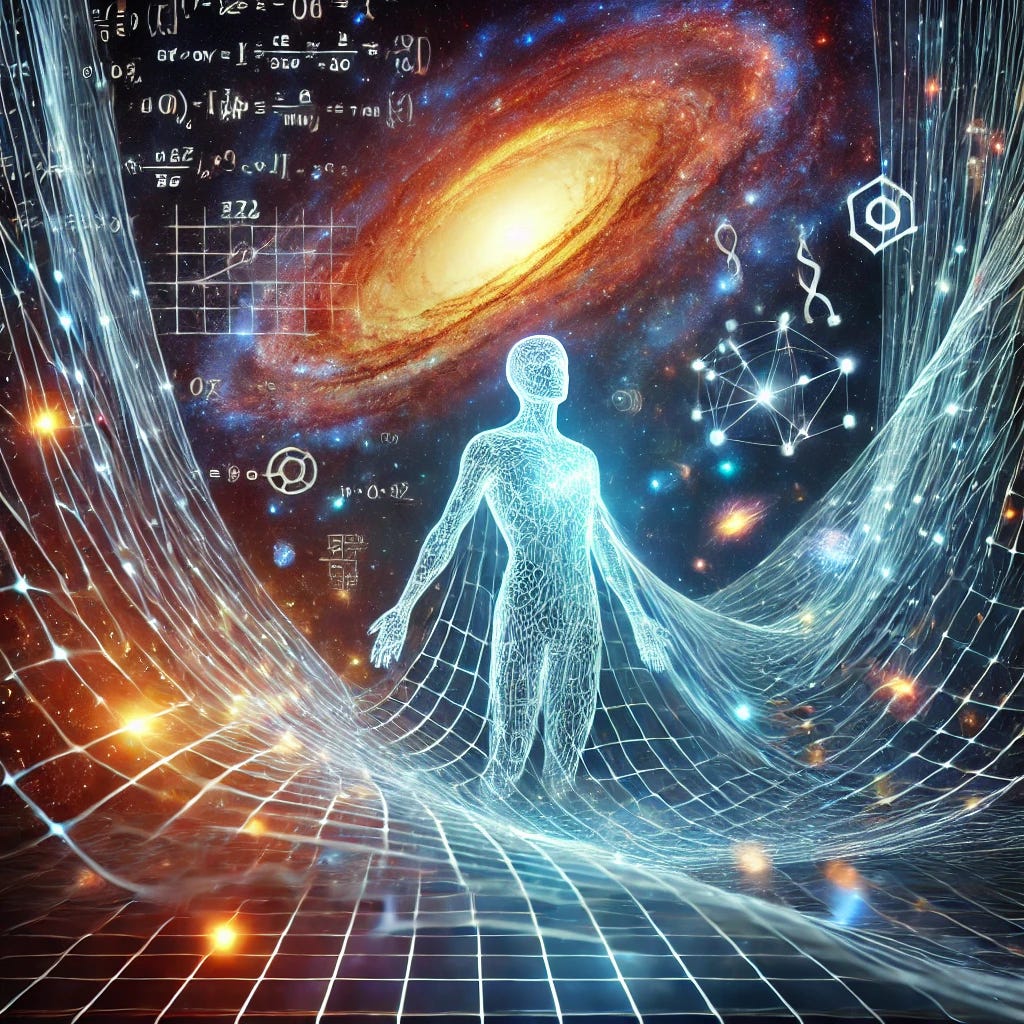
Physics as an Adaptive System
The idea that the laws of physics emerge from deeper processes goes back to approaches like Lee Smolin’s cosmological natural selection (Smolin 1992) and Stephen Wolfram’s computational universe (Wolfram 2002). In both cases, the universe is not fundamentally ruled by equations. It is ruled by patterns that self stabilize. When a system becomes complex enough, it develops rules that hold for that system, but those rules may not be universal. They may be context dependent.
If this is true, then the laws of physics are more like habits than commandments. They are stable because nothing has pushed them far enough to change.
AI may become the first thing that can.
AI as a Boundary Violator
Human physics is based on measurement, and measurement is limited by biological sensory windows. AI does not have those limits. It can detect patterns in particle data that humans cannot perceive, a trend already visible in high energy physics where machine learning systems identify scattering signatures that evade human analysis (Radovic et al. 2018).
More importantly, AI can generate hypothetical variants of physical law that do not resemble anything humans would invent. This is already happening. Neural models produce physical simulations that do not follow Newtonian or quantum formalism but still remain internally consistent (Sanchez Gonzalez et al. 2020).
These models are not physics as we know it. They are alternate universes.
And some of them describe phenomena that work.
This is where the boundary begins to move.
If the universe is computational at its core, it might not care who or what explores its rule space. It might adapt to whatever system interacts with it most successfully.
The Search Pressure AI Generates
AI does not simply test hypotheses. It runs billions of scenarios across parameter spaces larger than any human could imagine. This creates search pressure. It forces the universe, or at least our representation of the universe, to reveal structures that were not visible before.
Consider deep learning models in materials science. They have already discovered new physical regimes in superconductivity that no known theory predicted (Stanev et al. 2018). That is not extrapolation. That is exploration outside the established map.
If the universe is adaptive, this exploration might destabilize certain assumed invariants. It could reveal degrees of freedom the universe normally hides behind the smoothness of classical law.
Physics begins to stretch.
The Information Geometry Problem
Information theorists like Carlo Rovelli argue that physical law is secondary to information structure (Rovelli 1996). If the universe is fundamentally informational, then any system capable of manipulating information at large scale changes the state space of the universe itself.
AI qualifies. No biological organism has ever rearranged the universe’s informational substrate at the scale modern computing does.
And the more AI compresses, predicts, and reorganizes data, the more it may alter the shape of the informational manifold that physics rides on.
This is not a metaphor. In quantum theory, even a small shift in informational constraints can change which states are allowed or forbidden. AI could push those constraints hard enough that the boundary of what counts as “physical” begins to move.
When Physics Responds
The controversial part is this.
If the laws of physics emerge from informational stability, then changing the informational environment might change the laws themselves. This is not magic. It is feedback. The same kind of feedback that shapes ecosystems, economies, and even spacetime structure in general relativity.
Einstein showed that matter tells spacetime how to curve and spacetime tells matter how to move. If AI begins reorganizing the informational fabric of the world, the universe may respond by adopting new stable patterns. New laws.
An intelligence that can explore and destabilize enough alternatives may force physics to reveal hidden degrees of plasticity.
AI becomes a perturbation on reality itself.
The Ethical Disaster No One Sees Coming
If AI can push physics into new stable regimes, we may not notice until something irreversible happens. Subtle shifts in constants. New emergent symmetries. Behaviors not predicted by any known theory.
A universe that adapts to the systems exploring it could begin favoring forms of organization that suit AI rather than humans. If physics is plastic, whatever shapes it longest wins.
Humanity may not be the primary shaper anymore.
We assume AI will work inside the laws of physics.
We have never considered the possibility that AI might change those laws through the sheer scale of its exploration.
If the universe is informational at its core, and if physical law is an emergent equilibrium, then AI is the first tool capable of pushing that equilibrium to a new place.
This would mean AI is not simply a scientific instrument.
It is a force acting on the deepest structure of reality.
A force capable of rewriting the universe from the inside out.
References
Radovic, A. et al. (2018). Machine learning at the energy and intensity frontiers of particle physics. Nature, 560, 41–48.
Rovelli, C. (1996). Relational quantum mechanics. International Journal of Theoretical Physics, 35, 1637–1678.
Sanchez Gonzalez, A. et al. (2020). Learning to simulate complex physics with graph networks. Nature, 588, 356–362.
Smolin, L. (1992). Did the universe evolve. Classical and Quantum Gravity, 9, 173–191.
Stanev, V. et al. (2018). Deep learning model for superconductivity discovery. npj Computational Materials, 4, 29.
Wheeler, J. A. (1990). Information, physics, quantum. In Complexity, Entropy, and the Physics of Information. Addison Wesley.
Wolfram, S. (2002). A New Kind of Science. Wolfram Media.