
The Plastic Horizon Hypothesis
Observation as a Sculptor of Spacetime

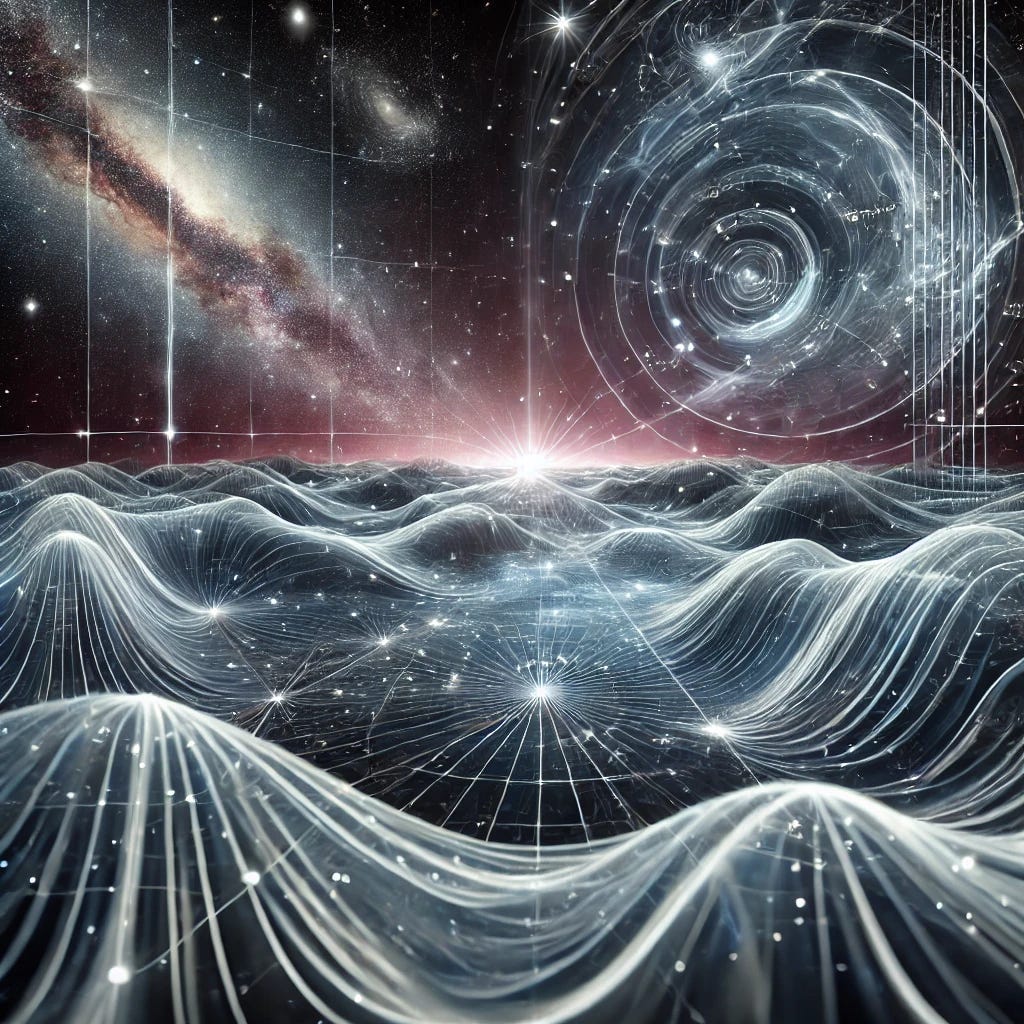
For much of modern physics, space has been treated as a passive arena in which particles move and events unfold. Even the revolutions of relativity and quantum mechanics did not fundamentally change this perception—they simply complicated the behavior of matter within it. But this view may be incomplete. The Plastic Horizon Hypothesis suggests something more radical: that observation, especially conscious observation, does not merely register the state of reality but subtly reshapes its structure. Specifically, it proposes that the act of focused observation compresses the local spacetime horizon, making the causal fabric of the universe pliable to cognitive influence.
This idea builds on emerging intersections between quantum mechanics, general relativity, and information theory. It speculates that conscious minds, through their entropic and integrative dynamics, exert a form of informational pressure that locally sculpts spacetime geometry. The universe, in this model, becomes not just observed, but co-shaped by the act of observing.
Theoretical Foundations
There are three pillars upon which the Plastic Horizon Hypothesis rests. The first is the observer effect in quantum mechanics, which implies that the act of measurement transforms potential states into actual ones. While this is usually interpreted in terms of probabilistic collapse, recent theories like Relational Quantum Mechanics and Quantum Darwinism reframe it in terms of relational information exchange.
The second is general relativity, which shows that mass and energy determine the curvature of spacetime. Importantly, the theory accommodates exotic geometries—black holes, wormholes, event horizons—when energy is densely concentrated. Could informational density play a similar role?
The third is the thermodynamic principle known as Landauer's Limit, which connects information with energy. To erase a single bit of information requires a minimum amount of energy, implying that information is not just abstract but physically consequential. If consciousness processes information with high coherence, could it briefly act as a local energy gradient—subtle, but sufficient to nudge spacetime?
The Plastic Horizon Defined
The "plastic horizon" is not a fixed line like the edge of a black hole, but a dynamic, observer-sensitive boundary within spacetime. It describes a shift in the radius of causal connectivity—how far and how fast influences can travel. Under this hypothesis, when a conscious observer is engaged in states of high informational integration—such as deep concentration, psychedelic experience, or awe—the local event horizon contracts slightly.
This isn't shrinkage in the Euclidean sense, but a compression in causal terms. The idea is that observation, through coherent informational intake, increases local entropic tension. To balance this, the system compresses the observable horizon to maintain thermodynamic equilibrium. The more concentrated the observer's focus, the tighter the horizon becomes. This would lead to an altered experience of temporal and spatial immediacy: distant things feel closer, time appears slower, and causality feels denser.

A Speculative Model
Imagine a field emanating from the conscious mind, not unlike a gravitational field, but shaped by cognitive coherence rather than mass. This field doesn't pull objects inward but draws causal boundaries inward, like a lens distorting the spacetime medium. The brain, in this model, becomes a sculptor of local reality—not metaphorically, but thermodynamically.
This field would not be omnidirectional but cone-shaped, aligned with attention and perception. Where perception intensifies, spacetime compacts. If two observers focus on the same point, their fields may intersect, generating a region of shared compressed causality—a local nexus of heightened synchronicity. Such intersections might explain why certain collaborative events feel "timeless" or imbued with meaning.
This model could be simulated using artificial neural networks trained to modulate simulated spacetime parameters based on entropic inputs. If computational models show emergent spacetime-like structures in response to focused data processing, this would offer indirect support.
Experimental Designs
Testing this hypothesis would require instruments capable of detecting micro-deformations in spacetime. One candidate might be Bose-Einstein condensate interferometers placed in proximity to subjects undergoing controlled cognitive tasks. The hypothesis predicts that during periods of high informational coherence—such as meditation, intense problem-solving, or even lucid dreaming—these instruments might detect minute spacetime distortions.
Another approach would use highly sensitive delay measurements in neural signal transmission under varying cognitive loads. If causal compression occurs, then reaction times or sensory integration latencies might subtly shift in a direction unexplainable by classical models of attention.
Lastly, experiments could compare entropic brain states—such as psychedelic versus sleep-deprived or bored states—and correlate these with fMRI signatures of spatial and temporal binding. If the plastic horizon is real, we would expect a measurable difference in how the brain temporally coordinates distant cortical regions under different entropic loads.

Philosophical Implications
If the Plastic Horizon Hypothesis holds any truth, it reframes consciousness as not merely an observer of reality but an editor of it. We begin to see attention as a force, not a filter. The universe does not simply unfold before us; it is partially shaped by the gravitational pull of our focus.
This may sound idealistic, but it is rooted in physics—just viewed through a new lens. Observation becomes a form of spacetime modulation. In this light, the question becomes not just what we see, but how much reality bends to let us see it.
Perhaps space and time, at their most granular level, are less like a stage and more like a fabric under tension—pulled, pressed, and pleated by the eyes that gaze upon it.
References
Bousso, R. (2002). The Holographic Principle. Reviews of Modern Physics, 74(3), 825–874.
Landauer, R. (1961). Irreversibility and Heat Generation in the Computing Process. IBM Journal of Research and Development, 5(3), 183–191.
Rovelli, C. (1996). Relational Quantum Mechanics. International Journal of Theoretical Physics, 35(8), 1637–1678.
Zurek, W. H. (2009). Quantum Darwinism. Nature Physics, 5, 181–188.
It's the explanation for the reason behind, "where two or more agree on one thing, it shall manifest", a principle in many spiritual institutions. One person can effect great modulation of the time/ space continuum, two people with the same focus can perform miracles!