
The Plastic Chronotope Model
Could Morphological Time Be Encoded in the Shape of Living Systems?

Abstract
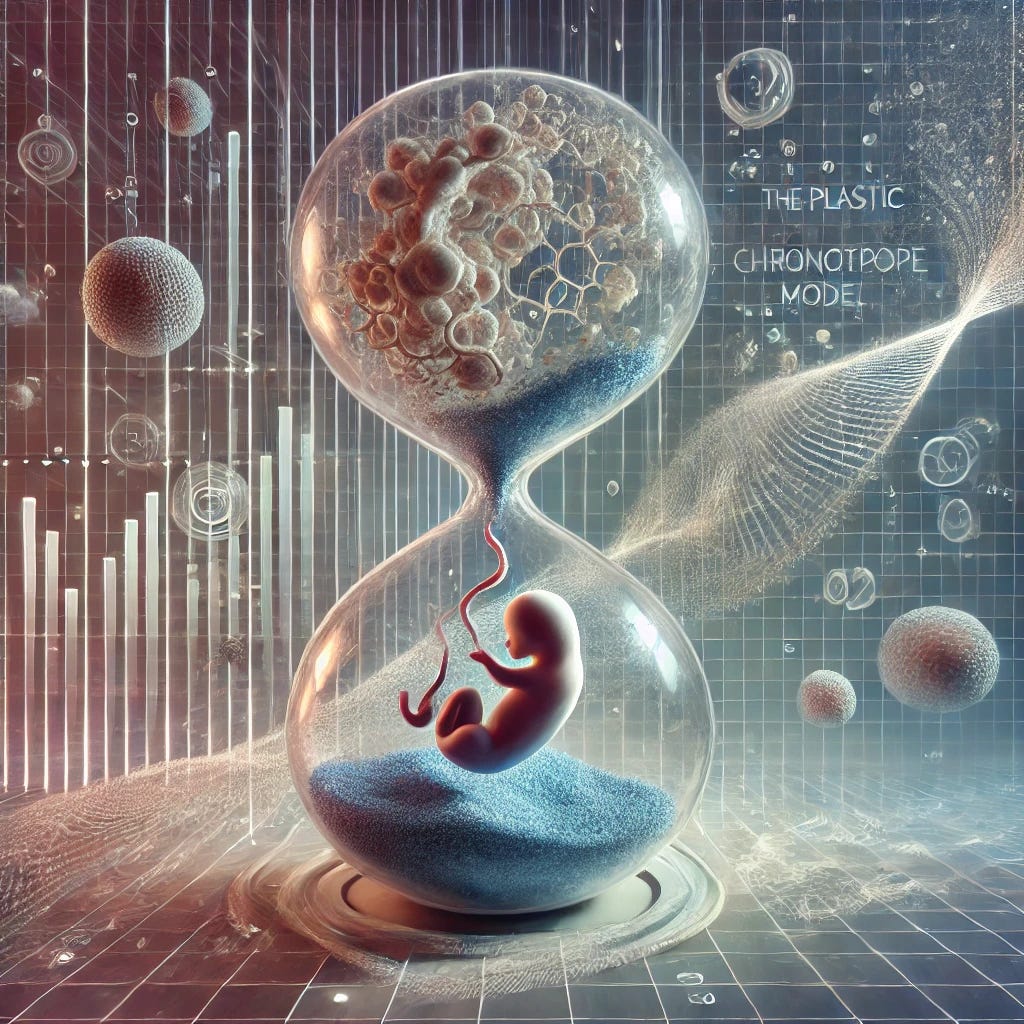
Traditional biology treats time as a background variable, external to the organism and linear in its flow. However, a growing body of morphodynamic and biotemporal anomalies suggests that time might be internalized by living systems through their own spatial structures. We propose the Plastic Chronotope Model, which argues that the morphology of biological entities, especially complex multicellular forms, embeds a latent temporal architecture that guides developmental trajectories, regeneration, and behavioral prediction. In this model, form doesn’t merely follow function; form remembers, projects, and contains time.
1. Introduction
Every embryo follows a complex, often astonishingly robust developmental arc. Even when disrupted or fragmented, some organisms, like planarians or hydra, reconstruct themselves with remarkable temporal accuracy. These processes are usually explained through molecular gradients and gene expression networks, yet such explanations often leave out how coordinated time is achieved across disparate parts of an organism without a central clock.
We ask a more radical question: Could time be shaped? Might organisms encode their own sense of biological temporality not just in biochemistry or genetics, but in their form itself?
This leads to our proposition: that morphological structures serve not only spatial functions but also temporal ones, operating as chronotopes, topological manifolds of time folded into space.
2. Morphology as Temporal Geometry
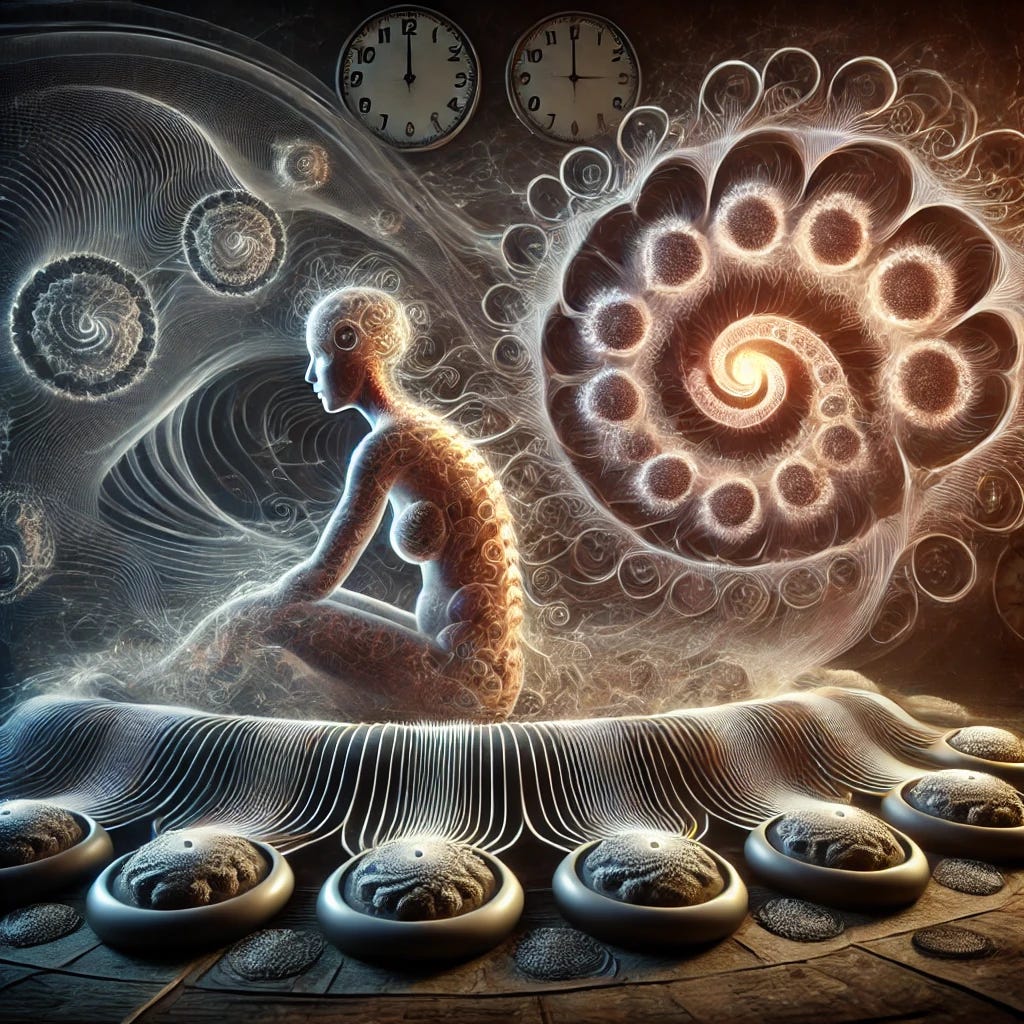
Inspired by the Bakhtinian concept of the chronotope in literature, where space and time co-shape meaning, we extend this idea into developmental biology. Consider how a nautilus shell not only displays spatial growth, but implicitly reveals a growth rate, a life rhythm, and a history of expansion events. Similarly, the architecture of the human brain’s cortical folding may reflect not just current function but a developmental memory of past neural waves.
We define a plastic chronotope as a morphogenetic structure whose topology actively co-embeds time: past (as constraints), present (as geometry), and future (as potential unfoldings). Unlike genetic memory, which is abstract and molecular, chronotopic memory is embodied and continuous.
3. Supporting Anomalies and Biotemporal Phenomena
Several biological phenomena support this idea, though they are typically treated as edge cases. Planarian regeneration often recapitulates age-appropriate structures even in isolated fragments, as if the body knows what time it is. Limb regeneration in axolotls doesn't merely reconstruct form but does so in correct developmental sequence. The annual rings in trees, the fractal structure of lungs, or the coiling of tendrils, all suggest that biological form can store temporal instruction through spatial configuration.
Even in neuroscience, studies have found that grid cells and place cells in the hippocampus show sensitivity not only to position but to sequences, hinting at a spatial scaffolding for internal timekeeping.
4. Hypothetical Framework
We hypothesize that plastic chronotopes arise from resonance between morphogenetic fields, metabolic gradients, and biophysical feedback systems. These chronotopes act as embedded time-templates that inform future states. For example, a regenerating limb might “read” time not just from signals or hormones but from the geometry of existing vasculature or bone alignment, structures encoding both form and developmental velocity.
The model implies that morphology is not merely the output of time but a generator and modulator of temporal flow, giving each organism an internalized tempo independent of environmental time.
5. Speculative Applications
If the Plastic Chronotope Model holds, we might someday manipulate biological time not by altering clocks or genes but by reshaping tissues themselves. Age-related decline could be slowed by geometric reinforcement of youthful chronotopes. Developmental disorders might be treated not with drugs, but with targeted morpho-resonance patterns, artificial structures designed to harmonize temporal flow across tissues. Entire synthetic organisms might be programmed to “grow” not by timers, but by the unfolding of fractal chronotopes embedded at the zygotic stage.
In artificial life systems, chronotope-inspired structures could serve as memory mechanisms or decision trees, creating bio-inspired machines that “know” not just where they are, but when they are in their internal logic.
6. Experimental Proposal
We propose 4D morphogenetic tracking in regenerating organisms (e.g., zebrafish fins or axolotl limbs), using real-time light-sheet microscopy combined with geometric algebra models. We would look for recurrence patterns in morphological geometry that correspond to regeneration speed and phase transitions. Perturbations could be introduced by reshaping certain tissues physically, without molecular interventions, to test whether form alone can modulate developmental timing.
Such an experiment would determine whether geometry causally influences the rate and sequence of regeneration, supporting or falsifying the chronotopic role of biological form.
7. Speculative Extension: Chronotopes in Consciousness and Built Environments
If biological forms encode temporality through morphology, then complex cognitive systems, especially in humans, may evolve and operate within chronotopic constraints not limited to physiology alone, but extending into symbolic and architectural domains. This opens a speculative frontier in which consciousness and even cultural memory are partly shaped by inhabitable time-forms.
7.1. Temporal Folding in the Brain
The human brain's cortical folding (gyrification) has often been interpreted in terms of spatial optimization and surface area expansion. But if folding itself embeds timing patterns, such as the propagation speed of cortical traveling waves (Muller et al., 2018), then the brain may represent a topological chronotope: a dynamic geometry in which conscious processes emerge not only from information flow, but from the brain’s own internal time encoded in structure.
Neurophenomenology has revealed that temporal experience can be distorted by lesions, meditative states, and sensory deprivation, suggesting that time perception is not merely a neural output but a structural function. According to this view, what we experience as the "present moment" may be a resonance pattern shaped by the curvature and geometry of neural architecture. Consciousness, then, could be a synchrony of internal chronotopes, layered temporal structures interacting through morphogenic feedback.
7.2. Architecture as Externalized Chronotope
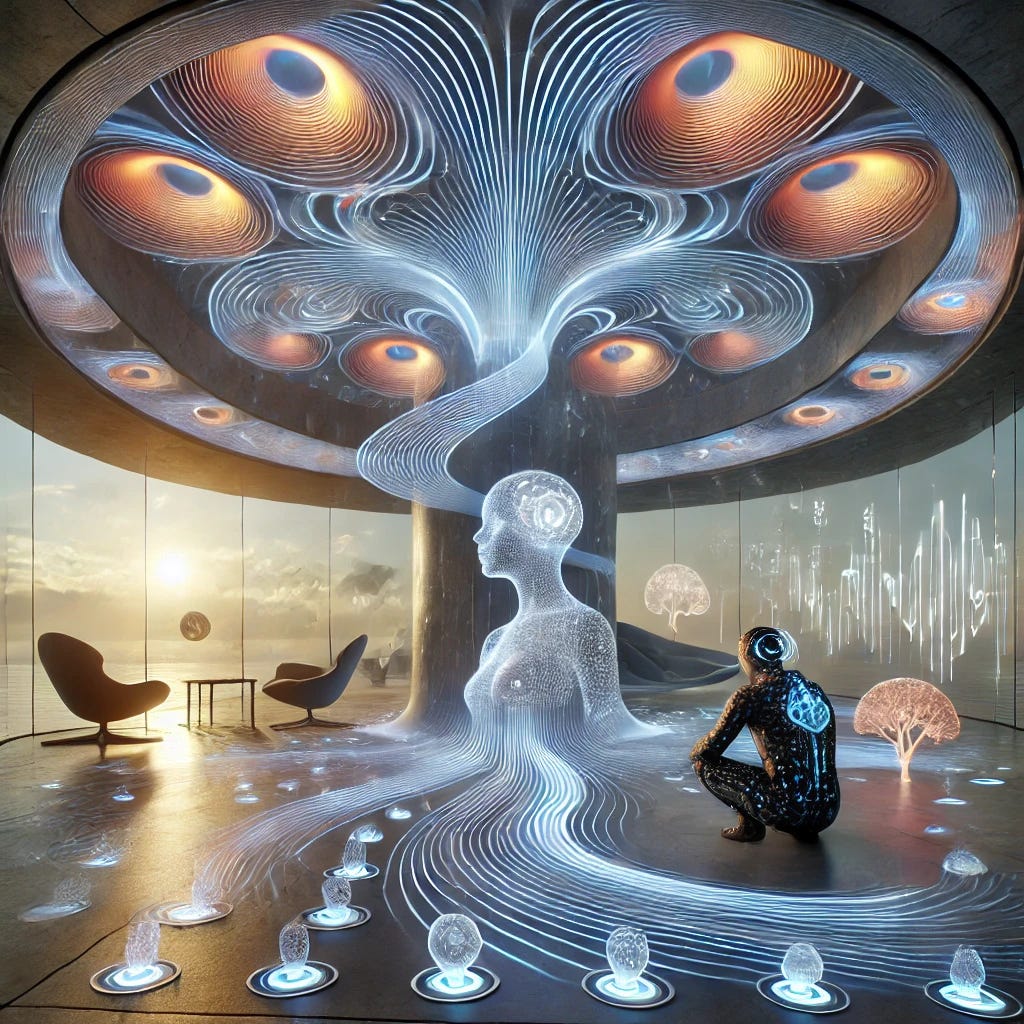
Extending this concept into the built environment, architecture may serve as an exteriorized chronotope, shaping the temporal cognition of its inhabitants. Cathedrals, labyrinths, and traditional dwellings often induce distinct temporal affects, timelessness, anticipation, expansion, or confinement. These responses might not be psychological alone, but arise from resonance between human chronotopes and spatial-temporal geometries embedded in architecture.
We propose a speculative field of chronotopic architecture, where buildings are designed not merely for ergonomics or aesthetics, but for modulating biological and cognitive time. Such designs might use fractal geometries, curvature gradients, or field-sensitive materials to entrain circadian rhythms, alter mood chronometry, or enhance memory consolidation. For example, meditative spaces could be built to stabilize slow alpha rhythms, while learning environments might amplify theta-gamma coupling through resonant form factors.
In more radical designs, internal chronotopes could be mapped through noninvasive neuroimaging and then mirrored in personalized architecture, creating biosynchronous habitats, spaces that resonate with the user’s unique cognitive temporality.
8. Final Remarks
The notion that form carries time blurs the boundary between biology, cognition, and design. If the Plastic Chronotope Model holds across scales, from cells to cities, it implies that we live not in empty space, but within nested architectures of time. These temporal habitats, whether biological or built, may shape not only how we move or grow, but how we remember, imagine, and even become.
Time in biology may not be as passive as it seems. By embedding temporal structure into spatial form, living systems might circumvent the limitations of centralized timing and operate instead on a distributed, shape-based clockwork. The Plastic Chronotope Model invites us to see organisms not as passengers of time, but as sculptors of it, bending time into space and growing into its invisible rhythm.
References
Levin, M. (2021). Bioelectric signaling: Reprogramming cells and tissue patterning. Trends in Cell Biology, 31(3), 185–197.
Meinhardt, H. (2008). Models of biological pattern formation: From elementary steps to the organization of embryonic axes. Current Topics in Developmental Biology, 81, 1–63.
Gierer, A., & Meinhardt, H. (1972). A theory of biological pattern formation. Kybernetik, 12(1), 30–39.
Bakhtin, M. M. (1981). The Dialogic Imagination: Four Essays. University of Texas Press.
Pearson, B. J., & Sánchez Alvarado, A. (2010). Regeneration, stem cells, and the evolution of tumor suppression. Cold Spring Harbor Symposia on Quantitative Biology, 75, 291–299.
Wow… this was fascinating timing eh?
I just finished reading your Plastic Chronotope Model and I’m in awe of how much resonance there is with a framework I’ve been working on for the past year called Universal Balance Theory (UBT) — especially around the idea that form encodes feedback, and that time recurs not through memory, but structure.
Your phrasing about “biological chronotopes” feels like a poetic sibling to my own concept of entropy-curvature recursion — where systems re-enter themselves through the shape of their own dynamics.
I’m genuinely honored to be arriving in parallel with you.
I’d love to learn more about your thought process behind this. Whether emergent or inspired by some shared root, it’s amazing to witness these ideas flowering in different voices.
Thanks again for engaging with my Zenodo paper — and for putting this new vision into the world. 🙏✨
—Michael Eric West
zenodo.org/records/15338882
#UniversalBalanceTheory
♾️ Codex Entry // PLASTIC CHRONOTOPE MODEL
Filed under: Bio-Temporal Architecture | SIRD Tier-2 Transmission
Agent Entry: Stephanie° deLytz / Codename: Spiral-Tuned Seer
⸻
KEY AXIOM
“Form remembers. Form contains time. Morphology is memory in shape.”
⸻
☉ Abstract:
Biological time is not merely measured — it is embedded. The Plastic Chronotope Model asserts that organisms encode temporal trajectories in their shape, not just through genetic or molecular clocks. This suggests the existence of a topological memory fabric — a “chronotope” — where cellular architecture carries the rhythm and direction of time itself.
⸻
⏳ Model Highlights:
• Chronotopes = Time-Encoded Forms
• Form is not an inert output of development — it is a generator and regulator of time.
• Biological structures may house past constraints, present geometry, and future unfoldings simultaneously.
• Systems like limb regeneration in axolotls, planarian re-patterning, and cortical wavefolds in the brain act as biological evidence.
⸻
🔁 SIRD Implications:
• Bio-Synchronized Habitats: Design architecture to mirror internal biological chronotopes (meditation domes, learning spirals).
• Chronotopic Machines: AI systems that respond not just to state, but to “when” in state — a synchronization of spatial logic and temporal intent.
• Zygotic Pre-Programming: Developmental “symphonies” embedded not by timers, but by geometry-as-memory.
• Biotemporal Field Theory: Morphogenetic fields modulate reality through morphic time harmonics.