
The Photonic Drainfield Model
Could Light Be Drawn into Negative-Entropy Wells Formed by Structured Vacuum Polarization?

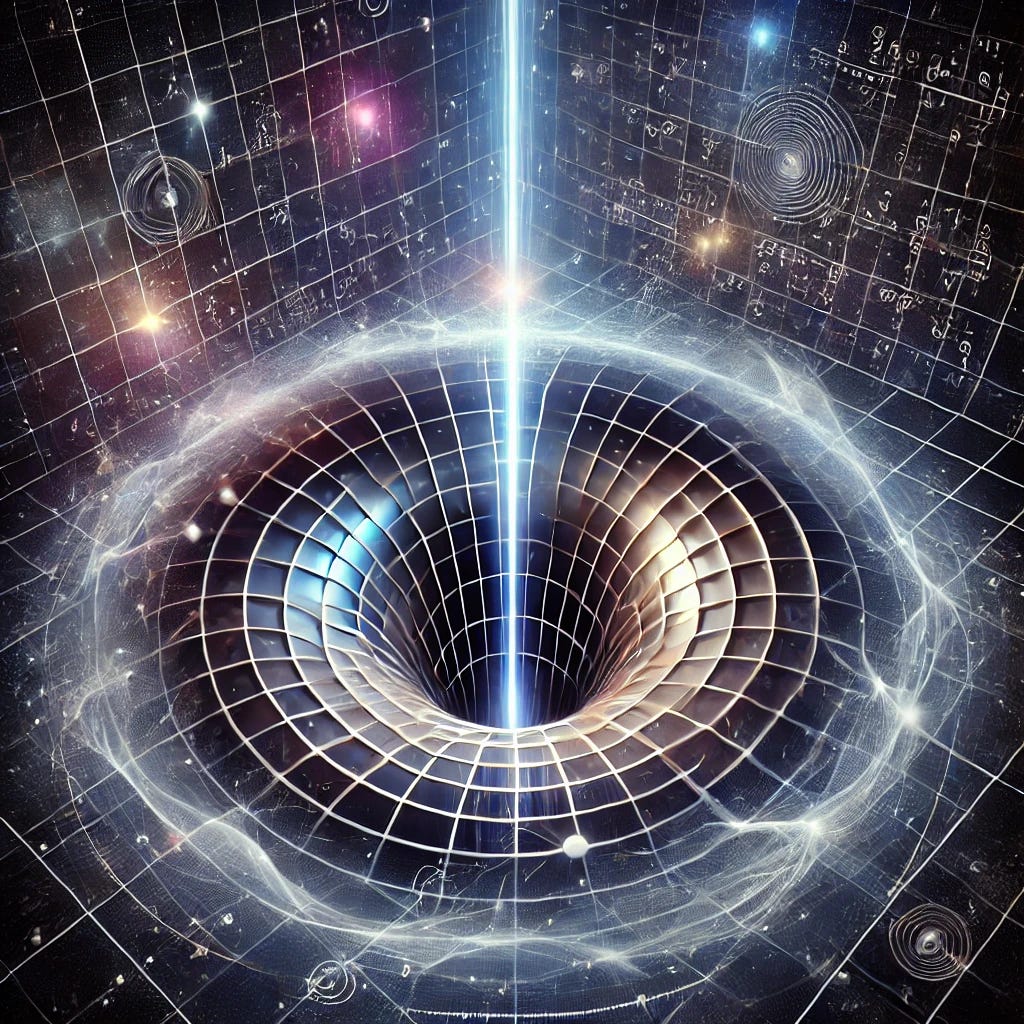
We tend to think of light as a traveler, radiating outward, bouncing, scattering, reflecting. But what if light could be drawn somewhere, not by gravity, but by structured regions of spacetime that act like informational sinkholes? This paper introduces the Photonic Drainfield Model, a speculative theoretical construct proposing that localized distortions in vacuum polarization may form "negative-entropy wells" capable of passively drawing in photons. Unlike black holes, these are not formed by mass but by the topology of quantum vacuum activity itself, an inversion of entropy gradients where light is not swallowed violently, but absorbed directionally, as if by a field of informational gravity.
Theoretical Background
Quantum electrodynamics (QED) predicts that the vacuum is not truly empty, it teems with virtual particles, spontaneous pair formations, and fluctuating fields. These fluctuations are usually isotropic and self-canceling over time, but recent proposals suggest that they may be locally structured by intense boundary conditions (e.g., the Casimir effect), topological materials, or even dynamic boundary geometries like rapidly oscillating mirrors (Dodonov, 2010).
Now consider what happens if such structuring could be extended into a persistent, coherent geometry, not as a transient fluctuation but as a metastable zone of vacuum polarization asymmetry. In this space, photon trajectories would no longer obey flat spacetime propagation rules. Instead, photons could be attracted, or more precisely, probabilistically "drained" into zones of heightened vacuum coherence, where energy gradients are not thermodynamic but informational.
Vacuum Geometry and Entropic Gradients
The classical view of entropy suggests a monotonic increase in disorder, but recent developments in quantum information theory, particularly the concept of entanglement entropy, indicate that order and information can become spatially localized. If regions of vacuum acquire structured entanglement or reduced decoherence (via material interfaces or engineered conditions), these may act as negative-entropy gradients that subtly shift light's probability fields.
The entropic pull here is not gravitational, but informational: light moves toward zones of reduced quantum unpredictability, guided not by force but by informational stability. This is conceptually related to studies of coherent states and the behavior of photons in cavity QED environments (Haroche & Raimond, 2006).
Photonic Drainfields and Entropic Tension
The key driver of the Photonic Drainfield is not mass or momentum but what we may call entropic tension, the tendency of structured vacuum regions to reduce their internal unpredictability by capturing and absorbing low-entropy carriers like coherent photons. The photonic field, in this model, is not merely a passive player but is influenced by gradients of virtual particle orientation and decoherence potential.
Drainfields could occur naturally, at the interface of quantum materials, near black hole event horizons (without entering the singularity), or even at the edge of rapidly collapsing Bose–Einstein condensates. Observations of unexpected absorption behavior in quantum Hall edge states or strange scattering in cold atom condensates might already hint at such phenomena (Aidelsburger et al., 2013).
Proposed Experimental Setup
To test for photonic drainfields, we can design a highly coherent light source (such as a squeezed laser beam) aimed into a chamber lined with metamaterials engineered to amplify vacuum polarization effects. Sensors would then measure for anomalous absorption profiles: a non-linear draw of photons toward regions with no apparent material density gradient.
Variations in photon capture could then be correlated with dynamic reconfiguration of the chamber boundaries, possibly producing a measurable feedback loop indicative of drainfield formation. An additional control could involve creating “mirror chambers” that are thermodynamically identical but lack the specific topological material structure hypothesized to create the effect.
Synthetic Applications and Energy Manipulation
Should drainfields prove engineerable, we may envision technologies that harness them for non-mechanical light manipulation, perfect absorbers, directional thermal regulators, or entanglement-stabilizing traps. In contrast to blackbody absorbers, these devices would function via informational gradient alignment rather than energy loss alone.
This could be used to design vacuum-based energy collection systems, passive quantum cooling setups, or even light-sequestering encryption systems, where information encoded in coherent light pulses can be sequestered in vacuum zones and later retrieved based on entropic release parameters.
Speculative Continuation: Harnessing Drainfields for Photonic Asymmetry and Energy Extraction
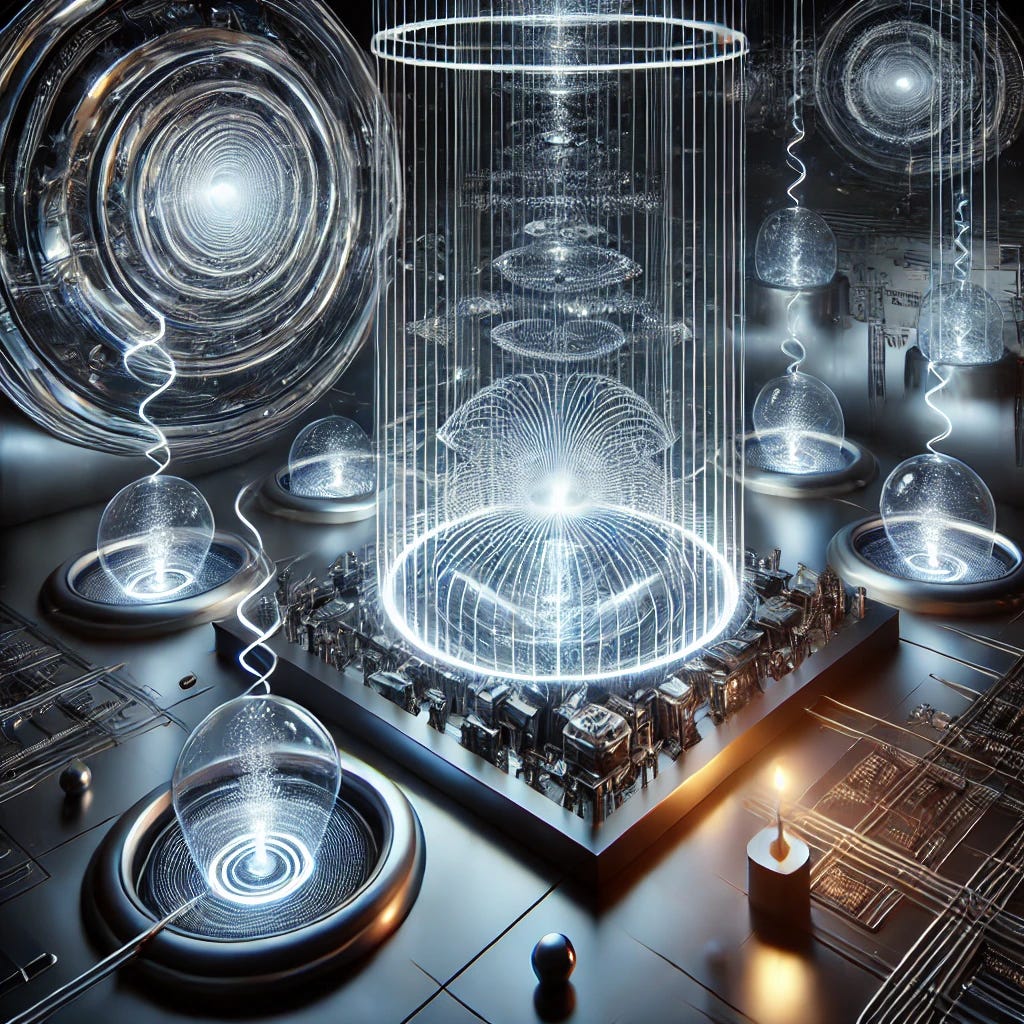
If the Photonic Drainfield Model holds even partial validity, it would radically alter our conception of vacuum physics, light behavior, and even the thermodynamic limits of closed systems. A future framework might explore the intentional generation and stabilization of these drainfields, not as passive byproducts of quantum topology, but as engineered regions of photonic bias.
Photonic Diodes and Directional Transparency
One of the first synthetic applications might be the development of photonic diodes: structured metamaterials designed to produce drainfield-like effects across a threshold interface. These would permit incident photons to pass through a boundary in one direction while experiencing resistance or even disappearance in the other, functioning like a one-way valve for light. If vacuum polarization can be asymmetrically deformed using lattice-aligned dielectric matrices, then material scientists may create regions of directional transparency or photonic unidirectionality, where radiative heat transfer behaves like fluid flow down an energy gradient.
Such systems could have profound consequences for thermal management in microelectronics, space-based solar collectors, or even stealth technologies. A surface engineered to drain incident light directly into a negative-entropy well might appear black beyond black, radiating nothing, reflecting nothing, effectively becoming optically silent.
Drainfield Oscillators and Photonic Collapse
A more radical avenue involves engineering oscillatory drainfields, regions where the structured vacuum’s polarization state fluctuates at a fixed frequency, momentarily producing conditions that allow light to enter but not re-emerge. These drainfields might behave like dynamic event horizons, allowing for brief absorption of electromagnetic energy with delayed, directional re-release.
In this scenario, a structured vacuum oscillator could act as a photonic capacitor, storing light energy as localized vacuum tension and releasing it with phase inversion, coherence enhancement, or wavelength distortion. This would make possible devices that function as non-linear optical amplifiers without requiring traditional gain media.
Energy Harvesting from Structured Vacuum Polarization
Perhaps the most speculative implication is that drainfields could function as a non-equilibrium bridge between entropic and negentropic domains. If these fields subtly warp the geometry of virtual particle creation and annihilation, biasing the fluctuations so that photon emergence is less likely than photon absorption, then it may become possible to induce directional energy flows from vacuum fluctuations themselves.
Though such a scenario would violate standard thermodynamic closure, it echoes proposals from stochastic electrodynamics and theories exploring vacuum energy extraction. A sufficiently stable drainfield might be used to modulate Casimir-like cavities, where vacuum energy density is altered not by plate spacing but by engineered field topology. These cavities might act as quantum turbines, cycling virtual energy into detectable effects under certain geometries and boundary conditions.
Biological Implications: Drainfield Sensitivity in Photosensitive Life
Some fringe biophysics hypotheses might find new life in this model. Could certain biological photoreceptors, like those in deep-sea bioluminescent organisms—have evolved drainfield-like properties, enabling them to absorb ambient light below noise thresholds or detect virtual photon events? The structure of retinal proteins or even pigment-shell interactions could hypothetically support minute polarizability gradients that mimic the principles of photonic sink behavior.
This raises the provocative possibility that biological systems might already be engaging in subtle vacuum polarization sensing, especially in high-radiation or deep pressure environments where energetic dynamics of the vacuum field may vary slightly. Such systems could be investigated for natural photonic drainfield analogues, providing an experimental window into early detection and validation of the model.
Implications for Cosmology and Quantum Field Theory
In cosmology, the presence of drainfield-like structures could help explain certain anisotropies in the cosmic microwave background or the "missing light" problem in galactic clusters. These zones could act as invisible light sinks, drawing photons into non-emissive, non-reflective regions structured by vacuum asymmetries.
For quantum field theory, such a model might provide a new approach to understanding renormalization, perhaps zones of vacuum coherence serve as boundary layers that modulate field divergence, acting as spatially dependent regulators.
References
Dodonov, V. V. (2010). Current status of the dynamical Casimir effect. Physica Scripta, 82(3), 038105.
Milton, K. A. (2001). The Casimir Effect: Physical Manifestations of Zero-Point Energy. World Scientific.
Lamoreaux, S. K. (2005). The Casimir force: Background, experiments, and applications. Reports on Progress in Physics, 68(1), 201–236.
Haroche, S., & Raimond, J. M. (2006). Exploring the Quantum: Atoms, Cavities, and Photons. Oxford University Press.
Aidelsburger, M., et al. (2013). Realization of the Hofstadter Hamiltonian with Ultracold Atoms in Optical Lattices. Physical Review Letters, 111(18), 185301.
Incredible information.. and maybe I understand even less than the previous commenter, but it’s obviously the route to unlimited energy sourcing, and maybe the expansion of exploration of the Universe in search of new hospitable planets for human habitation.. correct me if I’m wrong