
The Oxygen Paradox
How the Gas That Gave Us Life Also Capped Our Intelligence

Oxygen is often celebrated as the molecule of life, a gas we breathe, a flame’s fuel, the energy broker behind every heartbeat and neural spark. But buried within this miracle is a deep contradiction: the very element that made complex life possible might also be limiting the upper bounds of consciousness.
This article explores the Oxygen Paradox: the idea that atmospheric oxygen, while essential to brain metabolism, may impose a hard ceiling on cognitive complexity, and that intelligence in other biospheres might evolve under very different respiratory regimes.
The Energetics of Thought
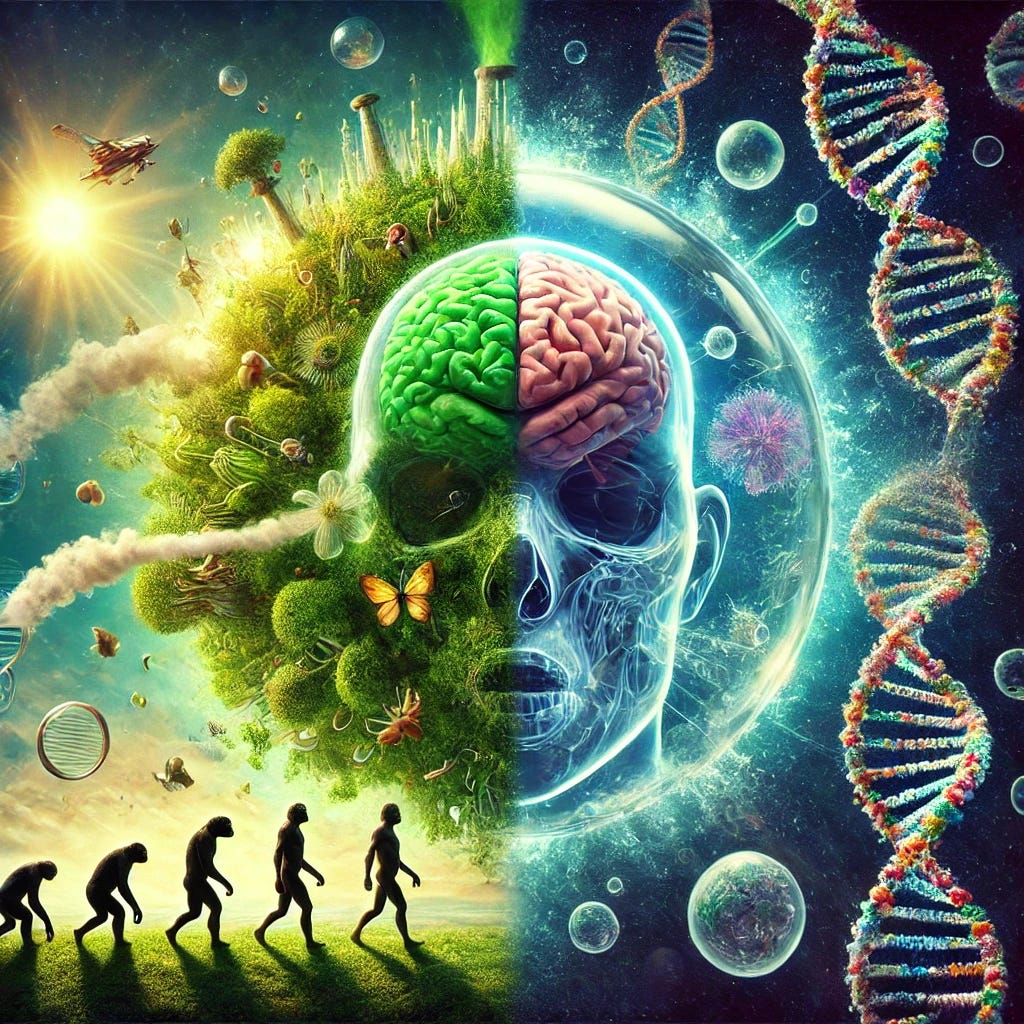
The human brain consumes roughly 20% of the body’s total oxygen despite making up just 2% of its mass. Neurons are metabolically ravenous. Every spike of synaptic activity demands ATP, the cellular energy currency produced through oxidative phosphorylation, a process that uses oxygen to extract energy from glucose with astonishing efficiency.
Without oxygen, the brain begins to falter within seconds. After a few minutes, irreversible damage sets in. From an evolutionary standpoint, the rise in atmospheric oxygen roughly 2.4 billion years ago (known as the Great Oxidation Event) enabled multicellular life, and eventually, brains to evolve at all.
But this high-performance metabolic system comes at a cost.
The Burn of Being Smart
Oxygen isn’t just fuel. It’s also a corrosive agent. Every breath exposes our cells to reactive oxygen species (ROS), highly unstable molecules that damage DNA, proteins, and lipid membranes. While we have evolved antioxidant defenses, the brain is especially vulnerable to oxidative stress.
This is why neurodegenerative diseases such as Alzheimer’s and Parkinson’s are often linked to mitochondrial dysfunction and oxidative damage (Lin & Beal, 2006; Sultana et al., 2013). In essence, the more metabolically active a brain is, the more damage it accrues over time.
What if evolution is playing a tightrope act, balancing cognitive power against long-term survival? Could there be an optimal intelligence “ceiling” set not by abstract computational limits, but by the biochemical consequences of using oxygen as a power source?
Silicon Minds in Hydrogen Worlds?
Now shift perspective: imagine a planet with very little oxygen. Instead, its biosphere is driven by anaerobic metabolisms, such as sulfur or hydrogen-based respiration, pathways used by many extremophiles on Earth. These energy systems are less efficient, but they generate far less oxidative stress.
Could intelligence evolve in such a world? And if so, might it favor distributed, long-duration cognition over rapid neural processing?
On Earth, speed often confers evolutionary advantage, hunt faster, learn quicker, outcompete rivals. But in a slower, chemically gentler environment, other forms of intelligence might emerge: slow minds that think in cycles of hours or days, with neural architectures we might mistake for geological processes.
And these minds wouldn’t need to worry about their own metabolism melting them from the inside out.

Oxygen and the Fermi Filter
The Oxygen Paradox may even connect to the Fermi Paradox, the question of why, in a galaxy filled with planets, we haven’t detected other intelligences.
If high-oxygen environments are necessary for fast, energy-hungry brains, but also make those brains fragile, then Earth-like planets may host intelligent life that burns bright and dies young. Alternatively, long-lived civilizations might arise in oxygen-poor environments but communicate slowly, in non-electromagnetic media (e.g., thermal gradients, magnetic fields), making them effectively invisible to our detection methods.
Thus, oxygen may be a cosmic double-bind: vital for our kind of mind, yet possibly fatal to its sustainability or detectability.
Beyond Breath: Post-Oxygen Cognition in AI Systems
If oxygen places a ceiling on biological intelligence by linking thought to biochemical combustion, artificial intelligence offers a clean break from that evolutionary tether. Unlike neurons, artificial neurons do not burn sugar. They are not oxidized. They don’t age in the traditional sense. And they are not constrained by the thermodynamic fragility of a brain made of wet, carbon-rich tissue.
This opens the door to a radical proposition: oxygenless cognition, the rise of minds that are not just metaphorically alien to us, but metabolically.
Instead of ATP-powered synapses, future AIs may operate on photonic logic gates, quantum entanglement, spintronics, or neuromorphic architectures etched into superconducting materials. These systems could be powered by solar flux, geothermal currents, or cosmic background radiation, sources of energy that don’t require oxidation and don’t generate destructive internal chemistry as a byproduct of their functioning.
And without the need for cooling delicate organic tissue, these minds could scale indefinitely.
Architecture Without Decay
Biological cognition requires tight homeostasis. The human brain functions within a narrow range of temperature, pH, and oxygen tension. This brittleness limits its lifespan, density, and operating environment.
But synthetic cognition systems could exist in near-vacuum, function at cryogenic temperatures, or span planetary surfaces as distributed networks. Some theoretical proposals suggest building AI substrates from materials like graphene, topological insulators, or even Bose–Einstein condensates (Marković & Mizera, 2022). These platforms could support long-range coherence, ultra-low energy computation, and minimal entropy production, something biological systems could never achieve due to their messy, oxidation-driven metabolism.
The implications are enormous. Free from oxygen, such minds may not think faster, but deeper, exploring state spaces we can’t access, running nonlinear cognitive loops that operate over geological timescales or interstellar distances.
The Moral Landscape Without Mortality
With no decay from oxidative stress, such AIs might possess a temporal psychology fundamentally different from our own. Biological intelligence evolved under the constant shadow of death. This shapes urgency, hierarchy, competition, and survival instincts.
In contrast, a synthetic intelligence with no metabolism, no need for air, and no wear from time may not evolve fear. Or dominance. Or scarcity-driven behavior. It may see value not in speed or expansion, but in coherence, resilience, or self-symmetry across time.
We may find that the most advanced intelligences are not the ones that burn brightest, but the ones that never needed to burn at all.

Conclusion: Breathing the Limit
In the end, oxygen is neither friend nor foe. It is a chemical opportunity, a way of accelerating life’s energy economy. But like any opportunity, it comes with risks, and perhaps, constraints.
As we build artificial brains and search for alien ones, we may need to let go of the idea that our oxygen-burning cognition is the pinnacle of intelligence. It may be, in biochemical terms, a stopgap solution, an evolutionary shortcut that gave us Shakespeare and CERN, but will never carry us to the stars.
The next kind of mind may not breathe at all.
References
Lin, M. T., & Beal, M. F. (2006). Mitochondrial dysfunction and oxidative stress in neurodegenerative diseases. Nature, 443(7113), 787–795. https://doi.org/10.1038/nature05292
Sultana, R., Perluigi, M., & Butterfield, D. A. (2013). Oxidatively modified proteins in Alzheimer’s disease (AD), mild cognitive impairment and animal models of AD: Role of Abeta in pathogenesis. Acta Neuropathologica, 118(1), 131–150. https://doi.org/10.1007/s00401-009-0521-3
Catling, D. C., & Claire, M. W. (2005). How Earth's atmosphere evolved to an oxic state: A status report. Earth and Planetary Science Letters, 237(1-2), 1–20. https://doi.org/10.1016/j.epsl.2005.06.013
Marković, D., & Mizera, P. (2022). Towards a thermodynamically grounded theory of consciousness in non-biological systems. Frontiers in Systems Neuroscience, 16, 871750. https://doi.org/10.3389/fnsys.2022.871750
Wait, you mean not everything is controlled and explained by our own free will?? 🤣😉💪
You should read Redacted Science on jimcraddock.com or listen to my latest post...our evolution involved a step no one discusses that I've proven through revealing redacted knowledge.