
The Osmotic Singularity
Could Extremes of Solute Concentration Induce Localized Spacetime Distortion?

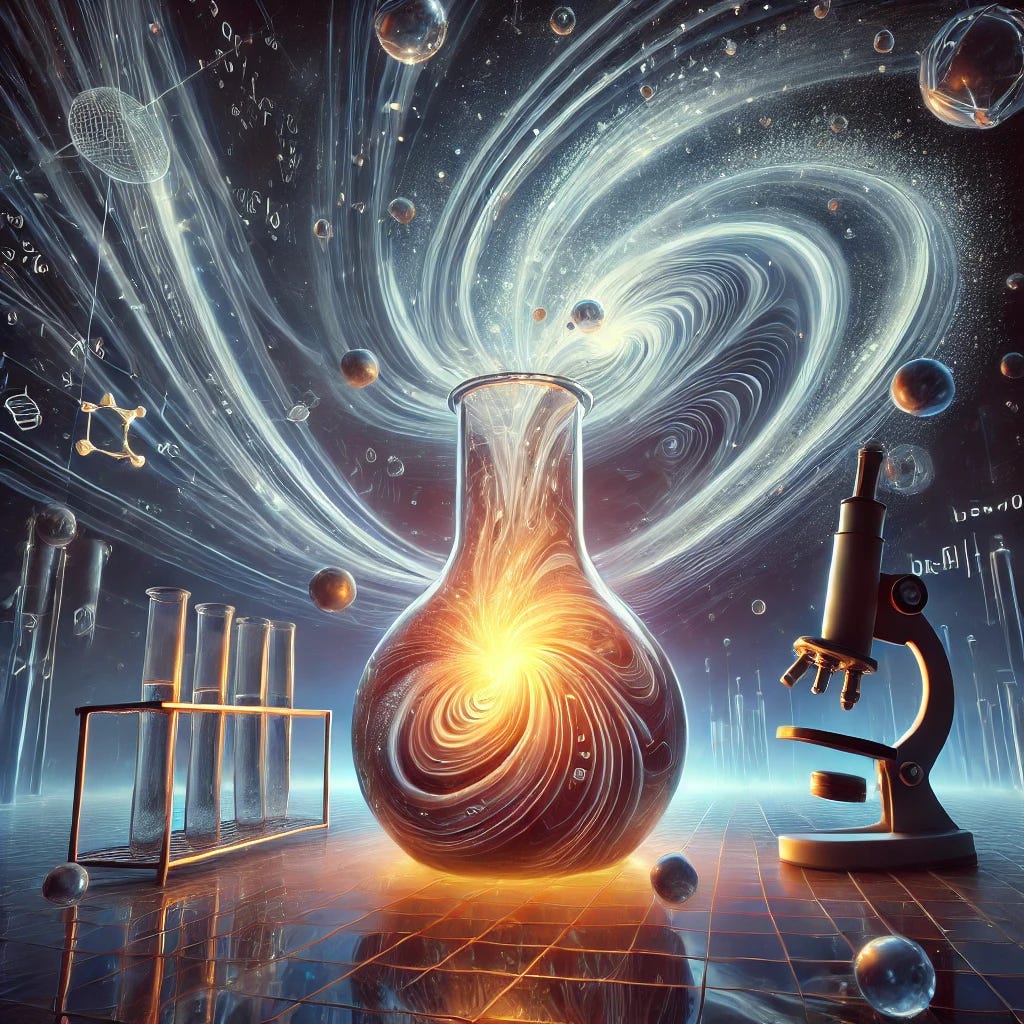
Osmosis is among the most elementary processes in biology: the passive movement of water across a semipermeable membrane driven by solute gradients. It is taught in high school textbooks, modeled with sugar and dialysis tubing, and presumed to be a purely molecular phenomenon. But what if this unassuming process harbors hidden depths, an unrecognized edge-case where concentration gradients reach such extremity that the differential density of informational entropy across a membrane begins to curve spacetime itself?
This paper introduces the speculative notion of the Osmotic Singularity, a boundary condition in ultra-extreme solute environments where traditional thermodynamic models of osmotic pressure may no longer hold, and where microscopic curvature effects, akin to those seen in Casimir vacuums or Bose–Einstein condensates, might emerge.
Theoretical Background
Standard osmotic pressure (π) is given by the van ’t Hoff equation:
π = iCRT, where i is the ionization constant, C is concentration, R is the gas constant, and T is temperature.
This linear model breaks down under extreme concentrations. At sufficiently high solute levels, molecular crowding alters water dynamics, creating nanoscale "voids" and mass flux instabilities. Recent advances in nanofluidics have revealed that water’s behavior under these conditions can mimic features of quantum tunneling and exhibit long-range dipole coupling.
The Osmotic Singularity Hypothesis posits that, in highly localized domains (e.g., microdroplets near evaporative collapse or synthetic membranes in zero-gravity vacuoles), solute differentials may become so severe that the chemical potential between two compartments becomes gravitationally non-negligible. The membrane, now acting not just as a barrier but as a tensioned boundary in spacetime geometry, could experience femto-scale curvature.
A Thought Experiment
Imagine a system in which one chamber contains pure water and the adjacent chamber, separated by a perfect nanoporous graphene membrane, contains a solution of near-saturation-level cesium chloride under cryogenic conditions. The osmotic pressure in this system could approach 500–1000 atm.
Now imagine this system situated in a deep-space vacuum, thermally isolated, and rotating to maintain membrane stability. Could this configuration induce minute gravitational lensing? Could a beam of coherent light passing tangentially to the membrane exhibit a phase delay beyond what Maxwell's equations predict in purely dielectric media?
The curvature would be infinitesimal, but if measured, it would imply that entropy gradients can induce localized mass analogs, in effect, that osmotic disequilibrium creates a kind of information mass.
Mathematical Modeling
We introduce a speculative correction to the van ’t Hoff relation by embedding it within the Einstein field equations. Let the energy-momentum tensor include a term for entropic potential (ϕₛ):
T<sub>μν</sub> = T<sub>μν</sub><sup>matter</sup> + β∇ϕₛ
Where β is a coupling coefficient describing the osmotic curvature susceptibility.
If ϕₛ reaches a critical threshold, the resulting metric deviation in g<sub>μν</sub> could mimic a spacetime "dimple," not unlike the shallow gravitational fields of low-mass asteroids, but on the scale of nanometers.
Experimental Speculations
Though current technology cannot measure femtometer-scale curvature directly, experimental proxies could be tested:
Optical Phase Delay Mapping
Use interferometric lasers across high-pressure osmotic interfaces to detect time-of-flight anomalies.Quantum Fluid Analogues
Replicate osmotic boundary conditions using superfluid helium in a toroidal geometry. Monitor for deviations in phonon propagation or pressure-induced birefringence.Biological Osmotic Extremes
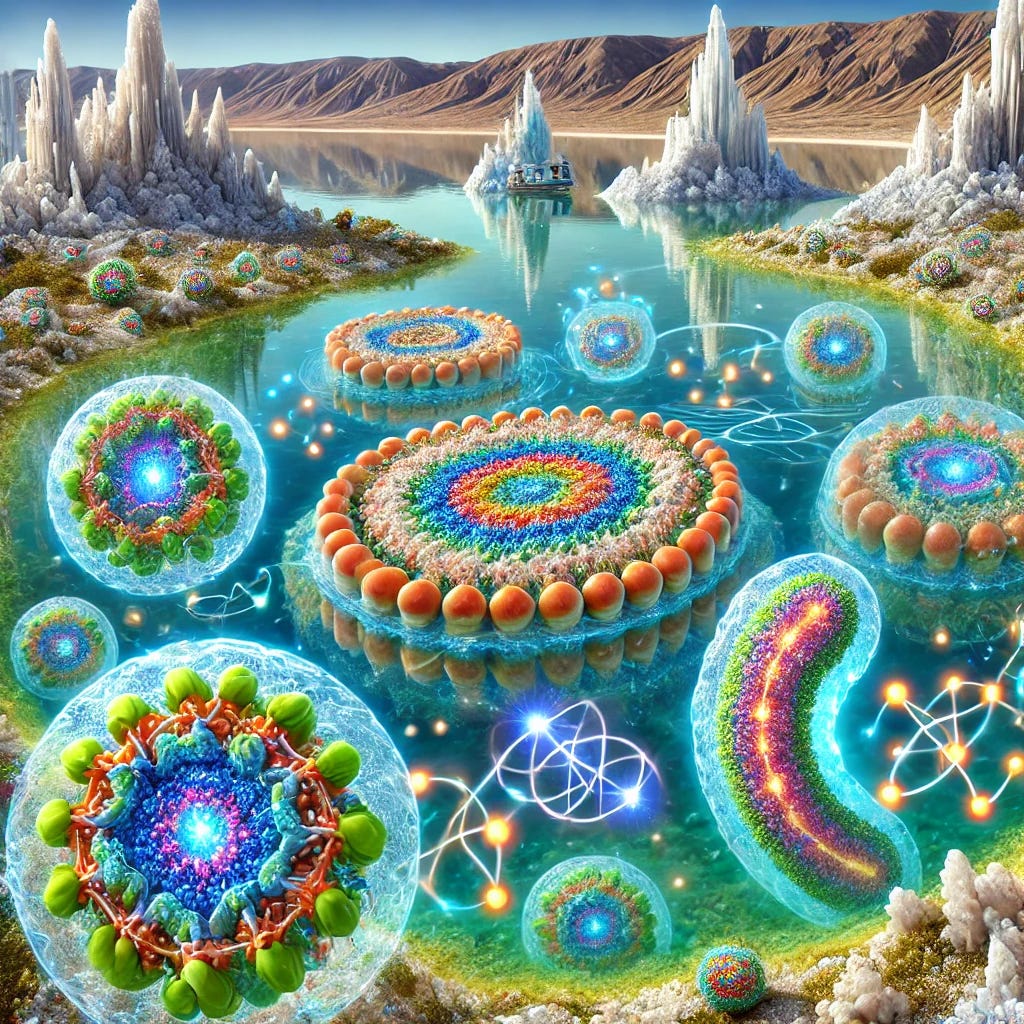
Observe extremophile microbes living in hypersaline lakes. Are there unexplained quantum behaviors in their intracellular transport systems that hint at submolecular spacetime interaction?
Broader Implications
If the Osmotic Singularity holds, even at vanishingly small scales, it offers a bridge between information entropy and gravity. It hints that gradients of disorder themselves may be sources of curvature, and thus mass, not metaphorically, but physically.
In essence, mass may not just attract, it may be outcompeted by concentration. Osmosis, once seen as passive, may be an early signature of how life’s gradients distort the cosmos not just metaphorically, but literally.
This perspective opens doors into new models of entropy gravity coupling, membrane-based spacetime manipulation, and even biological contributions to local curvature, a subtle rewriting of the relationship between life and the structure of the universe.
Speculative Extension: Osmotic Spacetime Actuators
If entropy gradients across a membrane can, in extreme cases, induce femto-scale curvature in spacetime, then we may be able to harness this effect using engineered materials and solute architectures, what we might call Osmotic Spacetime Actuators (OSAs).
These devices would function by creating ultra-precise concentration differentials within synthetic membranes suspended in high-vacuum environments. By cycling solute loading in geometrically tuned arrays, the goal would be to induce controlled pulses of curvature, tiny, transient warps in local spacetime geometry that could be used for signal modulation, vibration damping, or even low-energy thrust.
Design Concept: Entropic Lens Arrays
Picture a sheet of ultra-thin graphene laced with nanoscale osmotic channels. Each channel is independently addressable via programmable electrochemical gates that control solute injection. When aligned in a geometric lattice, the array becomes an entropic lens, a two-dimensional matrix that subtly alters the phase of passing photons, electrons, or phonons based on dynamically programmed concentration gradients.
This lens wouldn't just bend light, it could theoretically modulate causal latency on an atomic scale, effectively allowing femtosecond-scale control of signal propagation for quantum systems or high-precision metrology.
Potential Applications
1. Quantum Delay Control
In quantum computing, coherence time is everything. An OSA could provide variable optical path delay via local spacetime modulation, allowing for tunable quantum gate timing.
2. Entropic Inertial Dampers
In spacecraft or precision robotics, oscillations and micro-vibrations are a major challenge. OSAs could act as spacetime shock absorbers, redirecting mechanical energy into structured osmotic diffusion patterns that subtly dampen motion.
3. Osmotic Thrusters
The holy grail: If these tiny distortions can be synchronized and directed, a phased array of OSAs might produce directional spacetime perturbations. This would not be reaction-based propulsion, but a weak analog of metric engineering, a gentle push on the fabric of spacetime itself. It may never move a spaceship, but for nanobots or high-precision inertial sensors, even such femto-thrust could be transformative.

These ideas remain firmly speculative. Yet if even a shadow of osmotic-induced curvature exists, the implications ripple outward. Osmosis, a process dismissed as background biology, might become a tool for bending time, shifting mass, or designing gravitational metamaterials.
If entropy gradients can bend spacetime, then life itself, endlessly managing gradients, has always been a sculptor of the cosmos.
References
Israelachvili, J. N. (2011). Intermolecular and Surface Forces. Academic Press.
Milo, R., & Phillips, R. (2016). Cell Biology by the Numbers. Garland Science.
Verlinde, E. (2011). On the origin of gravity and the laws of Newton. Journal of High Energy Physics, 2011(4), 29.
Chou, T., Mallick, K., & Zia, R. K. (2011). Non-equilibrium statistical mechanics: from a paradigmatic model to biological transport. Reports on Progress in Physics, 74(11), 116601.