
The New Status Symbol
Human Effort

For most of modern history, status came from making things easier.
Faster travel.
Instant communication.
Automation everywhere.
Convenience meant progress.
Now something strange is happening.
People are starting to value effort again. Not efficiency. Not optimization. Effort itself.
Hand-made.
Hand-written.
Human-designed.
Done without AI.
What used to signal inefficiency is starting to signal prestige.
Because when machines can do almost everything instantly, choosing to do something the hard way becomes a statement.
Effort is no longer just work.
It’s proof you’re still human.

Effort Used to Mean Limitation
Historically, effort was unavoidable.
You wrote by hand because there was no alternative.
You calculated manually because you had to.
You learned slowly because nothing could accelerate the process.
Effort wasn’t admired. It was normal.
Status came from escaping it.
Industrialization reduced physical labor.
Computing reduced mental labor.
Automation reduced repetitive work.
Technology steadily turned effort into something to eliminate.
That pattern held for centuries.
Until now.
When Everything Becomes Easy, Effort Becomes Rare
AI changed the equation.
Writing, designing, coding, analyzing, planning, editing, summarizing, composing, generating. All of it can now be done faster, cheaper, and often better with machine assistance.
The barrier to producing output collapsed.
And when something becomes universally accessible, it stops signaling distinction.
Economists call this scarcity value. When a resource becomes abundant, its perceived worth drops (Frank, 1999).
Competent output is now abundant.
Effort is not.
That reverses the signal.
The Return of Visible Process
People are starting to care less about the result and more about how it was made.
Did a human write this?
Was this painted manually?
Did someone actually learn this skill?
Was this built without automation?
These questions would have sounded strange ten years ago.
Now they determine value.
This shift mirrors what happened in earlier industrial transitions. When mass production scaled, handmade goods became luxury items. Not because they were more functional, but because they embodied time and attention (Veblen, 1899).
We are watching the same pattern unfold cognitively.
Mass production of thinking creates demand for handcrafted thought.
Effort as a Signal of Authenticity
Psychological research shows that people associate effort with sincerity and authenticity. Work that visibly requires time or difficulty is perceived as more meaningful and trustworthy (Kruger et al., 2004).
That bias becomes stronger when automation is widespread.
If a machine can generate something instantly, effort becomes evidence of intention.
Not just output.
Presence.
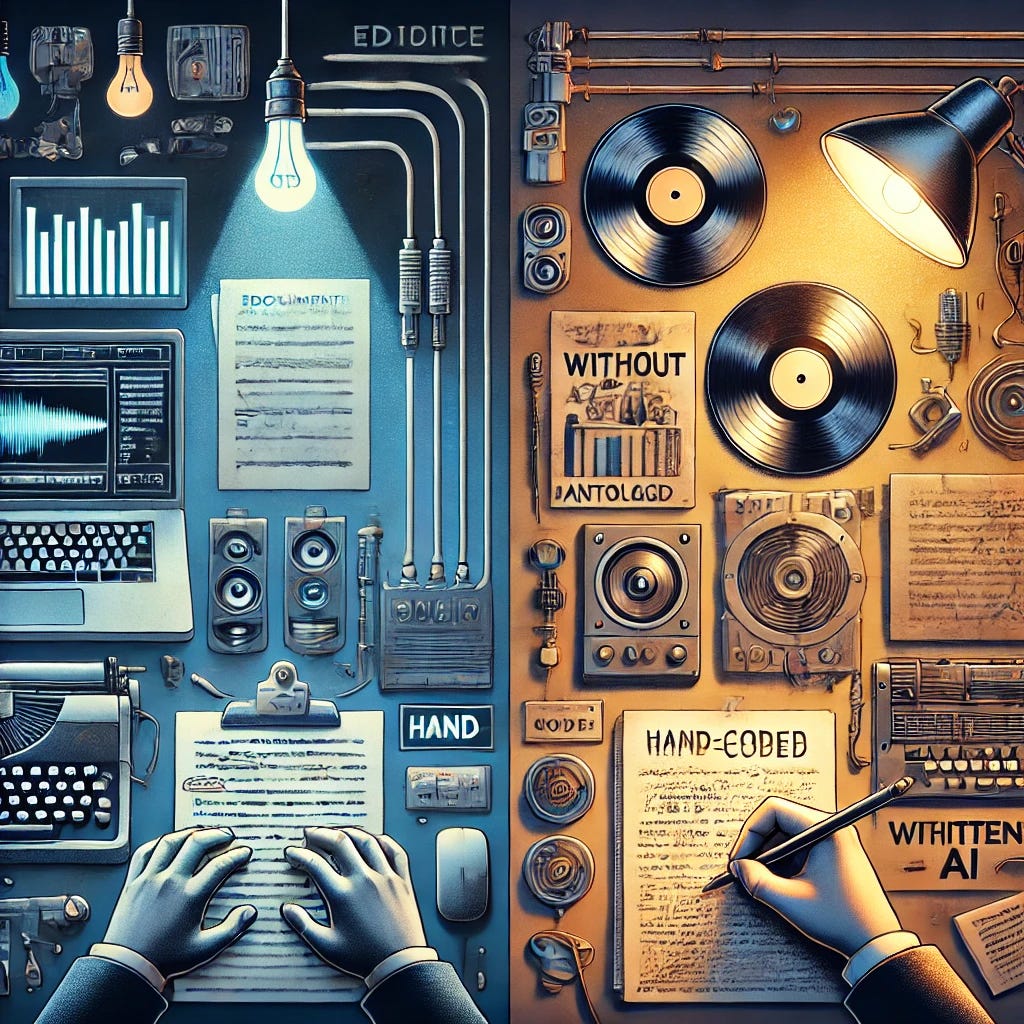
That is why people now advertise effort directly.
“Written without AI.”
“Hand-coded.”
“Analog recording.”
“Manual process.”
These are not technical details.
They are identity signals.
The Status Reversal
We are entering a cultural inversion.
Before AI:
Efficiency signaled sophistication.
After AI:
Effort signals control.
Choosing difficulty shows independence from automation. It suggests you are not merely optimizing. You are deciding.
That distinction matters socially.
In behavioral economics, costly signals are powerful precisely because they require sacrifice. They demonstrate commitment that cannot be easily faked (Spence, 1973).
Human effort is becoming a costly signal.
And costly signals create status.
The New Prestige Economy
This shift is already visible across domains.
Education
Students who solve problems manually are praised differently than those who rely entirely on tools.
Creative work
Audiences ask whether artists actually made what they produced.
Professional life
Deep expertise now includes knowing when not to automate.
Physical craft
Hand skills regain symbolic importance even when machines outperform them.
None of this rejects technology.
It reframes what counts as valuable within it.
When machines handle capability, humans compete on intentionality.
The Hidden Psychological Function
Effort does more than signal status.
It stabilizes identity.
Psychologists have long shown that effortful engagement strengthens agency and meaning. When people invest time and struggle into an activity, they feel ownership over outcomes (Deci & Ryan, 2000).
Automation removes friction.
Friction used to produce attachment.
Without effort, outcomes feel less personal. More replaceable. More interchangeable.
Choosing effort restores psychological grounding.
It reminds people they are still causal agents in the world.
The Risk of Performative Effort
There is a complication.
Once effort becomes prestigious, it can become performative.
People may choose difficulty for visibility rather than substance. Effort becomes aesthetic rather than functional.
This mirrors earlier luxury signaling. Expensive goods often communicate cost more than utility.
The same dynamic can emerge cognitively.
Doing something manually does not guarantee depth. It only guarantees time investment.
Status systems always distort behavior.
Effort is no exception.
Why This Shift Will Intensify
As AI capabilities expand, the supply of effortless output will grow exponentially.
Which means the scarcity of genuine effort will grow with it.
Scarcity drives value.
Value drives signaling.
Signaling drives culture.
We should expect:
More emphasis on process transparency.
More cultural prestige around manual mastery.
More distinction between generated and authored work.
More identity tied to how something is made, not just what it is.
This is not resistance to AI.
It is adaptation to abundance.

Technology spent centuries removing effort from human life.
AI is finishing that project.
But once effort becomes optional, it stops being invisible.
It becomes visible precisely because it is chosen.
And what is chosen when it is no longer required carries meaning.
Human effort is becoming rare.
Rarity creates value.
Value creates status.
The future may not belong to those who produce the most.
It may belong to those who can prove they still chose to try.
References
Deci, E. L., & Ryan, R. M. (2000). Self-determination theory and the facilitation of intrinsic motivation. American Psychologist, 55(1), 68–78.
Frank, R. H. (1999). Luxury Fever. Princeton University Press.
Kruger, J., Wirtz, D., Van Boven, L., & Altermatt, T. (2004). The effort heuristic. Journal of Experimental Social Psychology, 40(1), 91–98.
Spence, M. (1973). Job market signaling. Quarterly Journal of Economics, 87(3), 355–374.
Veblen, T. (1899). The Theory of the Leisure Class. Macmillan.
I agree with the main tenet of this article but I notice the pictures are AI generated. Perhaps it's more about balance or when/how/why AI is used rather than all or none.
Seems like a lot of people are coalescing around this point at the same time. Probably as a result of some of the news about the software industry. Fascinating.
Including myself in that: https://open.substack.com/pub/theslowpanic/p/trading-solely-on-reputation