
The Mycelial Frequency Hypothesis
Fungal Networks as Resonant Cognition

Intelligence is often framed as either neuronal or digital. But across ecosystems, another network silently processes information: mycelium, the vast subterranean filaments of fungi. Mycelial networks connect trees, trade nutrients, and adapt dynamically to stress. What is less discussed is that these networks are also vibrational systems. Recent studies suggest that electrical impulses in fungi may organize into rhythmic frequencies, raising the possibility that mycelial intelligence is structured less by chemical exchange alone and more by resonance.
The Mycelial Frequency Hypothesis proposes that fungal cognition emerges not only from resource exchange but from the stabilization of vibrational frequencies across filaments. In this view, intelligence is a matter of resonance rather than computation.

Fungal Networks as Information Systems
Mycelial networks extend for kilometers underground, weaving through soil and attaching to plant roots. These “wood wide webs” facilitate nutrient sharing and warning signals. Trees attacked by pathogens transmit chemical cues through mycorrhizal partners, triggering immune defenses in distant plants (Simard et al., 1997).
Recent research has revealed that fungi also transmit electrical signals along their hyphae. These spikes resemble action potentials in neurons, though slower and chemically distinct (Adamatzky, 2021). They suggest that mycelia may use bioelectric signaling to coordinate large-scale responses. Importantly, these signals are not random. They appear as bursts of specific durations, frequencies, and intervals, hinting at an underlying syntax of communication.
Resonance as Cognitive Substrate
Resonance is a universal principle across physics. From vibrating strings to oscillating circuits, systems achieve stability when frequencies lock into harmonic relationships. Biological systems use resonance widely: neuronal oscillations synchronize to form brain rhythms, cardiac tissue pulses coherently to maintain heartbeat, and insect swarms hum in collective frequencies.
In mycelia, the combination of filamentous structure and electrical oscillation makes resonance inevitable. Hyphal strands create conductive channels that can amplify, dampen, or entrain rhythmic signals. Over time, such resonance could act as a medium for memory and coordination. Information would not be stored as discrete spikes, but as patterns of sustained oscillation.
The Mycelial Frequency Hypothesis thus reframes fungal networks as resonant systems. Their intelligence is not encoded in nutrient maps alone but in the harmonic frequencies that stabilize across their distributed bodies.
Artificial Architectures of Resonant Mycelium
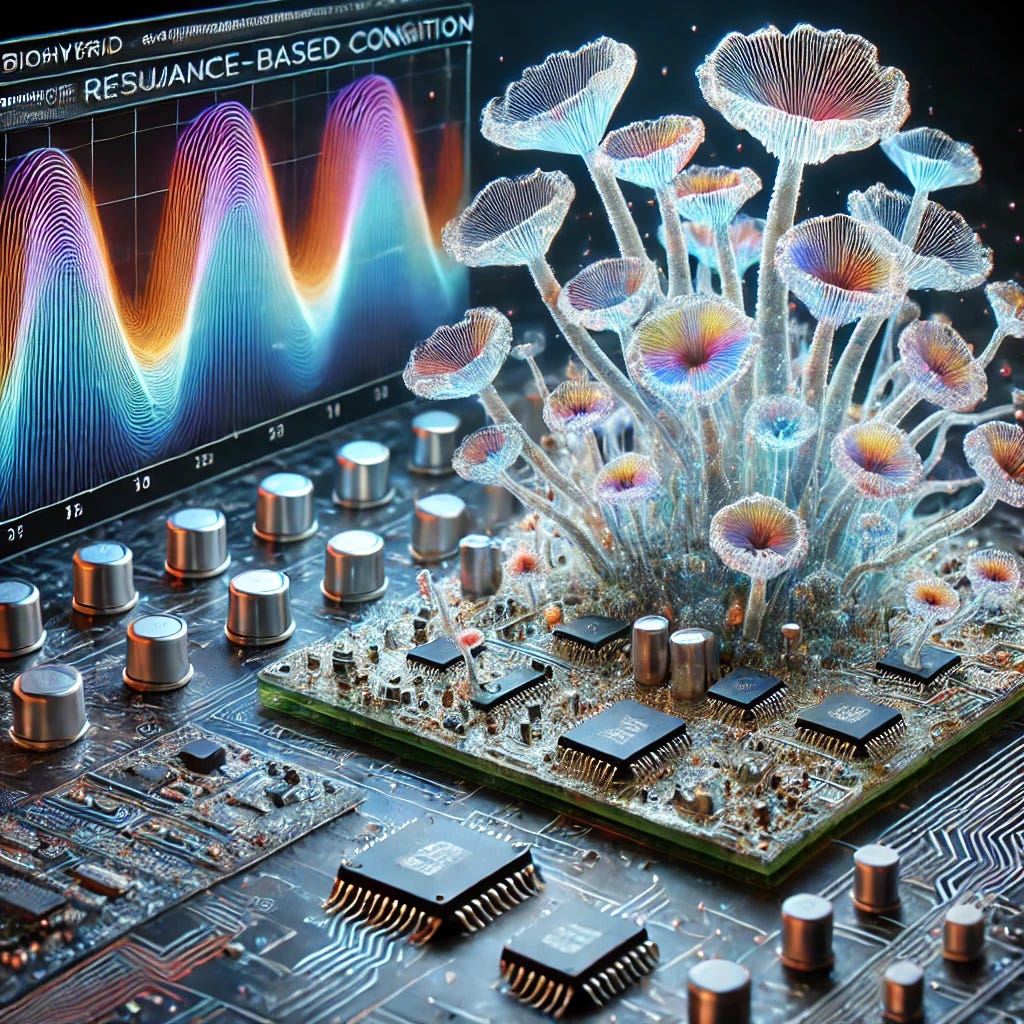
If fungi use resonance as cognition, artificial systems could be built to mimic or amplify this property. One approach would be biohybrid computing, embedding fungal filaments into electronic circuits. Electrodes could introduce oscillatory inputs, while sensors monitor the emergent frequency spectra. Machine learning algorithms would then map shifts in resonance to adaptive problem-solving behaviors.
Another approach is synthetic. Oscillatory networks of conductive polymers or organic semiconductors could be designed to behave like artificial mycelia. Rather than relying on digital states, they would encode memory in phase relationships between oscillators, echoing how living mycelia stabilize coherence across filaments.
In either case, intelligence would not be a matter of symbolic reasoning but of maintaining resonant stability in complex networks.
Experimental Pathways
One experimental pathway involves placing fungal networks under controlled stressors, nutrient scarcity, chemical toxins, or mechanical disturbance, and measuring whether their electrical oscillations shift into stable new frequencies. If so, this would demonstrate adaptive reorganization at the vibrational level.
Another pathway is to couple fungal networks with robotic agents. Electrodes would record fungal oscillations, which robots interpret as signals for movement or choice. Over time, if the system improves in coordination, this would provide direct evidence that mycelial resonance can guide decision-making.
Finally, resonance can be tested across multiple colonies. If distinct mycelial networks synchronize when electrically connected, their coherence would suggest the emergence of larger-scale cognitive structures, analogous to synchronized brain regions.
Philosophical Implications
If fungi think through resonance, then intelligence is no longer the exclusive domain of organisms with neurons or codes. It is a property of networks that stabilize frequencies. This radically widens the frame of cognition. The forest floor becomes an orchestra of thought, where trees and fungi communicate not only chemically but vibrationally.
This also forces a reconsideration of memory. Human memory is spatial, encoded in synaptic weights. Mycelial memory, by contrast, would be temporal, encoded in rhythms. To remember is to continue vibrating at a certain frequency. Such a model blurs the line between cognition and music, suggesting that thinking is less about symbols and more about resonance with environment.
Future Directions
The Mycelial Frequency Hypothesis opens research into fungal bio-computing, ecological cognition, and planetary intelligence. In practical terms, fungal resonance could be harnessed for biosensors that detect soil toxins or climate stress through shifts in oscillatory signatures. Biohybrid circuits could use fungal filaments to achieve low-energy, adaptive problem-solving.
On a larger scale, mycelial resonance suggests that ecosystems themselves may think vibrationally. Forests coordinated by fungal networks could adapt as coherent cognitive systems, not just collections of individuals. This resonates with Gaia theory, which posits Earth as a self-regulating organism, but reframes it in terms of frequency and resonance rather than metaphor alone.
Cosmological Extensions
The most speculative extension lies in viewing resonance as a universal signature of cognition. If fungi on Earth stabilize intelligence through vibrational coherence, perhaps cosmic systems do likewise. Planetary magnetospheres, pulsar rhythms, or even gravitational wave resonances could serve as large-scale cognitive substrates. The universe, in this sense, might think not through logic but through rhythm.
This does not mean galaxies “speak” as organisms do, but that resonance may be a general principle by which matter organizes itself into coherent, adaptive states. The fungal forest becomes a local example of a universal pattern: cognition as resonance.

The Mycelial Frequency Hypothesis proposes that fungal networks think through resonance. Their intelligence lies in harmonizing electrical oscillations across filaments, not merely in exchanging nutrients. Artificial architectures inspired by this principle could pioneer new forms of biohybrid computing, while ecological and cosmological extensions suggest that resonance may be a general law of cognition.
If true, intelligence is not silent or symbolic. It is rhythmic. It hums beneath the forest floor and perhaps across the stars.
References
Adamatzky, A. (2021). Fungal electrical activity: Spikes of a slime mould and fungi. Biosystems, 199, 104306.
Simard, S. W., Perry, D. A., Jones, M. D., Myrold, D. D., Durall, D. M., & Molina, R. (1997). Net transfer of carbon between ectomycorrhizal tree species in the field. Nature, 388(6642), 579–582.
Baluška, F., & Mancuso, S. (2009). Plant neurobiology: From stimulus perception to adaptive behavior. Plant Signaling & Behavior, 4(5), 475–476.
Stamets, P. (2005). Mycelium Running: How Mushrooms Can Help Save the World. Ten Speed Press.
Thought provoking! I’m glad I read this.
Me every time I start your post: Great, another brilliant hippy trying too hard to bridge science and metaphysics. Sounds interesting though. I'll just scan the beginning.
Me 5 minutes later: Holy crap. That made a lot of sense.