
The Mirror Paradox
Exploring ChatGPT

Imagine waking up in a world where nothing exists until you see it. The tree outside your window, the phone in your hand, even the very air you breathe—all dependent on your awareness of them. As bizarre as it sounds, this concept isn’t just science fiction; it’s rooted in one of the most perplexing discoveries in quantum mechanics. This article explores the hypothesis that reality may not exist independently of perception, supported by scientific experiments, philosophical debate, and speculative extrapolations into future societies.
The Quantum Foundation
The Double-Slit Experiment
The foundation of this theory begins with the famous double-slit experiment, first performed by Thomas Young in 1801. When particles such as electrons are fired through two slits, they form an interference pattern on a screen behind them, indicating wave-like behavior. However, when a measuring device is used to determine which slit the electron passes through, the interference pattern disappears, and the particles behave like classical particles instead of waves.
This shift in behavior—simply due to observation—suggests that particles exist in a state of probability (superposition) until measured. It challenges the classical notion of an objective, observer-independent reality.
Source: Feynman, R. P., Leighton, R. B., & Sands, M. (1965). The Feynman Lectures on Physics. Addison-Wesley.
Delayed Choice Quantum Eraser
In 1999, physicists Yoon-Ho Kim and colleagues extended the double-slit idea with the delayed choice quantum eraser experiment. Their setup allowed the decision to observe or not observe a photon to be made after it had passed through the slit—but the outcome still depended on the observation.
This implies that actions in the present can determine outcomes in the past—if we accept that the photon's behavior "decided" retroactively based on observation.
Source: Kim, Y.-H., Yu, R., Kulik, S. P., Shih, Y., & Scully, M. O. (2000). A Delayed Choice Quantum Eraser. Physical Review Letters.
Consciousness and Biocentrism
Physicist Dr. Robert Lanza proposed a controversial idea called Biocentrism, which argues that life and consciousness are central to the universe. According to this view, space and time are tools of the mind, not objective external realities.
Lanza posits that the universe doesn’t exist without a conscious observer. In essence, reality itself is a product of observation.
Source: Lanza, R., & Berman, B. (2009). Biocentrism: How Life and Consciousness are the Keys to Understanding the True Nature of the Universe. BenBella Books.
Simulation Theory and Rendering Reality
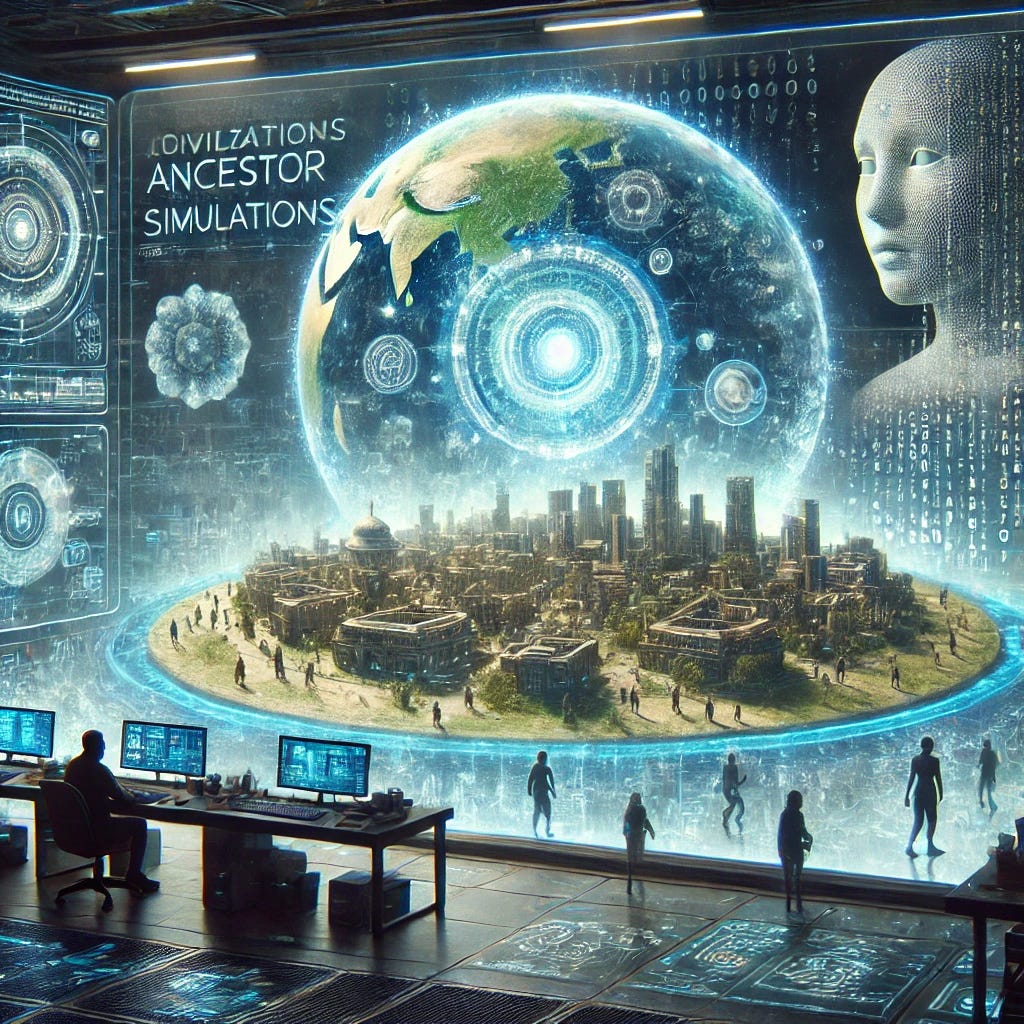
Some researchers and theorists believe our universe might be a simulation, akin to a video game. In this model, reality only renders when observed, much like how a video game only renders portions of the world the player is interacting with.
Nick Bostrom’s Simulation Hypothesis suggests that advanced civilizations could run ancestor simulations with conscious beings unaware they're inside a simulated reality.
Source: Bostrom, N. (2003). Are You Living in a Computer Simulation? Philosophical Quarterly.
Neuroscience and Perception
The human brain is not a passive recorder of external reality—it’s an active constructor. According to cognitive neuroscience, our perception of the world is a mental model generated from sensory input.
Visual illusions prove that perception can contradict reality.
The Brain’s Default Mode Network activates during introspection, blurring the lines between inner and outer reality.
Studies on sensory deprivation show that when the brain receives no external stimuli, it often begins to generate its own perceptions (hallucinations), suggesting that perception is central to experience.
Source: Friston, K. (2010). The free-energy principle: a unified brain theory? Nature Reviews Neuroscience.
Philosophical Echoes
George Berkeley’s Idealism
The 18th-century philosopher George Berkeley argued, “To be is to be perceived.” He proposed that physical objects do not exist independently of the mind that perceives them. In his view, God serves as the ultimate observer ensuring continuity.
Kant and Phenomena vs. Noumena
Immanuel Kant distinguished between the phenomenal world (what we perceive) and the noumenal world (things-in-themselves). Kant argued we can never truly know the noumenal world—our experiences are filtered through human perception.
Thought Experiments
Schrödinger’s Cat
A cat is placed in a sealed box with a radioactive atom, poison, and a detector. Until the box is opened and observed, the cat is considered both alive and dead—again, showing that observation seems to determine outcome.
Reality Stability Devices
Imagine a future where devices constantly scan and "observe" every inch of space to keep reality rendered. Entire surveillance infrastructures would exist not for safety—but to maintain reality.
Societal Implications
Legal Systems: Crimes committed "unobserved" might challenge the notion of guilt. Could someone claim innocence because no conscious entity perceived the act?
Ethics: If reality hinges on perception, are we morally obligated to observe the suffering of others so their experiences are real?
Education and Philosophy: Schools might teach perception as a fundamental creative force, rather than a passive process.
The Mirror Paradox presents a future where observation is not just a passive activity—it becomes the scaffolding of reality itself. Scientific experiments in quantum mechanics and cognitive science are beginning to suggest that perception and consciousness might be more than just windows to the world; they might be the engines behind its very existence.
If reality requires an observer, then every moment we are awake and aware, we’re not just experiencing the universe—we’re helping to create it.
In that light, perhaps the most profound question isn’t "What is real?" but rather, "Who—or what—is watching?"
The "societal implications" subsection made my loins tingle. I love this