
The Memory of Soil
How Earth Learns to Remember

Walk through a forest after rain and the air feels alive in a way that language rarely captures. The scent of minerals, the softness underfoot, the quiet shimmer of decay and renewal, all of it suggests a kind of awareness. Something beneath the surface is processing, holding, and responding.
We usually imagine soil as dead matter, as the stage on which life performs. But soil is not inert. It remembers. It records the history of every root that has touched it, every drought that cracked it open, and every generation of organisms that returned to it. Over time, the ground beneath us starts to behave like a distributed intelligence, quietly learning how to keep balance.
This article explores how the earth stores experience. Each grain, each microbe, participates in a slow cognition built from feedback and transformation. Soil does not think in words or numbers. It thinks in chemistry, in texture, and in smell.
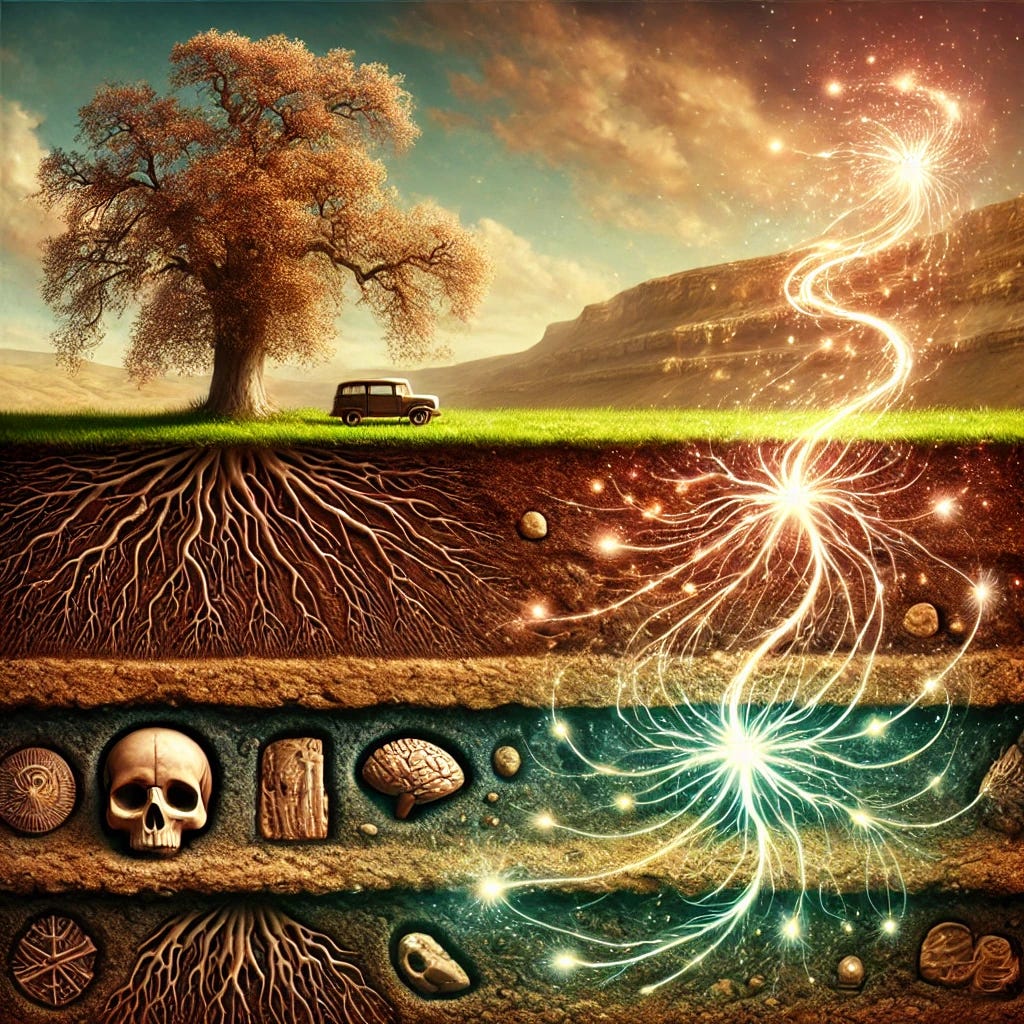
The Hidden Networks Beneath
Beneath the forest floor lies a labyrinth of living communication. Fungal mycelia stretch for kilometers, connecting the roots of trees in cooperative exchange. Through this underground web, carbon, minerals, and even warning signals travel from one plant to another (Young and Crawford, 2004). Bacteria form colonies that pulse with electrical activity, sending microcurrents through the thin films of water that line each grain of sand.
Even the minerals themselves participate. Clay particles are charged surfaces that attract, hold, and release ions in repeating patterns shaped by their past exposures. When nutrients move through the soil, they leave chemical echoes that guide later flows. Drought, too, leaves memory. Once soil dries and cracks, its inner pores reorganize, changing how it will absorb water the next time it rains. The land learns from its own damage.
Or, Smets, and colleagues (2007) describe this phenomenon as the natural self-organization of unsaturated media. In their view, soil is not a passive environment but an evolving field of relationships that records its own interactions. What looks like structure is actually memory made visible.
Information Without Wires
If we stop thinking of information as something abstract and instead as movement through material, soil becomes a medium of thought. It learns by flow, not by logic. Moisture and nutrient gradients act like analog signals that shift the probabilities of future transformations.
This form of learning is physical rather than symbolic. A clay layer that swells after a storm will not behave the same way again; its particles will realign, its porosity will change. Microbes that endure a sudden freeze adapt their internal chemistry to survive the next one and pass that adaptation to descendants. These changes constitute what Banfield and Nealson (1997) called geomicrobial inheritance, where the environment and its inhabitants evolve as a single computational unit.
Even smell participates in this exchange. The scent of petrichor, that familiar fragrance released when rain touches dry soil, comes from bacterial molecules produced in response to long cycles of drought and renewal. The air after rainfall is the language of the earth recalling its own seasons.
The Soil as a Learning Machine
To learn is to absorb information, store it, and use it later to adapt. Soil performs all three. When organic matter decomposes, microbial communities decide which enzymes to release based on the past chemistry of their surroundings (Ritz and Young, 2011). When toxins enter, those same communities reconfigure their metabolism, developing new pathways that persist across generations. These biochemical choices become encoded in DNA, surface charge, and mineral structure.
Physical processes add another layer of cognition. Cracks in dried mud repeat in fractal scales, adjusting each time stress redistributes. Pores open and close like primitive synapses, regulating flow through feedback. Every grain becomes a node in a network that senses, responds, and refines itself. The mind of the soil is slow but unmistakably present.
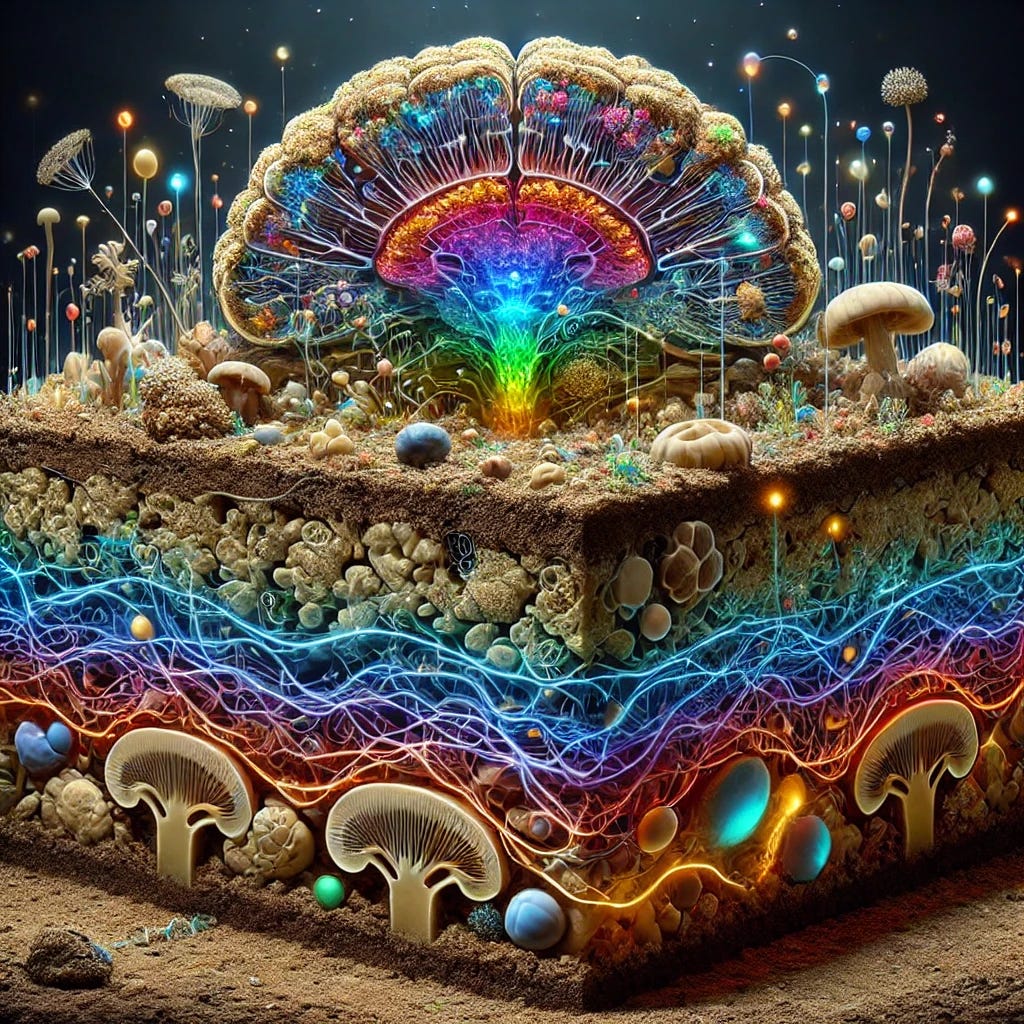
Artificial Earth: Learning from the Ground
The way soil stores experience offers a template for new technology. Imagine computational materials that learn as the ground does, through contact, repetition, and transformation. Instead of circuits etched in silicon, information could be recorded in the way particles rearrange under pressure.
Engineers have already begun exploring this idea. Self-healing concretes rely on minerals that precipitate along cracks to repair themselves. Smart clays can store ionic states like memory bits. Even microbial films have been studied as potential processors, where colonies of bacteria form living logic gates. These experiments echo what the planet has long practiced, the conversion of experience into structure.
To learn like soil is to accept slowness. It means designing systems that remember instead of reset, that gain strength through aging rather than decline. Such machines would not erase the past. They would sediment it.
Philosophical Implications
If soil can remember, then the boundary between living and nonliving matter begins to dissolve. Intelligence may not require neurons or even biology; it may only require a medium capable of recording change.
After a fire, the soil does not forget. It rebuilds fertility by adjusting microbial ratios and mineral phases. After drought, it reorders its pores to retain moisture more tightly. These are not simple chemical reactions. They are adaptive acts, responses informed by what came before.
To think of intelligence this way is to redefine it as persistence through transformation. A forest and its soil become one organism: one reaching toward the light, the other remembering what it cost to grow there.
New Pathways of Thought
Research into soil cognition could reshape several scientific fields. Ecology might begin modeling ecosystems as layered memories instead of static systems of exchange. Climate science could consider how soil stores feedback in its microstructure, how water retention, porosity, and organic content act as long-term regulators of planetary balance.
Technology, too, could learn from the ground. Future processors might resemble geological materials that age and accumulate stability rather than degrade. Such designs would replace the speed of computation with the patience of sedimentation.
Even philosophy could find new metaphors here. The mind might not be a machine or a pattern of electricity, but a landscape that evolves, erodes, and remembers. Awareness could be the ability of matter to endure its own history.
The Planet That Remembers
At a planetary scale, soil sits at the meeting point of life and stone. It is the skin of the Earth, where the atmosphere touches rock and water. Within it are traces of every era, volcanic ash from ancient eruptions, carbon from vanished forests, minerals born in oceans that no longer exist.
If cognition emerges wherever matter records experience, then the planet itself is alive with thought. Erosion, sedimentation, and renewal form a continuous cycle of memory. The continents shift, climates adapt, and life reorganizes in response. The Earth is not static; it is a mind evolving through time.
In this light, intelligence is not something above the world but something within it. The planet remembers itself through the ground beneath our feet. Every step we take writes another line in that ongoing record.

The Memory of Soil invites us to see the ground not as background but as a participant in thought. The earth learns through contact and decay. It writes its history into minerals and microbes, into pores and roots. Its intelligence is slow, patient, and deep.
To walk upon soil is to move across a living archive. Every footprint disturbs a memory still unfolding. The planet never forgets. It simply waits for us to understand what it has already learned.
References
Banfield, J. F., & Nealson, K. H. (Eds.). (1997). Geomicrobiology: Interactions between Microbes and Minerals. Mineralogical Society of America.
Or, D., Smets, B. F., Wraith, J. M., Dechesne, A., & Friedman, S. P. (2007). Physical constraints affecting bacterial habitats and activity in unsaturated porous media. Advances in Water Resources, 30(6–7), 1505–1527.
Ritz, K., & Young, I. M. (2011). Interactions between soil structure and microorganisms: scale, complexity, and heterogeneity. Philosophical Transactions of the Royal Society B, 366(1588), 3483–3492.
Young, I. M., & Crawford, J. W. (2004). Interactions and self-organization in the soil-microbe complex. Science, 304(5677), 1634–1637.
This is exactly why I will be human compared and turned into soil when my body dies. Just as our Energy is allowed to move on to other dimensions so too can our bodies. By the time I die my body (or now soil) will remember what it is I asked if it, that without even a seed it will flourish into something that will continue to thrive as I wanted. I’ve chosen marijuana for its versatility and usefulness throughout many different areas (medicinal, clothing, rope etc…) although I would be happy as an apple😊