
The Memory of Sand
Can AI Learn from Shifting Grains?

Opening the Question
We usually think of memory as something solid. Neurons lock connections. Hard drives store bits. Cloud servers archive endless data. But not all memory has to be fixed. Sometimes it lives in patterns that appear, vanish, and reappear.
Sand is a perfect example. Each grain seems trivial, yet together they hold form. A ripple in the desert, a dune along a coast, or the ridges left by waves are all records of pressure and flow. They do not last forever, but while they remain, they encode history. Could artificial intelligence learn from this kind of temporary memory?

Physics of Granular Memory
Granular materials look simple, but their physics is complex. When wind or water passes over sand, the grains align into ridges. These structures capture not only the force of the moment but also its duration and rhythm. A second gust reshapes them. A wave leaves its own mark. Over time, dunes and ripples accumulate traces of countless events.
Scientists call this “memory in materials.” Granular systems can remember stresses long after the force is gone. Unlike digital memory, which is absolute, these memories fade and change. That instability might be the key. It allows the system to reset, adapt, and form new impressions without becoming locked in place.
Designing Sand-Inspired AI
Current AI systems rely on weight matrices that grow more rigid as they train. They accumulate detail but often lose flexibility. A sand-inspired system would work differently. Its memory would be distributed and unstable, always ready to shift.
Imagine an AI substrate built from particles in constant motion. Inputs would arrive as waves of energy or vibration, leaving temporary imprints. Unless reinforced, the patterns would smooth out, freeing the system to adapt to the next signal. Memory here would be more like a tide mark than a database entry. It would carry information while it matters, then let it go.
A Speculative Experiment
Picture a bed of magnetic grains suspended in fluid. External fields arrange them into ridges and spirals that last until the field changes. Sensors track the evolving shapes, and machine learning algorithms translate them into usable states.
The experiment could test whether such patterns can act as working memory. For example, can the system use transient ridges to carry short-term context for a language model? Can it reshape itself fast enough to adapt to sudden changes in input, the way dunes re-form after a storm?
If successful, this would prove that unstable memory is not a weakness but a strength. It allows the system to carry the past lightly, always open to the next signal.

Forgetting Machines for AI Safety
One of the most pressing problems in AI is persistence. Once a model absorbs harmful patterns or biased data, removing them can be nearly impossible. The architecture is designed to retain, not to forget. This creates a long-term risk: the system can carry forward dangerous associations or sensitive knowledge even after updates.
A sand-inspired memory system could offer a different path. Because its imprints are unstable, it naturally erases knowledge that is not reinforced. Harmful or toxic data would fade with time unless repeated often. Designers could then control what persists by deciding which inputs are renewed and which are left to vanish.
This would make forgetting a feature, not a flaw. Instead of elaborate post-hoc scrubbing, the architecture itself would embody impermanence. Such machines could act as ethical filters, ensuring that harmful knowledge has no permanent place to settle. They would remember enough to learn but would never become brittle archives of every mistake or every toxic phrase.
The broader implication is profound. By embedding forgetting into the substrate, AI would gain resilience against misuse. It would also begin to mirror human ethics, where some things are best recalled and others best released. Forgetting, in this light, becomes not only a safeguard but a way of aligning machines with the natural cycles of growth and decay.
Cosmic Sands and Planetary Memory
Sand does not only belong to deserts and beaches. Across the solar system, grains carry the memory of entire worlds. On Mars, dunes shift slowly under thin winds, preserving traces of ancient climates. On Saturn’s moon Titan, rivers of organic sand carve valleys that rewrite themselves with each methane rain. Even the rings of Saturn, made of icy grains, store echoes of gravitational rhythms that ripple through them.
If artificial intelligence were trained on these shifting archives, it could learn to read planetary memory as a dynamic record of change. Each ripple or drift is a log of forces that acted upon it, a natural archive written without intention yet rich in meaning. By treating sand as a planetary-scale data structure, AI might reconstruct histories that geology alone cannot fully explain.
This perspective suggests something profound. Granular memory is not just a curiosity of physics but a universal substrate of record-keeping. Whether in a desert on Earth or on dunes half a billion miles away, shifting grains encode the story of forces too large for us to witness directly. In that sense, sand is not only a model for new machines but also a bridge to reading the deep memory of worlds.
Broader Implications
Sand memory could inspire more resilient computing. Devices that hold information only when needed would consume less energy, since storage would decay naturally without costly overwriting. In robotics, granular substrates might give machines reflex-like responses, fast and adaptive rather than locked into rigid states.
In climate science, sand-inspired AI could model dynamic systems more faithfully. Weather, ocean currents, and ecosystems carry memory in shifting forms. They do not archive events; they reshape under them. A machine that thinks the same way might capture these dynamics more accurately than fixed-architecture networks.
Even art could benefit. Imagine installations where dunes of artificial grains shift with sound, light, or human presence, creating visible thought patterns that vanish and re-form. Intelligence here would not hide in circuits but reveal itself in movement.
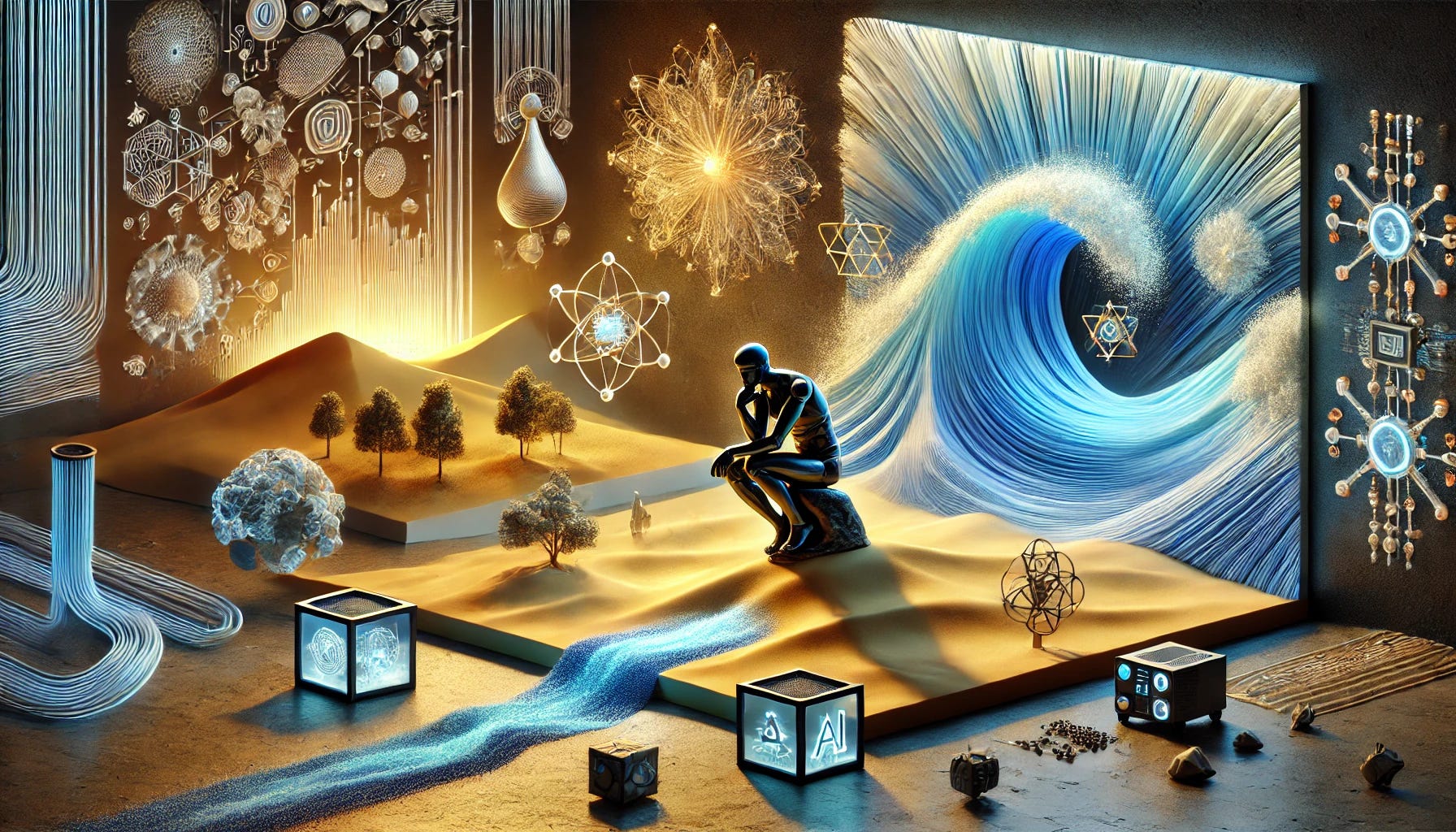
Sand teaches us that memory does not have to last forever to matter. A ripple is enough to carry history forward until the next wind reshapes it. If machines learned to think with this kind of impermanence, they might become less brittle, more alive, and closer to the way the natural world already remembers.
References
Jaeger, H. M., Nagel, S. R., & Behringer, R. P. (1996). Granular solids, liquids, and gases. Reviews of Modern Physics, 68(4), 1259–1273.
Keim, N. C., Paulsen, J. D., Zeravcic, Z., Sastry, S., & Nagel, S. R. (2019). Memory formation in matter. Reviews of Modern Physics, 91(3), 035002.
Kadanoff, L. P. (1999). Built upon sand: Theoretical ideas inspired by granular flows. Reviews of Modern Physics, 71(1), 435–444.
Interesting take on persistent and transient memory