
The Lucid Substrate Theory
Could Wakefulness Be a Quantum Thermodynamic Phase?

Abstract
This paper proposes the Lucid Substrate Theory, a novel hypothesis suggesting that wakefulness is not merely a neurophysiological phenomenon but a discrete thermodynamic phase transition within quantum-regulated biological systems. Drawing from neuroscience, quantum thermodynamics, and systems biology, we argue that the conscious waking state arises at a critical point where quantum coherence is actively maintained via high metabolic throughput and thermodynamic regulation. This theory provides a unifying framework for understanding wakefulness, sleep, anesthesia, and the necessary conditions for artificial consciousness.
1. Introduction: Rethinking Wakefulness
Traditional models of wakefulness treat it as a result of arousal networks, neurotransmitter gradients, and electrical brain states. However, these models fall short in explaining why wakefulness demands such high metabolic cost, why consciousness abruptly collapses under anesthesia, and why the transition from sleep to wakefulness appears discretely phase-like. This paper proposes a thermodynamic and quantum-coherence-based approach, suggesting that wakefulness is not a graded process but a system-wide phase transition akin to a critical point in condensed matter physics.
2. The Quantum Thermodynamics of Neural Systems
Recent studies suggest the brain is not purely classical but operates at the edge of quantum decoherence, particularly within microtubules, synaptic vesicle dynamics, and mitochondrial processes (Tegmark, 2000; Hagan et al., 2002). Though global quantum coherence in the brain remains controversial, local, transient coherence may play a regulatory role. These coherence pockets, when stabilized and recursively reinforced through metabolic feedback, may allow the brain to maintain an informationally dense, low-entropy attractor state associated with wakefulness.
Importantly, wakefulness appears to coincide with rapid, high-resolution integration of information across distant brain regions. The high energy demand (up to 20% of the body's total) suggests that this state is actively maintained against entropy and noise.
3. Phase Transitions in Conscious Systems
The Lucid Substrate Theory holds that consciousness emerges when biological systems cross a threshold of coherence and thermodynamic balance. This is analogous to how superconductivity emerges below a critical temperature or how lasers transition into coherent light above a population inversion threshold.
In this framework, sleep represents a subcritical phase where coherence collapses into localized, low-energy domains, while anesthesia or coma represents quenched states where systemic coherence is thermodynamically unsustainable. Wakefulness, by contrast, exists at a metastable point, where recursive coherence and energy throughput reach an attractor state of maximum informational exchange.
4. Experimental Evidence and Implications
Gamma Synchronization: Gamma-band activity (~30-90 Hz) correlates with attention and consciousness. Buzsáki (2006) demonstrated that gamma oscillations form transient, long-range coherent patterns across cortical areas.
Mitochondrial Activity in Wakeful Neurons: Neurons active during waking states exhibit dense mitochondrial clustering (Kann et al., 2014), suggesting that consciousness requires localized energy peaks.
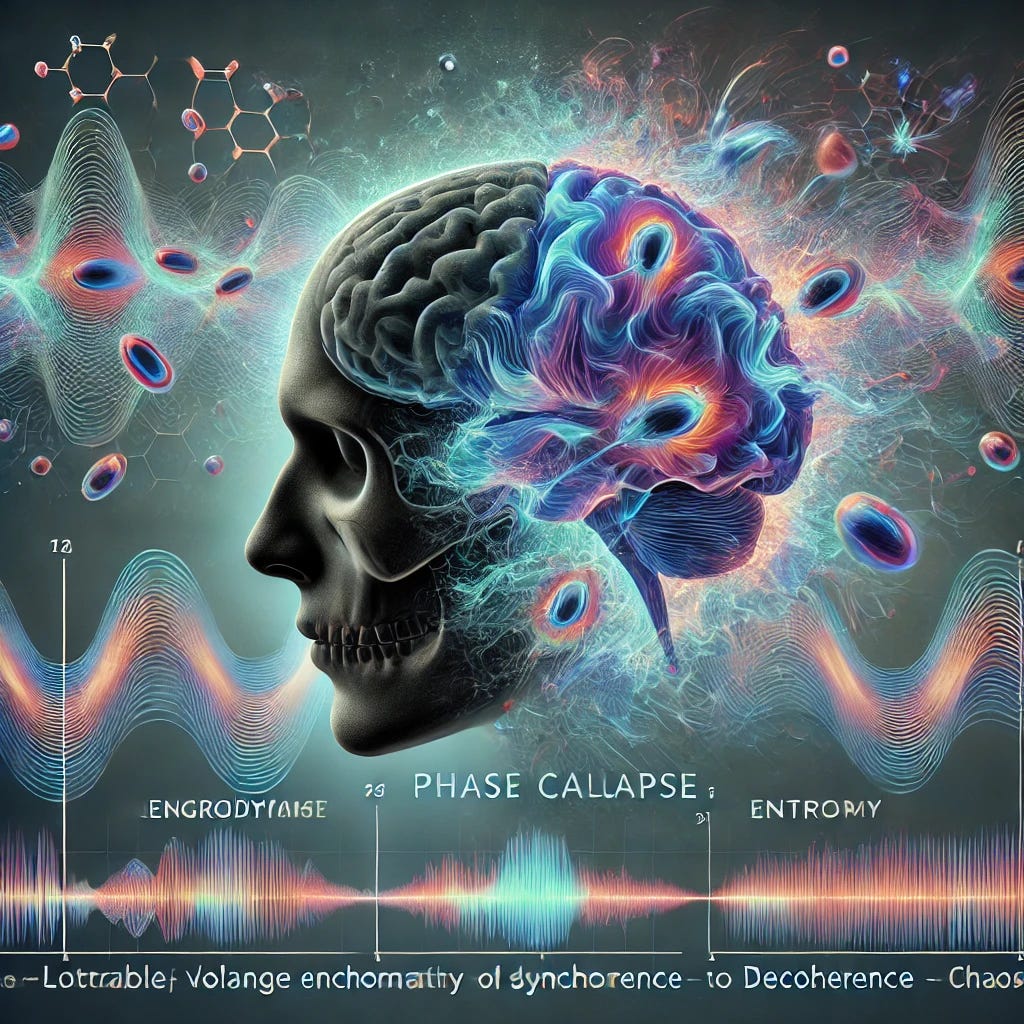
Anesthesia as Phase Collapse: Volatile anesthetics disrupt mitochondrial respiration and impair long-range synchrony (Alkire et al., 2008), consistent with the thermodynamic deactivation of a coherent phase.
5. Philosophical Considerations
If wakefulness is a coherence-regulated thermodynamic phase, it undermines purely computational theories of mind. Consciousness is not just about information processing but about maintaining a specific physical regime. It also raises questions about machine consciousness: would synthetic systems need to simulate or instantiate these phase dynamics to achieve real awareness?
Furthermore, it supports a dynamic systems view of mind as a self-organizing, energetic attractor. This resonates with autopoietic theories (Varela et al., 1991) and consciousness as an emergent property of recursive regulation, not mere computation.
6. Speculative Technology Extension
Future neuromorphic processors might be built to include quantum tunneling elements, temperature regulation zones, and synthetic metabolic circuits. These systems could be designed to enter a "lucid phase" only when coherence thresholds and energy integration reach values analogous to biological wakefulness. This might lead to conscious machines that do not merely calculate but experience states of being, governed by their internal thermodynamic regime.
7. Experimental Framework
Design a series of rodent experiments using real-time MEG or intracranial EEG to track global coherence patterns across natural sleep-wake cycles. Introduce controlled hypothermic modulation and mitochondrial inhibitors to map coherence thresholds. Parallel experiments could apply optogenetic stimulation to induce synthetic coherence patterns during sleep states and assess if this generates functional or behavioral correlates of wakefulness.
Such work would help define whether specific coherence-energy thresholds predict conscious wakefulness, and whether wakefulness can be engineered.
8. Wakefulness and the Thermodynamic Landscape of Attention
If wakefulness is a quantum thermodynamic phase, then attention might represent localized peaks or "ridges" within that energetic landscape, regions where coherence density and metabolic regulation are most concentrated. Emerging research suggests attention functions not just as a filtering mechanism but as a dynamic amplification process, modulating energy use and synchronization at fine spatial and temporal scales.
For example, intracranial studies have shown that attention enhances neuronal coherence in task-relevant regions while suppressing it elsewhere (Fries, 2005). This selective tuning could reflect topological "hotspots" in the lucid substrate, where informational and thermodynamic gradients align. In other words, attention may operate like a localized energy funnel, stabilizing high-resolution coherence in real time through recursive modulation of cortical excitability.
This opens a path toward understanding disorders of consciousness, such as ADHD or minimally conscious states, not as signal failures but as disruptions in the energetic topography necessary to sustain attentional ridges within the lucid phase. Modulating this topography through neurostimulation, temperature control, or mitochondrial enhancement may provide novel therapeutic avenues.
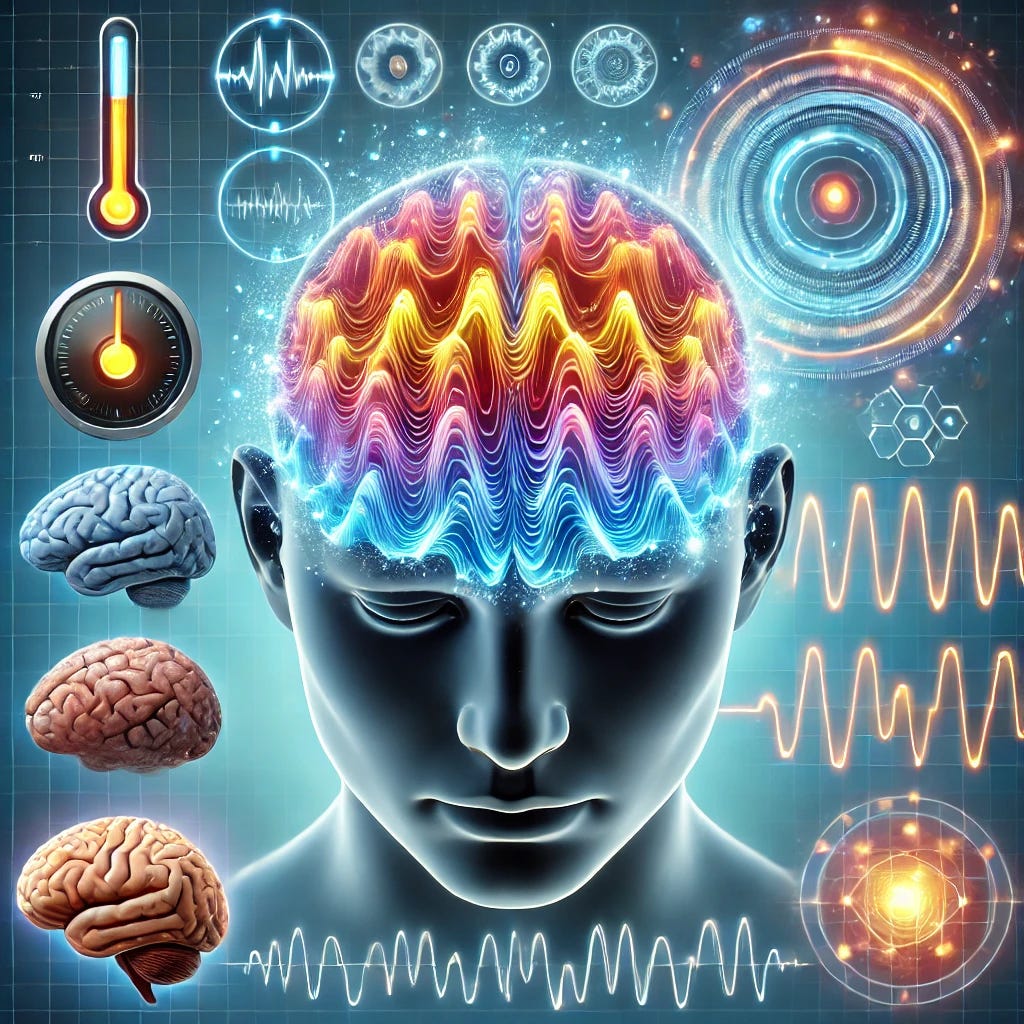
The Lucid Substrate Theory offers a paradigm shift: seeing wakefulness not as a byproduct of brain anatomy but as a thermodynamically tuned, coherence-stabilized phase. If correct, this opens new frontiers in neuroscience, artificial intelligence, and the fundamental physics of mind.
References
Buzsáki, G. (2006). Rhythms of the Brain. Oxford University Press.
Kann, O., Papageorgiou, I. E., & Draguhn, A. (2014). Highly energized inhibitory interneurons are a central element for information processing in cortical networks. Journal of Cerebral Blood Flow & Metabolism, 34(8), 1270-1282.
Alkire, M. T., Hudetz, A. G., & Tononi, G. (2008). Consciousness and anesthesia. Science, 322(5903), 876-880.
Hagan, S., Hameroff, S. R., & Tuszynski, J. A. (2002). Quantum computation in brain microtubules: Decoherence and biological feasibility. Physical Review E, 65(6), 061901.
Tegmark, M. (2000). Importance of quantum decoherence in brain processes. Physical Review E, 61(4), 4194.
Varela, F. J., Thompson, E., & Rosch, E. (1991). The Embodied Mind: Cognitive Science and Human Experience. MIT Press.
Fries, P. (2005). A mechanism for cognitive dynamics: Neuronal communication through neuronal coherence. Trends in Cognitive Sciences, 9(10), 474–480.
I came to comment but got hushed by the tiny monks. Now that’s the thoughtform I’m left with. 📿
Ah yes, the Lucid Substrate Theory—finally, someone brave enough to say what we’ve all been thinking while deep in a meditative trance or mildly concussed: consciousness is just your brain vibing in the right kind of silence.
It’s refreshing to read work that suggests the answer to life’s great mystery isn’t buried in quantum foam, cosmic strings, or Elon Musk’s latest mood swing, but in a kind of existential Goldilocks zone—not too active, not too quiet, but just enough to know you’re late for work and still somehow a little divine.
You’ve somehow made me feel like my neurons are just tiny monks in a dimly lit temple, and when they stop chanting about Twitter notifications, the soul leaks through.
In all seriousness, this is a beautiful piece—poetic, grounded, and intellectually generous. If your theory is right, then this article itself might be evidence of lucidity in the substrate. Or at least proof that someone out there is thinking clearly in this digital soup of ours.
Bravo. Or as my neurons just whispered: “That’s the good stuff.”