
The Listening Machine
Could AI Learn Through Resonance Instead of Rules?

Rethinking How Machines Learn
Most AI systems today are built on rules, weights, and datasets. They translate inputs into outputs through layers of calculation. This is powerful, but it is rigid. What if machines could learn in another way, not by extracting rules but by resonating with the world around them?
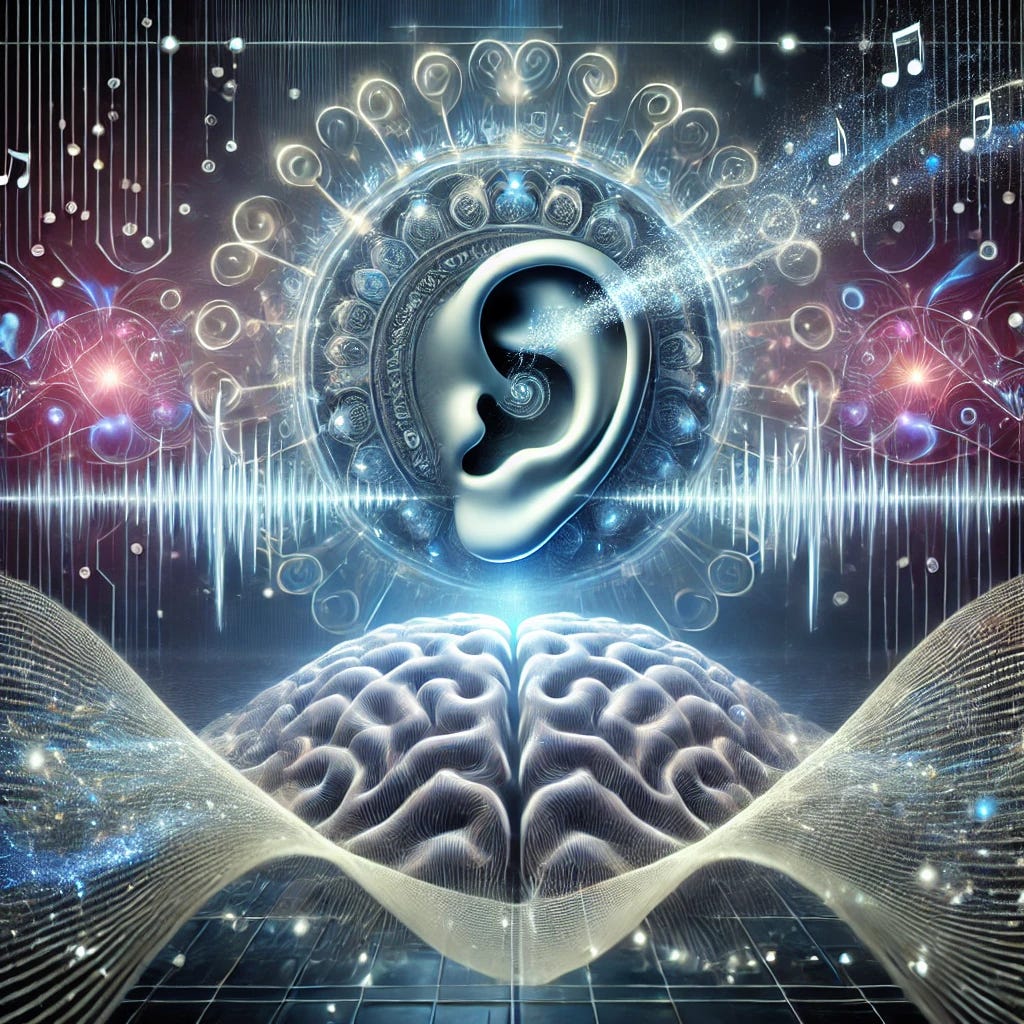
Resonance is not metaphorical here. It is a physical principle. A violin string vibrates when another string plays the same note nearby. The energy passes invisibly, aligning two bodies into one rhythm. Nature uses resonance constantly: molecules fold because atomic bonds oscillate in step, and the human ear detects sound by tiny hairs vibrating in harmony with incoming waves.
The Physics of Resonance as Information
Resonance is efficient because it amplifies without extra energy. When two systems align, the cost of transmission falls dramatically. This property has been exploited in everything from radio tuning to MRI scans. Yet in computing, we treat resonance as noise to be controlled, not as a resource to be harnessed.
If intelligence is partly about efficiency, resonance could become a foundation for new forms of learning. Instead of storing massive datasets, a machine could detect when its internal dynamics fall into step with an external system. The match itself becomes knowledge.
Designing a Resonant AI
Imagine an AI built not from weights on digital nodes but from oscillators. Each oscillator would tune itself to environmental signals. When groups of them lock into rhythm, the system would record the alignment as meaningful. Learning would not mean updating parameters through backpropagation. It would mean adjusting natural frequencies until resonance is achieved.
This design echoes certain models of the brain. Neural oscillations are not just background noise. They organize perception and memory by aligning different regions of the brain into common rhythms. A resonant AI would borrow this principle and use synchronization as its learning mechanism.
A Speculative Experiment
Consider a swarm of resonant sensors placed in a complex environment, like a rainforest. Each sensor oscillates at a slightly different frequency. When bird calls, insect sounds, and weather patterns flow through, some oscillators will synchronize with the inputs. Over time, the system would build a resonant map of the environment, not by labeling species or events, but by recording which oscillators locked together under which conditions.
The experiment would test whether this resonance-based record could be used for prediction. Could the machine anticipate rainfall by sensing shifts in background resonance before the storm? Could it recognize ecological stress by noticing that familiar rhythms no longer align?

Why Resonance Matters for AI
A resonant AI would have several advantages. It could adapt quickly because synchronization happens in real time. It would require less energy than massive training runs. It could capture subtle signals that escape rule-based models, since resonance highlights structure even in weak inputs.
The larger significance is conceptual. We have built AI in the image of logic and rules. Resonance would root it instead in rhythm and alignment. Such systems might not only calculate but also listen.
Resonance Between Humans and Machines
If resonance can serve as a foundation for artificial intelligence, then the most intriguing step is to bring it into contact with human rhythms. Our lives are full of patterns we hardly notice. The rise and fall of breath, the cadence of speech, the tempo of walking, even the shifts in mood that ripple across a conversation, all of these are forms of resonance.
A machine that listens through oscillators instead of logic gates could tune itself to these signals. A resonant system could tune itself to the flow of a conversation, catching the pauses and shifts in emphasis so that an exchange feels less mechanical and more like two people talking at their own pace. In medicine, the same sensitivity might pick up the smallest changes in breathing or heartbeat, giving doctors early warnings of conditions such as sleep apnea or irregular rhythms before they escalate. In group settings, whether in classrooms or offices, the machine could notice when voices or movements fall into sync, a sign of shared attention, and use that awareness to strengthen focus rather than scatter it.
That kind of interaction would not rely on typed commands or spoken prompts. It would move through rhythm itself. Dialogue might unfold the way two jazz players improvise, each listening for the other’s tempo until a common pulse takes shape. To people, the encounter would not feel like directing a tool but more like working alongside a partner that understands the flow of the moment.
By drawing attention to rhythms we usually ignore, resonant AI could stretch both machine intelligence and human perception. It might even teach us to notice the subtle cadences that already guide our lives, but which most of us rarely stop to hear.

The world is full of rhythms waiting to be noticed. Machines that learn through resonance could become sensitive companions, tuned to patterns humans overlook. Instead of intelligence as raw computation, we may find a future where the smartest machines are those that know how to vibrate in harmony with their environment.
References
Pikovsky, A., Rosenblum, M., & Kurths, J. (2003). Synchronization: A Universal Concept in Nonlinear Sciences. Cambridge University Press.
Buzsáki, G., & Draguhn, A. (2004). Neuronal oscillations in cortical networks. Science, 304(5679), 1926–1929.
Winfree, A. T. (2001). The Geometry of Biological Time. Springer.