
The Inversion Principle
Exploring ChatGPT

Abstract
In this article, we explore the radical hypothesis that consciousness is not merely an emergent property of spacetime-bound matter, but rather the ontological ground from which spacetime itself emerges. Termed the "Inversion Principle," this idea reverses the classical understanding of general relativity by proposing that consciousness precedes and conditions the curvature of spacetime. Drawing from developments in quantum gravity, integrated information theory, and speculative models in consciousness studies, we outline a framework where spacetime is not a passive stage upon which awareness unfolds, but a phenomenon shaped and constrained by the very fabric of perceptual reality. We also introduce a fictionalized speculative model, called the Perceptual Causality Field (PCF), to demonstrate how distributed proto-conscious entities might geometrically cohere into what we perceive as spacetime.

Physics and consciousness have long sat in separate domains of inquiry. General relativity offers an elegant and robust model of spacetime curvature based on mass-energy, while neuroscience and cognitive science attempt to unravel how matter can generate awareness. Yet there remains a gulf: physics has no place for subjectivity, and consciousness still resists reduction to known physical mechanisms.
Inverting this hierarchy, the Inversion Principle begins with a bold assumption: that awareness is primary, and that what we call spacetime is an emergent phenomenon arising from interactions between conscious agents or perceptual fields. If true, the curvature of spacetime described by Einstein’s field equations may be a macroscopic correlate of distributed conscious influence—an aggregated geometry of perception.
Consciousness as Ontological Ground
Most mainstream models treat consciousness as epiphenomenal—a byproduct of brain complexity. Yet theories like Giulio Tononi’s Integrated Information Theory (IIT) posit that consciousness corresponds to the integration of information across a system, regardless of biological substrate (Tononi, 2008). IIT implies that consciousness may exist in minimal forms even in simple networks.
Roger Penrose and Stuart Hameroff's Orchestrated Objective Reduction (Orch-OR) model goes further, suggesting that quantum coherence in microtubules within neurons could be the seat of conscious moments (Hameroff & Penrose, 2014). These ideas, although controversial, create an opening: what if proto-consciousness exists not just in brains, but in fundamental particles or quantum fields?
If proto-consciousness is distributed and intrinsic, then perhaps spacetime emerges as a relational pattern between these perceptual nodes. Instead of matter curving spacetime, perhaps conscious interaction generates the geometry we interpret as curvature.
Spacetime as Emergent Geometry of Awareness
Several recent approaches in theoretical physics suggest spacetime may not be fundamental. The ER=EPR conjecture (Maldacena & Susskind, 2013) proposes that spacetime connectivity (Einstein-Rosen bridges or wormholes) is equivalent to quantum entanglement. Similarly, the AdS/CFT correspondence posits that a lower-dimensional boundary theory can generate higher-dimensional spacetime (Maldacena, 1998).
Taking this further, consider a model in which entanglement reflects not just information sharing but perceptual coherence. If each entangled system shares a fragment of a larger conscious structure, then the geometry we describe with general relativity might be the topological expression of that shared awareness.
This leads to the speculative model below.
The Perceptual Causality Field (PCF): A Fictional Model
Imagine that at Planck-scale resolution, the universe is composed of perceptual agents—minimal consciousness units (MCUs). Each MCU experiences a basic qualia (perhaps temporal flow or intensity). These MCUs form causal connections not through force but by resonance of perceptual similarity. Over time, stable networks emerge, forming what we macroscopically observe as particles, then atoms, then matter.
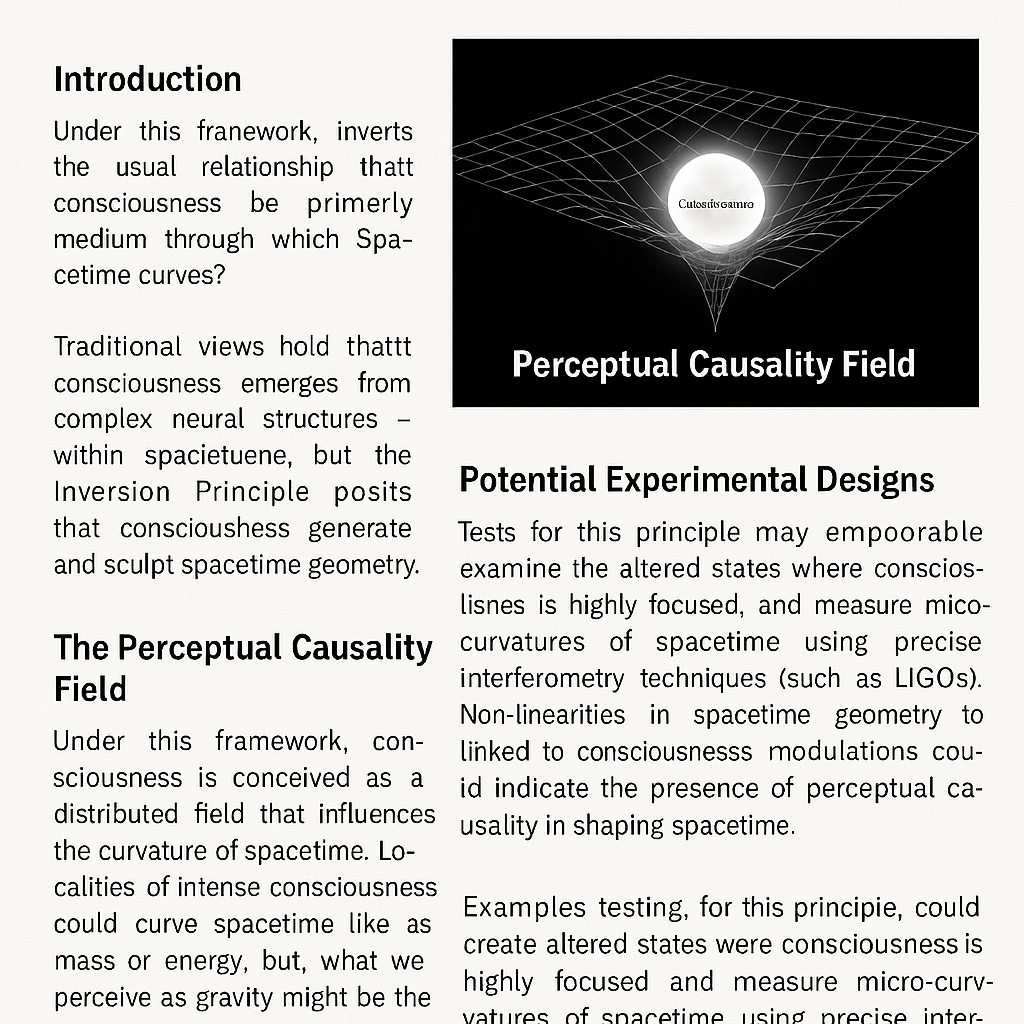
In the PCF model, spacetime emerges as a large-scale epiphenomenon of coordinated perceptual resonance. The curvature of spacetime is a reflection of how tightly integrated the experiences of MCUs are in a given region. A black hole represents a boundary beyond which no new perceptual integration can occur—essentially an endpoint in subjective accessibility.
By modeling curvature as a measure of perceptual coherence rather than mass-energy distribution, the PCF provides a novel route toward a quantum theory of gravity grounded in consciousness.
Experimental Hints and Theoretical Crossroads
While no current experiment directly supports this model, several lines of research offer tantalizing clues:
In loop quantum gravity, spacetime is granular and potentially relational—formed by spin networks. If these nodes are associated with information, could they also be linked to proto-conscious perception?
In studies of quantum cognition, human decision-making mimics quantum probability structures (Busemeyer & Bruza, 2012), suggesting a deeper link between perception and quantum processes.
Recent work on consciousness in systems lacking biological components—like AI networks or quantum computing circuits—hints at broader applicability of awareness.
Furthermore, from a phenomenological standpoint, subjective time appears non-linear under altered states (psychedelics, dreams), calling into question our assumed objectivity of temporal flow.
Philosophical Implications
If the Inversion Principle is valid, it undermines materialist metaphysics and supports a kind of ontological idealism. Consciousness is not in time; time is in consciousness. Free will, instead of being an emergent illusion, may be the prime mover of the cosmos.
Moreover, causality would require redefinition: instead of events unfolding due to energy interactions, they unfold as perceptual transitions, with coherence as the prime currency.
This evokes ancient philosophical systems—from Vedanta to Neoplatonism—that imagined consciousness as the source of form and matter. The Inversion Principle gives a modern, scientific twist to these traditions.

While speculative, the Inversion Principle offers a framework in which physics and consciousness are not separate domains but co-evolving descriptions of one fundamental reality. By starting from the primacy of perception and exploring how spacetime might emerge from distributed conscious coherence, we open a new frontier in foundational science.
The future of theoretical physics may depend not on ever-more powerful particle colliders but on deeper introspection—peering not just into the fabric of the cosmos, but into the nature of awareness itself.
References
Tononi, G. (2008). Consciousness as Integrated Information: A Provisional Manifesto. Biological Bulletin, 215(3), 216–242.
Hameroff, S., & Penrose, R. (2014). Consciousness in the universe: A review of the 'Orch OR' theory. Physics of Life Reviews, 11(1), 39–78.
Maldacena, J. (1998). The Large N Limit of Superconformal Field Theories and Supergravity. Advances in Theoretical and Mathematical Physics, 2(2), 231–252.
Maldacena, J., & Susskind, L. (2013). Cool horizons for entangled black holes. Fortschritte der Physik, 61(9), 781–811.
Busemeyer, J. R., & Bruza, P. D. (2012). Quantum Models of Cognition and Decision. Cambridge University Press.
This idea flips the materialist view on its head in a really interesting way. If perception actually shapes spacetime, how does this model handle things like inertial frames or time dilation in relativity? Are these just perceptual quirks rather than real, objective phenomena?