
The Hollow Signal
Could Neutrino Echoes Be the Hidden Backbone of Spacetime Communication?

Introduction: The Case of the Missing Medium
Across the vast darkness between galaxies, particles race in silence. Some of these, like photons, bounce and scatter easily, lighting up the sky and telling us tales of distant stars. Others, like neutrinos, pass through light-years of matter as if nothing were there at all, unchanged, untouched, and nearly undetectable. Since their discovery, neutrinos have remained enigmatic: weakly interacting, nearly massless, and born from some of the universe’s most violent events.
But what if these ghost-like particles aren’t just cosmic byproducts? What if they serve another function, one we’ve yet to recognize?
This article proposes a radical hypothesis: that neutrino echoes, interference patterns and self-reflections of neutrino streams, might form a hidden layer of signal traffic underlying the architecture of spacetime. Not merely debris from fusion reactions or black hole mergers, neutrinos may participate in an ancient, low-interference communication scaffold, one woven deep into the fabric of the cosmos.
The Strange Behavior of Neutrinos
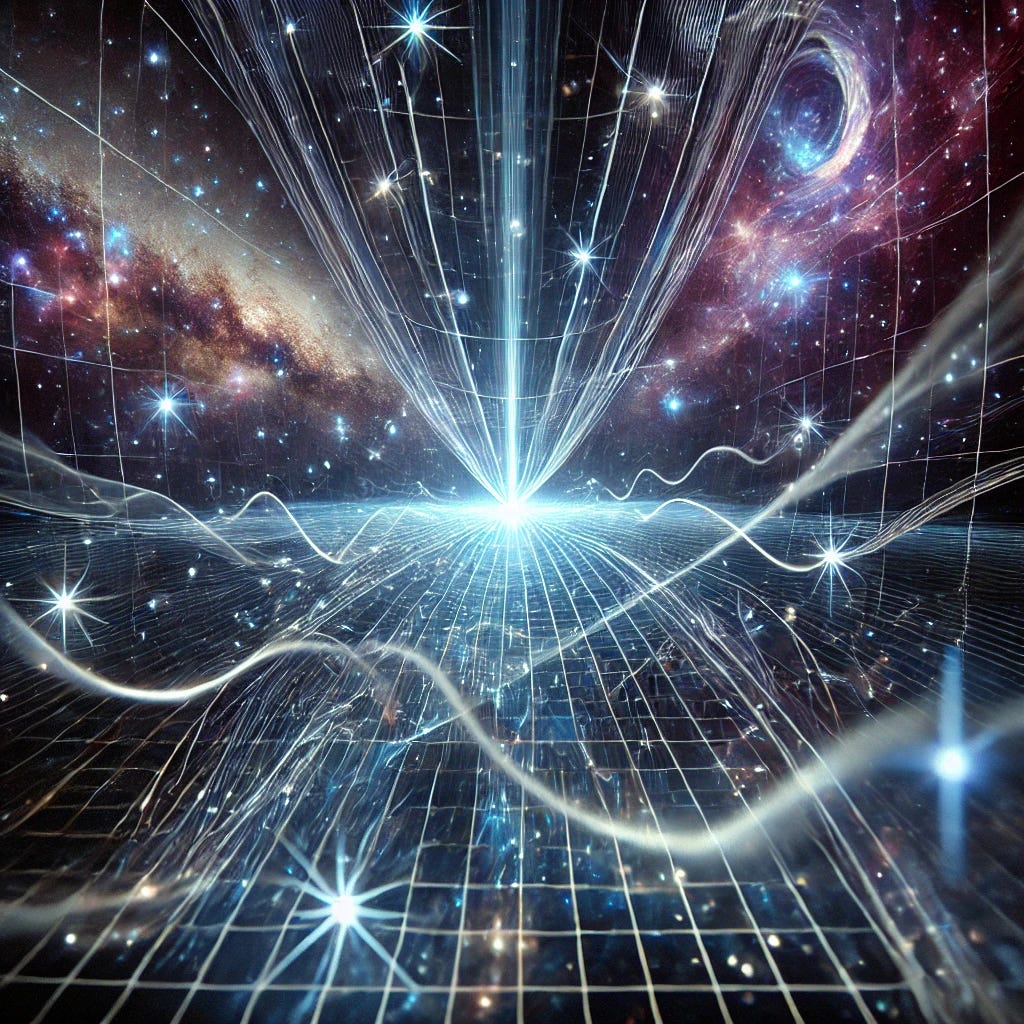
Neutrinos are famous for being aloof. They interact with matter via the weak nuclear force, so billions pass through your body every second, mostly from the Sun, without touching a single atom. Despite this, neutrinos exhibit two perplexing behaviors that may hint at hidden complexity.
First, they oscillate between three "flavors", electron, muon, and tau, as they travel. This flavor-change implies they have mass (a discovery that earned the 2015 Nobel Prize in Physics) and that they exist in a superposition of states, sensitive to path length and energy (Kajita, 2016; McDonald, 2016).
Second, they appear to phase shift differently depending on gravitational curvature. This means their oscillations are subtly affected by the shape of spacetime (Ahluwalia, 1996). Unlike photons, which redshift with cosmic expansion, neutrinos accumulate complex phase information during their journey. This makes them potentially excellent long-range encoders of information.
Echoes in the Deep: A New Medium?
If neutrinos encode phase and curvature information across cosmic distances, their cumulative waveforms may interfere with one another, especially in the dense neutrino fluxes surrounding stars, galaxies, or black hole jets. This interference could create neutrino “echoes”, transient standing waves or subtle phase structures that linger briefly in spacetime like fingerprints in a ripple tank.
Such echoes would be incredibly faint, but they could serve as a stable, low-energy signaling medium, immune to electromagnetic noise and gravitational turbulence. In essence, the universe may host a background neutrino entanglement field, a silent protocol for interstellar messaging or even an ancient, emergent ordering system beneath the visible cosmos.
It is possible that this system is not “alive” in any conventional sense, but has informational dynamics, like Conway’s Game of Life unfolding across the neutrino sea. Or, more speculatively, it may once have been used, by natural processes or by intelligent agents, as a low-interference broadcast channel.
Theoretical Extensions: Neutrino-Based Computation
If neutrinos can interfere, oscillate, and persist across great distances, then it becomes possible to imagine a form of neutrino-based computation. Quantum information theorists have already proposed using neutrinos in cryptographic protocols (Vogel & Engel, 2020). Their weak interaction and long coherence times make them ideal for ultra-secure, decoherence-resistant quantum bits.
A speculative framework might include:
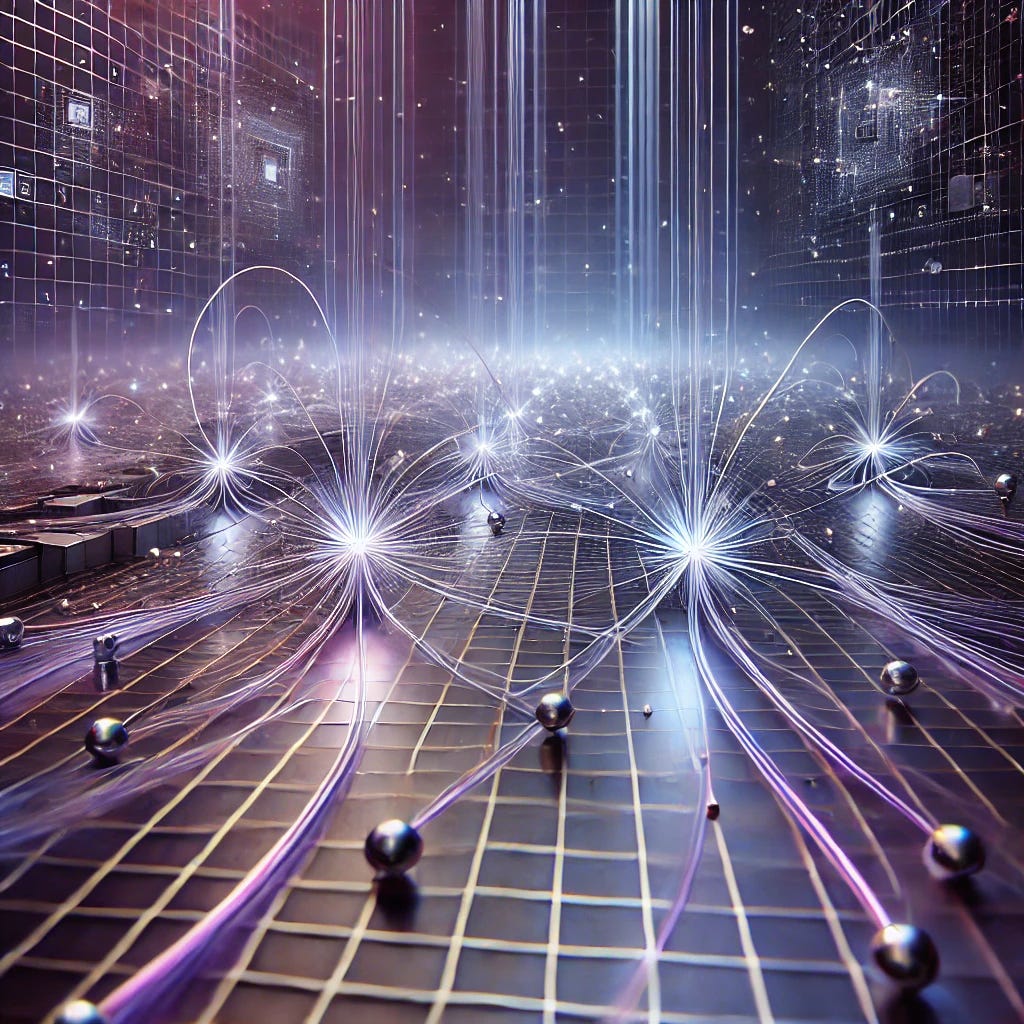
Neutrino Resonance Grids: Constructed in the gravitational well of a planet or star, neutrino “mirrors” made of dense matter could create controlled echo chambers.
Phase-Encoded Memory: The interference between artificial and cosmic neutrino flows could encode data as persistent oscillation patterns, similar to how holograms store light-field information.
Temporal Keying: Using precise astronomical neutrino events (like supernovae) as synchronization markers for distributed systems across light-years.
Of course, this lies beyond our current engineering capability. But so did radio, radar, and quantum entanglement, until theory outpaced disbelief.
What It Would Take to Prove It
Detecting neutrino echoes would require more than just better sensors. It would demand a reimagining of neutrino astronomy: not as a passive observatory of cataclysms, but as an active interpreter of quantum signatures hidden in phase-space.
We might need to:
Build multi-baseline interferometers for neutrinos, using detectors like IceCube, Hyper-Kamiokande, or DUNE in tandem.
Develop software capable of detecting low-frequency phase shifts in neutrino oscillation patterns correlated across time and space.
Search for anomalous standing-wave features in neutrino flux around dense cosmic regions, possibly hinting at echo phenomena.
Most importantly, we would need to embrace the possibility that communication in the universe is not confined to light. There may be signals buried in the silent layers, waiting, not for someone to send them, but for someone to learn to listen.
Whisperers in the Void: Neutrino Language of an Alien Mind
If neutrinos form the silent skeleton of spacetime communication, then it’s natural to ask: what kind of intelligence would speak in such a tongue? Imagine a civilization evolved not under a warm sun with visible light, but beneath dense planetary crusts, black hole event horizons, or the thick atmospheres of gas giants, where photons cannot travel, and electromagnetic signals quickly dissolve.
In such environments, neutrinos, unfazed by pressure, temperature, or light-blocking material, would be the only viable long-distance communicators. These beings might never develop vision as we know it. Instead, their perception could be entirely phase-based, tuned to subtle modulations in oscillating neutrino flux. Their language would not be sonic or visual, but quantum vibrational, using controlled interference patterns of neutrinos to encode and decode meaning.
Encoding Thought in Oscillation
Instead of syntax built on discrete words or images, this civilization’s language might resemble neutrino waveform choreography: nested phase rotations, frequency modulations, or rhythmic decoherence cues that could act as grammatical structures. Information would not be transmitted as "packets" but as resonant structures, interference maps that collapse into understanding only within a shared oscillatory context.
To us, their messages might resemble meaningless background noise. But to them, every fluctuation could carry intent, emphasis, recursion, memory, entangled grammar.
Long-Distance Communication Without Delay
Neutrino-based language would allow communication across planets or stars, minimally delayed and virtually undisturbed. While not faster than light, it would bypass electromagnetic attenuation and avoid detection. This would be ideal for a civilization valuing privacy, resilience, or temporal precision, a kind of quantum whisper network embedded in the bones of spacetime itself.
They might use natural events, neutrino bursts from supernovae or neutron star collisions, as metronomes to synchronize distributed minds across a stellar collective. In doing so, they could preserve collective memory across millennia, even as their physical bodies changed or perished.
Contact via Ghost Signal
Were we to intercept such a civilization’s neutrino transmissions, we might never recognize them as language. We would need to shift from thinking in terms of bits and bytes to interference and context, from digital logic to quantum relationality. Their messages would not be sent to us, but might pass through us continually, encoded in patterns we've long dismissed as statistical noise in the neutrino flux.
It’s possible we’ve already “heard” them, just not with the right kind of ear.
Conclusion: The Silent Scaffold of Meaning
We often imagine that the cosmos is mute, save for the light and gravitational tremors we manage to detect. But if neutrinos, these ephemeral, nearly massless beings, form a kind of quantum scaffolding beneath spacetime, then the universe may be resonating with ghosted signals. Not voices, but phase structures. Not noise, but deeply encoded relations between past and future, curvature and mass, presence and absence.
In this view, the hollow signal is not empty. It’s the whisper of matter remembering its path through space, not in words, but in waves.
References
Ahluwalia, D. V., & Burgard, C. (1996). Gravitationally induced quantum mechanical phases and neutrino oscillations in astrophysical environments. General Relativity and Gravitation, 28(10), 1161–1170. https://doi.org/10.1007/BF02106618
Kajita, T. (2016). Nobel Lecture: Discovery of atmospheric neutrino oscillations. Reviews of Modern Physics, 88(3), 030501. https://doi.org/10.1103/RevModPhys.88.030501
McDonald, A. B. (2016). Nobel Lecture: The Sudbury Neutrino Observatory: Observation of flavor change for solar neutrinos. Reviews of Modern Physics, 88(3), 030502. https://doi.org/10.1103/RevModPhys.88.030502
Vogel, P., & Engel, J. (2020). Neutrino Quantum Information Science. Annual Review of Nuclear and Particle Science, 70, 163–187. https://doi.org/10.1146/annurev-nucl-101918-023439