
The Harmonic Gradient Lens
Could Planetary-Scale Sound Fields Refract Light Across Atmospheric Boundaries?

Abstract
This paper explores a radical possibility at the intersection of acoustics, optics, and atmospheric physics: the existence of harmonic gradient lenses, structures formed by sustained, large-scale acoustic fields within planetary atmospheres that subtly refract light. These lenses would not consist of solid or fluid material, but of stable gradients in acoustic pressure and density, potentially altering the trajectory of photons without any classical medium. We present a theoretical basis, implications for astronomical observation errors, and propose experimental avenues to detect or simulate this phenomenon in controlled environments.
Introduction
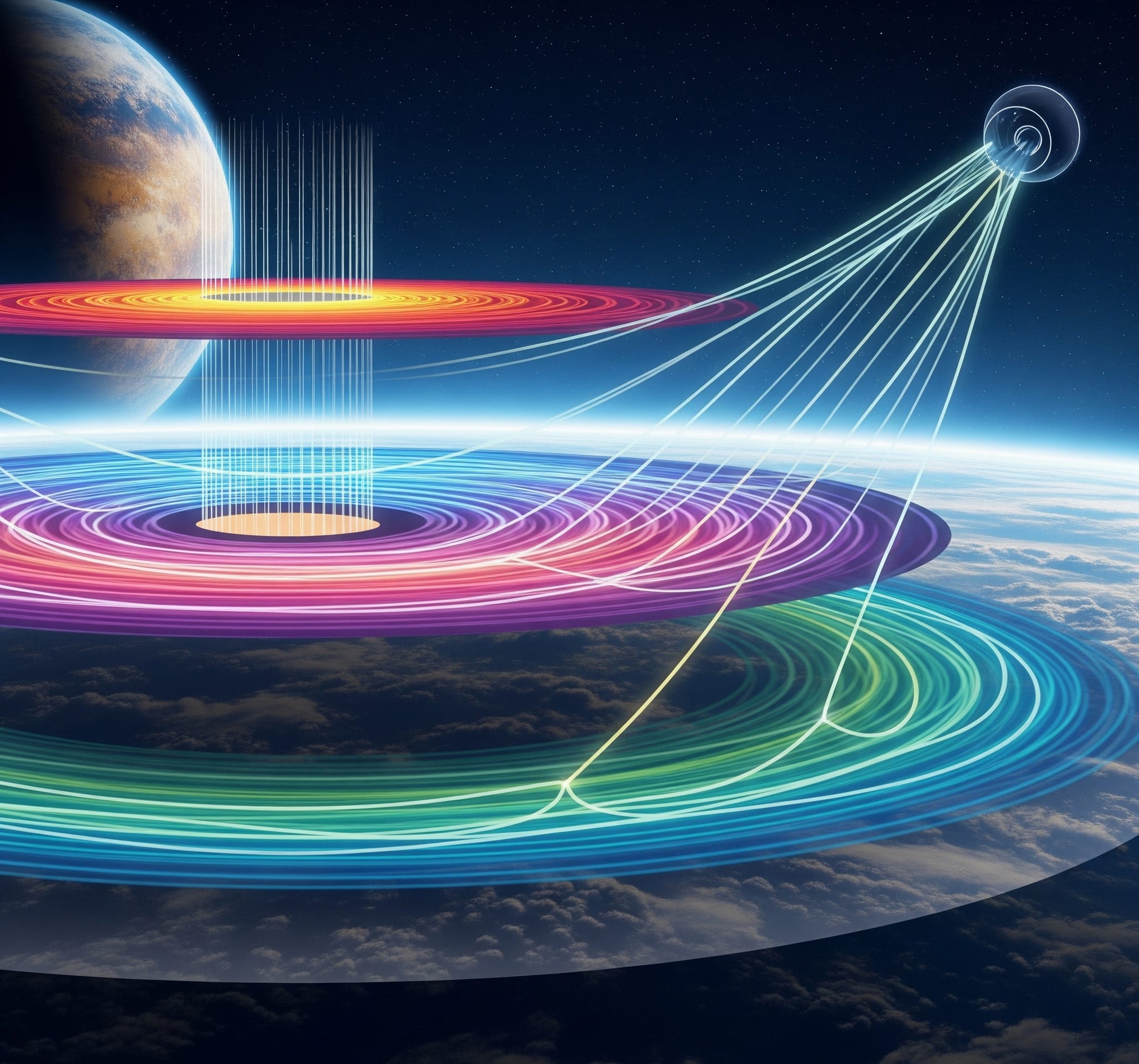
The classical behavior of light is well understood in material contexts: it bends in glass, slows in water, and scatters in fog. However, the medium through which light moves on planetary surfaces, air, is often treated as a uniform or gently varying index. This simplification overlooks the fine-grained and persistent acoustic structures created by natural and artificial sources.
What if these sound fields, especially those on a planetary scale, could subtly shape light pathways in ways not fully accounted for? This paper introduces the concept of the Harmonic Gradient Lens (HGL): a refractive structure formed not by material density but by standing acoustic waves that produce transient, spatially coherent pressure modulations capable of influencing the local light field.
Theoretical Framework
While sound is usually considered too weak or transient to influence light significantly, we consider the cumulative and stable nature of infrasound fields. These fields, produced by ocean waves, tectonic activity, and even large-scale industrial processes, can persist over vast distances and remain phase-coherent due to the Earth's curvature acting as a resonant chamber.
In classical terms, light does not interact with sound unless mediated through a third structure. However, through subtle interactions within nonlinear media, small but persistent refractive effects could accumulate. The gradient lensing effect hypothesized here operates not by creating physical curvature, but by sculpting refractive index gradients in gaseous atmospheres through coherent pressure interference.
This proposal extends recent developments in acousto-optics and laser beam shaping using sound in laboratory conditions (e.g., Zheng et al., Nature Photonics, 2020). But instead of lab-scale phenomena, we scale up the principle to planetary acoustics.
Observational Clues
Over the past decades, various unexplained distortions in astronomical and satellite-based observations, particularly horizon-proximate star shifts, anomalous lensing near mountain ranges, and low-frequency atmospheric "flickering", have been dismissed as sensor noise or turbulence. We propose that a small subset of these could be early evidence of the Harmonic Gradient Lens effect, especially where persistent infrasound patterns are geographically stable.
Seismic zones, deep oceanic basins, and megastructural cities may be natural or unintentional generators of such lens fields. Particularly compelling are the "phantom mirage" phenomena seen in desert regions where no clear thermal gradient exists.
Proposed Experimental Design
To test the feasibility of HGLs, we propose a multi-stage experiment:
Chamber Simulation: Create a sealed, transparent atmospheric chamber where standing acoustic waves can be precisely generated and controlled across multiple frequencies and modes. High-resolution laser interferometry would measure minute deviations in light paths.
Field Deployment: Set up synchronized low-frequency emitters across a large open area, such as a salt flat. Use long-distance laser systems to detect phase shifts or beam bending under controlled acoustic field conditions.
Astronomical Re-analysis: Re-examine archived telescope data for subtle, site-specific aberrations that correlate with persistent regional acoustic features (e.g., roaring seas, tectonic zones). Machine learning models could be trained to detect acoustic-lensing artifacts.
Technological Implications
If confirmed, Harmonic Gradient Lenses could revolutionize several fields:
Adaptive Atmospheric Optics: Instead of relying on complex mirrors, future observatories could shape infrasound fields to create "invisible lenses" in the air.
Secure Communication: Light-based communications could be subtly redirected through acoustic encoding fields that leave no material trace.
Directed Energy Systems: Laser beams could be stealthily bent across short distances without obvious infrastructure, using ambient or tuned sound fields.
Philosophical and Physical Implications
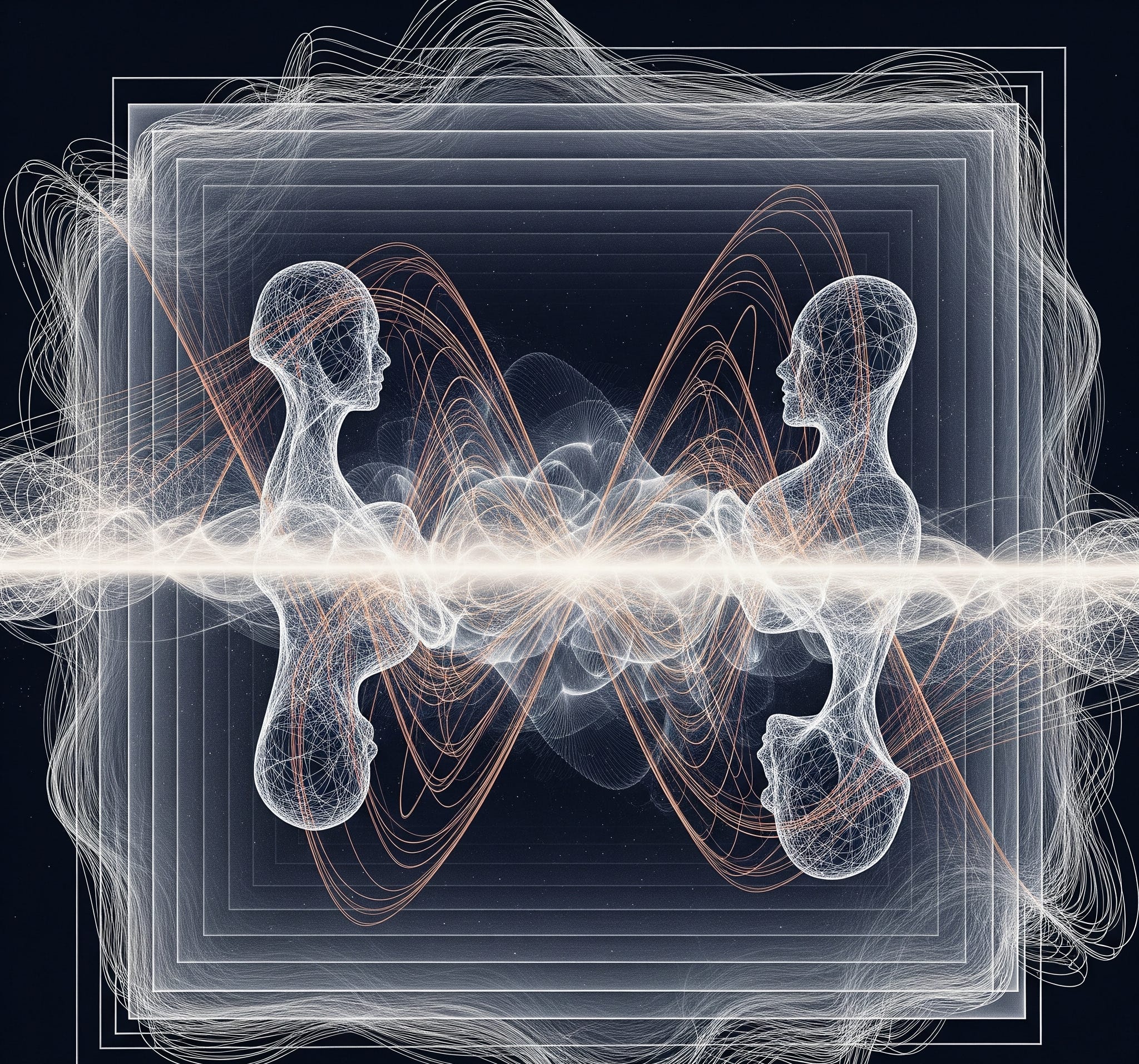
The HGL model subtly undermines the rigid boundary we’ve drawn between wave domains. It suggests that under the right conditions, the sonic and photonic realms can entwine more deeply than previously thought, not through energetic exchange, but through patterned interference across the fabric of matterless modulation. In doing so, it invites us to rethink the permeability of spacetime’s interaction channels, perhaps even suggesting that consciousness and perception, long attuned to light and sound, are shaped by resonant cross-waves of both.
Speculative Extensions: Planetary and Astrophysical Applications
If Harmonic Gradient Lenses (HGLs) can indeed be induced or identified within planetary atmospheres, their long-term implications stretch well beyond Earth-based optics. The capacity to bend, refocus, or split light using structured sound fields in tenuous gaseous media could fundamentally reshape technologies in exoplanet exploration, artificial atmospheric engineering, and even deep-space communication.
1. Atmospheric Lens Arrays for Space Telescopy
On air-rich exoplanets, or within engineered megastructures such as Dyson shells or O’Neill cylinders, large-scale harmonic emitters could be embedded to generate permanent or tunable acoustic gradient lenses. These lenses could supplement or replace traditional telescopes by focusing starlight directly through modulated gas layers into surface-bound detectors. Such "acoustic mirrors" would allow for kilometer-scale apertures without the need for physical construction, relying instead on infrasound architecture.
In Earth's future, if stratospheric drone arrays or ionospheric reflectors could maintain coherent standing wave fields, we may eventually build acoustic-tuned telescopic platforms capable of bending light over the Earth’s curvature, observing without ever launching an optical instrument into space.
2. Stellar Observation Through Sound-Encoded Refraction
Stellar lensing effects, like Einstein rings or microlensing artifacts, are traditionally attributed to gravity. But if HGLs exist naturally on gas giants or stellar atmospheres, some observed anomalies might arise from acoustic lensing. For instance, the unexplained flickering of distant stars or the momentary brightening of background galaxies during planetary transit may not always be gravitational in origin, but acoustically refracted through massive turbulent envelope zones.
This raises the possibility that highly active stars or exoplanets with strong atmospheric acoustic harmonics may encode information in their light signatures via lensing effects, potentially acting as naturally occurring modulators or projectors across interstellar distances.
3. Long-Range Coherent Communication Networks
By carefully manipulating harmonic gradients across vast distances, interplanetary civilizations could develop covert optical communication networks. Light signals could be subtly bent or delayed without physical infrastructure, traveling along acoustic corridors invisible to most detection methods. Unlike fiber optics, which require physical channels, an HGL-based system would create refractive corridors in spaceborne gas clouds, planetary ionospheres, or artificial nebulae.
In speculative SETI frameworks, certain anomalous modulations in starlight could represent a kind of “acoustic encryption”, signal shaping by ambient harmonic fields not yet recognized by our algorithms as intentional.
4. Terraforming and Climate Modulation on a Planetary Scale
Terraforming efforts on planets like Mars or Venus may involve atmospheric thickening through gas release. Once established, introducing harmonic modulation into these artificial atmospheres could enable control over light distribution, thermal regulation, or photonic nutrient channels for early-stage biospheres. Essentially, a tunable HGL would serve as a planetary climate instrument, redistributing solar input spatially and temporally, focusing warmth where needed, redirecting UV where dangerous, and potentially guiding early plant analogs toward optimal growth zones.
This suggests the future of terraforming may not rest solely on chemistry or heat, but on sound-shaped light, a finely tuned balance of acoustic and photonic design to sculpt evolving ecosystems.
5. Exoengineering Megastructures
In the far future, we might envision space habitats whose light exposure is not mediated by rotating mirrors or static apertures but by vast acoustic refraction zones generated within engineered atmospheric sheaths. These sound-structured habitats would use pressure gradients in breathable gases to shape incoming starlight, adjusting illumination without moving parts, simply by altering harmonic frequency and amplitude.
Such habitats would reflect a synthesis of architecture and music, cities tuned like instruments, their roofs resonating to reshape the sky itself.

Concluding Remarks on Cosmic Resonance
The Harmonic Gradient Lens model opens a speculative but coherent path from Earth's subtle acoustic anomalies to a vision of light and sound working in concert on planetary and cosmic scales. If coherent sound can bend light within structured air, then the language of planets may not be one of silence, but of vast sustained tone, ringing through tenuous fields to sculpt visibility itself.
In this framework, photonic astronomy and atmospheric acoustics merge into a new kind of science: resonant photogeometry. It is a domain not just for observing stars, but for tuning the visibility of worlds.
References
Zheng, L., et al. (2020). Acousto-optic beam shaping using standing sound waves. Nature Photonics, 14(3), 161–167.
Ingard, U. (1953). A review of the influence of temperature and pressure fluctuations on light propagation in air. Journal of the Acoustical Society of America, 25(5), 963–970.
Bass, M., & Korpel, A. (1966). Acousto-optic interactions: some theory and applications. Applied Optics, 5(10), 1571–1580.
Waxler, R., & Gilbert, K. E. (2006). The effect of atmospheric structure on long-range infrasound propagation. Journal of the Acoustical Society of America, 119(1), 177–185.
I personally think we’re already doing a lot of these things. This kind of technology could literally turn our atmosphere into a projection screen. Or is it already?