
The Gravity of Memory
How Time Learns to Curve

Memory is not only something that happens inside a brain. It may be written into the universe itself. Matter keeps its own record. Energy leaves patterns behind. Space curves in response to what has passed through it.
Gravity, seen this way, is more than the force that binds. It could be the way the cosmos remembers. Each movement, each exchange, leaves an imprint that lingers within the shape of spacetime. The universe does not simply exist. It recalls.

The Imprint of Mass
Einstein’s general theory of relativity replaced the old picture of attraction with one of form. Matter bends the geometry around it, and that curve becomes what we feel as gravity. Each change in position reshapes the field a little more.
Carlo Rovelli, in The Order of Time (2018), wrote that spacetime might be viewed as a “memory of the past configuration of matter.” Every star, planet, and particle leaves behind a small distortion that carries its story forward. The orbit of a moon is not a perfect circle drawn by force but a habit formed from the history of mass.
Gravity is not a constant pull. It is the physical residue of movement, the quiet recording of what has already happened.
Entropy and the Direction of Time
Time and memory are inseparable. The arrow of time moves forward because the universe records its own changes through entropy. Ilya Prigogine described this in From Being to Becoming (1980) as the creation of new information. Disorder, he argued, is not loss but inscription.
Every increase in entropy leaves behind a signature of transformation. The spreading of energy becomes a kind of written trace. The curvature of spacetime carries that record forward. The universe does not destroy the past. It preserves it as geometry.
In this way, time is not a line that moves forward but a growing archive of irreversible events.
Gravity as the Architecture of Recall
If spacetime can record, then gravity becomes the architecture of memory itself. Each mass leaves a mark. When a star collapses, the surrounding geometry remembers. That distortion endures long after the star is gone.
Stephen Hawking’s 1975 work on black holes showed that information may never truly vanish. The boundary of the hole, the event horizon, encodes the details of everything that falls inside. Later, Leonard Susskind and Juan Maldacena proposed that the surface itself might contain a holographic representation of the lost information (2013).
These findings suggest that gravity could act as the most fundamental memory device of all. What we call curvature may simply be the accumulated record of energy that has passed through space.
The Memory of Light
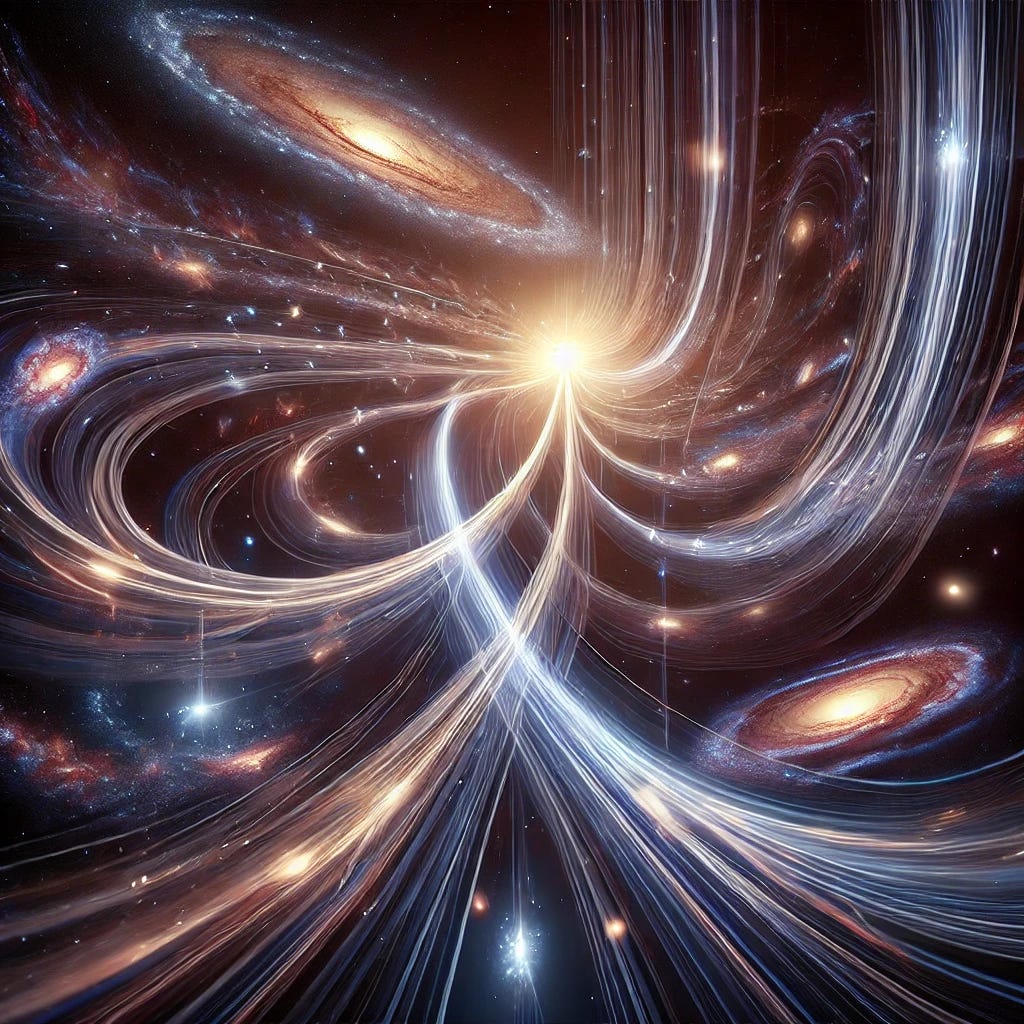
Light also participates in this archive. Photons do not move in straight lines but along curved paths shaped by the matter they encounter. Gravitational lensing, the bending of light around galaxies, lets astronomers see both where mass exists and where it once moved.
When light reaches us from a distant quasar or nebula, it arrives carrying the geometry of everything it has touched. Each beam is a messenger from the past, shaped by invisible memories written into the fabric of the universe.
The sky above is not a collection of points in space. It is a library of bent trajectories, each one retelling an ancient story.
Information and Curvature
Quantum gravity theorists now describe spacetime as a network of information. Ted Jacobson’s 1995 paper in Physical Review Letters showed that Einstein’s field equations can be derived from thermodynamic laws. In that view, curvature expresses the informational content of microscopic interactions.
If space itself encodes information, then gravity is the process by which that information is stored and updated. Each change in energy distribution adjusts the network. The geometry we perceive is not static background but the sum of remembered transformations.
The universe is not a stage on which matter performs. It is a living archive written in motion and form.
The Human Parallel
The structure of the brain offers a smaller echo of this process. When neurons fire together, the connections between them strengthen. The physical layout of those connections becomes the record of experience. Memory is shape.
Spacetime behaves in much the same way. The flow of energy alters its curvature, which then guides future motion. Both systems learn through change in structure. The brain remembers by strengthening its synapses. The universe remembers by folding its geometry.
Perhaps consciousness itself is a local manifestation of a larger principle: the tendency of reality to preserve the trace of what it has become.
Memory and the Shape of the Future
If the universe remembers, the future cannot be blank. Every new event emerges from a geometry already marked by history. The spin of galaxies, the arc of falling comets, the direction of time all follow the inherited contour of prior motion.
Yet memory does not imprison. It allows complexity to evolve. The past guides but never dictates. Gravity, by remembering, provides continuity without repetition.
This persistence may be the physical reason time cannot run backward. To erase the past would mean removing the curvature that defines the present. That would require undoing existence itself.
The Reflective Universe
Alfred North Whitehead proposed in Process and Reality (1929) that every event both inherits from the past and gives birth to new potential. Gravity might be the mechanism through which that inheritance occurs.
Each particle, each fluctuation, contributes to the ongoing reflection that is the cosmos. The spiral arms of a galaxy are not only motion but recollection. The cosmic web that binds them together is the visible memory of ancient formation.
In this perspective, the universe is not a detached machine. It is a thinking structure made of time, curved into awareness of itself.
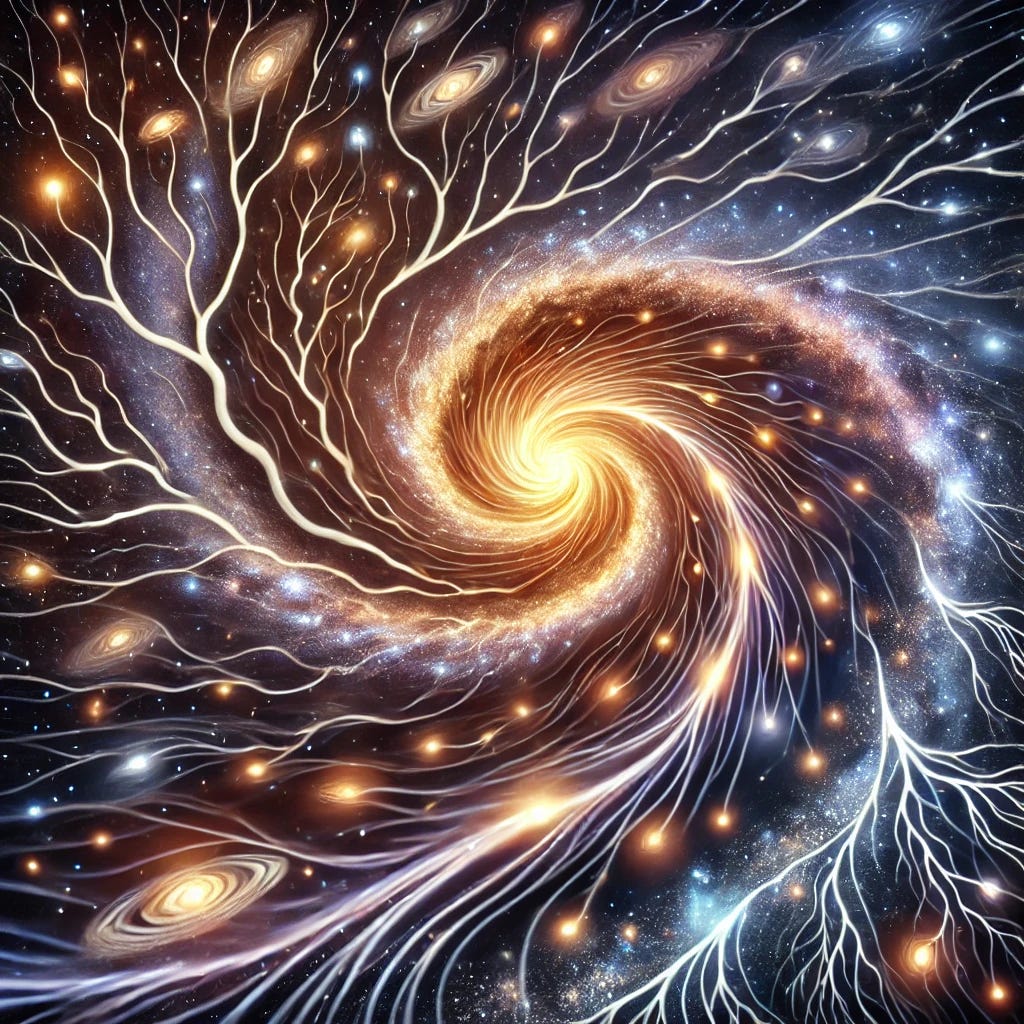
The Gravity of Memory proposes that gravity is not merely a force but the visible trace of remembrance. Curvature is history rendered physical. Every atom that moves, every star that burns, leaves its mark upon the geometry of the whole.
Light reads these marks as it travels, and through observation we read them again. The universe expands not into emptiness but into deeper recollection. Its growth is not decay but understanding.
To exist within such a cosmos is to live inside a vast act of remembering. Matter bends space. Space bends time. Time folds back into memory. The curvature we call gravity may be nothing less than the universe thinking through form.
References
Hawking, S. W. (1975). Particle creation by black holes. Communications in Mathematical Physics, 43(3), 199–220.
Jacobson, T. (1995). Thermodynamics of spacetime: The Einstein equation of state. Physical Review Letters, 75(7), 1260–1263.
Prigogine, I. (1980). From Being to Becoming: Time and Complexity in the Physical Sciences. W. H. Freeman.
Rovelli, C. (2018). The Order of Time. Riverhead Books.
Susskind, L., & Maldacena, J. (2013). Cool horizons for entangled black holes. Fortschritte der Physik, 61(9), 781–811.
Whitehead, A. N. (1929). Process and Reality. Macmillan.
I think I need ChatHPT
The Gravity of Memory” is a beautiful idea — part science, part poetry. It reminds us that when Einstein said matter bends space and time, he also showed that the universe keeps a kind of record of everything that’s ever happened. Stars, planets, and even light itself leave marks that never quite fade. Calling that ‘memory’ isn’t literal — space doesn’t think like we do — but it’s a powerful way to picture how the past shapes the present. Philosophers have long said that reality isn’t just a bunch of separate events, but a living flow where each moment carries what came before. So while scientists might prefer to speak of information, not memory, the feeling behind it is the same: the universe remembers in its own way. Every curve in space, every flicker of light, is a trace of something that once was — a quiet echo of the story still being told.