
The Gravity of Memory
Could the Past Exert a Physical Pull on the Present?

Time, Memory, and the Enigma of Experience
Memory is usually treated as an internal function of the mind—an intricate biological process by which neurons encode, store, and retrieve past information. Yet anyone who has been deeply immersed in a powerful memory knows that recollection is not merely informational; it is experiential. We feel as though we are being pulled back into a moment, as if some fragment of the past has gravitational force. Could this be more than metaphor? Might memory involve an actual interaction with the fabric of time?
This article explores a radical hypothesis: that memory, especially vivid episodic memory, may participate in a subtle retrocausal dynamic, where aspects of the past exert a non-local influence on the present. Drawing from developments in quantum mechanics, temporal philosophy, and cognitive neuroscience, we ask whether memory might not only reflect the past but interact with it.

Memory as Temporal Anchoring: A Neuroscientific Foundation
The dominant model in neuroscience posits that memories are encoded through long-term potentiation and synaptic plasticity, primarily in the hippocampus and associated cortical areas. Memory consolidation is believed to stabilize neural patterns, allowing recall through network activation. Yet even this biological framing leaves us with enigmas: why do certain memories feel more vivid, immersive, or even involuntary, as in the case of flashbacks or trauma?
Recent work has shown that memory retrieval is not a simple readout of static information. Rather, it is reconstructive, dynamic, and deeply embodied (Schacter et al., 2012). Neuroimaging has revealed that recalling a memory activates not only memory centers but also sensory and emotional cortices, suggesting a full-body simulation of past states. This immersive reactivation is not easily explained by digital-like storage.
The Retrocausal Frontier in Quantum Physics
Quantum physics introduces a set of bizarre but experimentally verified phenomena that defy classical temporal direction. In particular, the delayed-choice quantum eraser experiment (Kim et al., 2000) has demonstrated that measurements made in the present can influence how particles behaved in the past. Such retrocausal interpretations remain controversial but have gained traction in interpretations like the Two-State Vector Formalism (Aharonov et al., 2009).
While such effects have only been verified in subatomic systems under highly controlled conditions, they force us to reconsider whether causality is as one-directional as assumed. Could the act of memory retrieval function as a kind of measurement on our own temporal history, subtly collapsing or reshaping how past states manifest in consciousness?
Temporal Gravity Wells: A Speculative Model
Let us entertain the notion that moments of intense emotional salience—a child's birth, a near-death experience, a first love—may create local warps in psychological or even physical spacetime. These events could function as what we might call "temporal gravity wells": regions of cognitive spacetime that exert a lingering pull on the self.
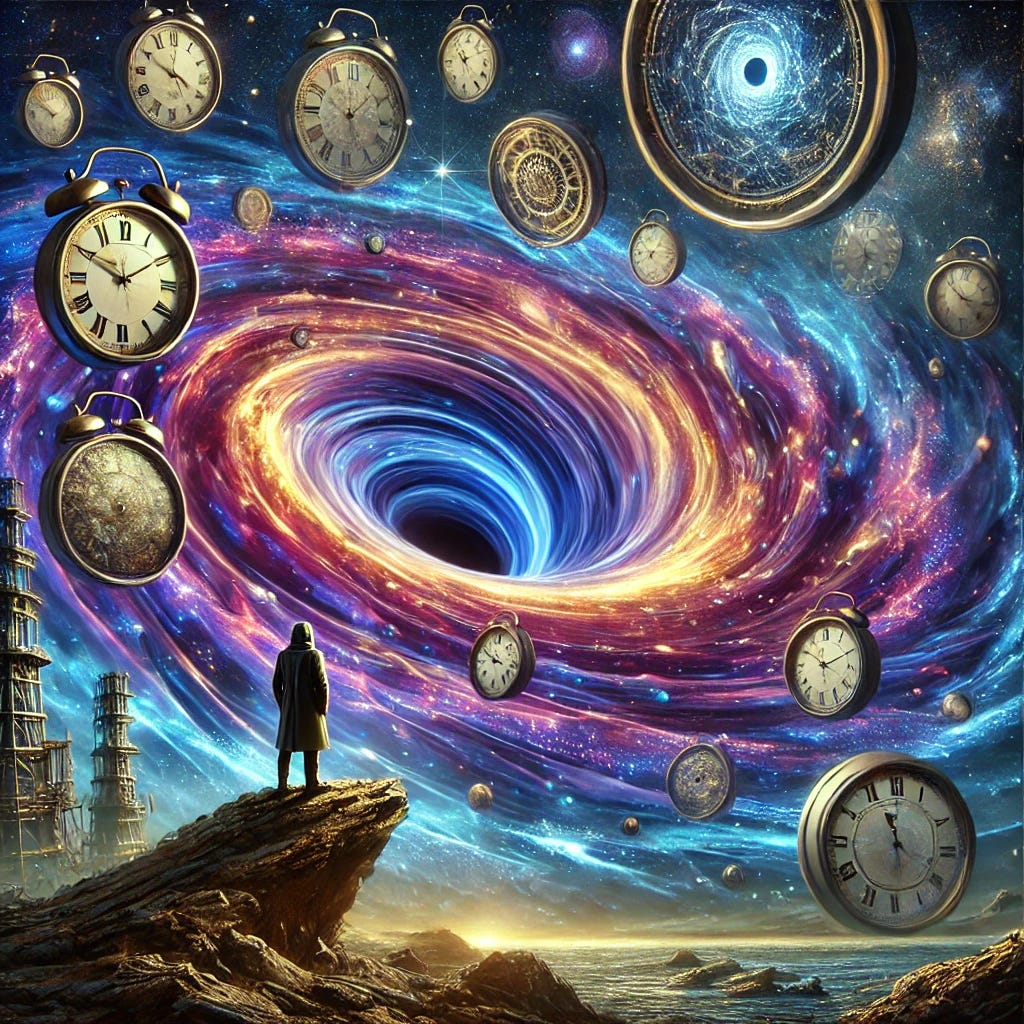
In this model, the brain's recall mechanisms might do more than simulate. They might temporarily entangle with these past states, using quantum coherence in microtubules (Hameroff & Penrose, 2014) or other subcellular structures as a means of spanning temporal distance. The intensity of a memory's pull would thus correlate with the entropy gradient between present cognitive state and the stored potential of the past event.
This concept might explain why certain memories feel involuntary or even invasive, as in PTSD. Rather than simply being "retrieved," such memories might be partially re-lived because they exert temporal curvature—a warping of the conscious trajectory.
Philosophical Implications: The Loop of Identity
If memory can influence the present not only by recall but by actual interaction, then the distinction between past and present becomes blurred. Personal identity, already viewed by many philosophers as a narrative or construct (Dennett, 1992), might actually be a recursive temporal loop—a feedback cycle of consciousness stabilizing itself through entangled memory.
In such a framework, nostalgia is not merely a yearning for the past, but an energetic reconnection to prior self-states. The past, in this view, does not merely influence the present through causality but co-exists with it in a kind of distributed temporal network.
This idea harmonizes with block universe theory, where all moments in time are equally real. In such a spacetime ontology, memory could serve as an act of navigation rather than recall—the consciousness choosing, however unconsciously, to dwell in certain coordinates of its own historical manifold.
Experimental Designs and Scientific Challenges
Testing such a model is enormously difficult, but not beyond imagination. One possible experimental design might involve advanced neuroimaging (such as MEG or high-resolution fMRI) during deep episodic recollection tasks, while simultaneously analyzing coherence patterns, neural entropy, and temporal phase-locking.
Another speculative route might involve quantum sensors to detect entanglement-like behavior in biological systems during memory tasks. While current technology is far from precise enough, future advances in quantum brain imaging might allow researchers to look for retroactive shifts in synaptic potentials or coherence anomalies suggestive of non-classical temporal influence.

Memory as an Axis of Time
This hypothesis—that memory may function as a form of temporal interaction rather than passive storage—remains speculative, but it touches on intuitions that many people share: that the past can feel alive, that memory can reach out and change us, even haunt us. Whether these experiences are purely emergent from complex biological processes or indicative of deeper temporal entanglements remains to be seen.
Yet the possibility opens new doors: that perhaps the mind is not merely moving forward through time, but constantly negotiating with its own history. And that the past is never entirely behind us, but waiting, gravitationally, to be felt again.
References:
Aharonov, Y., Popescu, S., Tollaksen, J., & Vaidman, L. (2009). Multiple-time states and multiple-time measurements in quantum mechanics. Physical Review A, 79(5), 052110.
Hameroff, S., & Penrose, R. (2014). Consciousness in the universe: A review of the 'Orch OR' theory. Physics of Life Reviews, 11(1), 39-78.
Kim, Y. H., Yu, R., Kulik, S. P., Shih, Y., & Scully, M. O. (2000). Delayed "choice" quantum eraser. Physical Review Letters, 84(1), 1-5.
Schacter, D. L., Guerin, S. A., & St Jacques, P. L. (2012). Memory distortion: an adaptive perspective. Trends in Cognitive Sciences, 15(10), 467-474.