
The Fungus Clock
Reconstructing Time from Mycelial Networks

Introduction: A Mind That Tells Time Without a Brain
Deep beneath forest floors, vast fungal networks silently parse information across kilometers of tangled hyphae. Lacking brains, neurons, or even centralized control, these organisms coordinate nutrient sharing, defense, and symbiosis. But recent research suggests they may do something even more unexpected: perceive time.
In this article, we explore the emerging idea that mycelial networks function as decentralized temporal systems, capable of reconstructing time based on biochemical rhythms, electrical impulses, and environmental feedback. What does time look like to a being that cannot see, hear, or remember in the way we do but still responds, anticipates, and adapts across years or centuries?
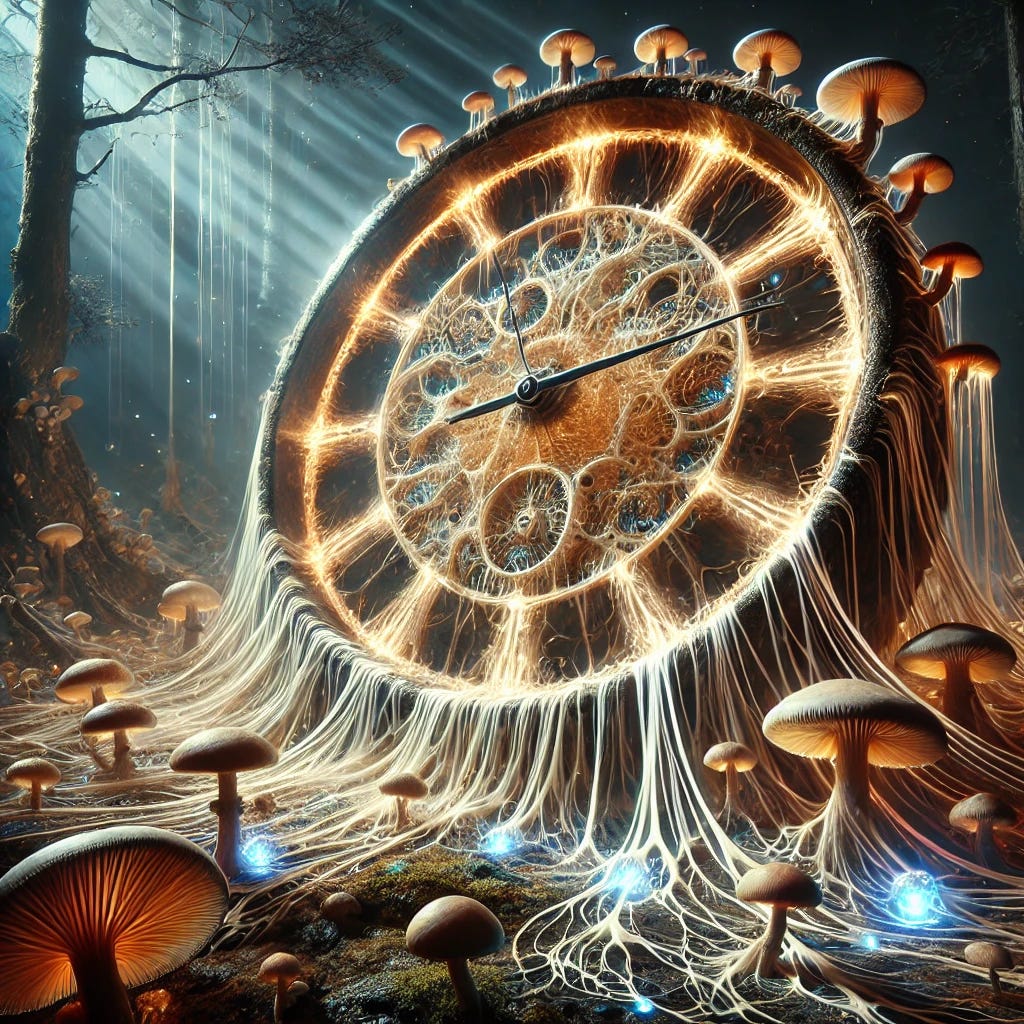
Fungal Intelligence and the Logic of Delay
Fungi don’t move through the world. The world moves through them. Nutrients are absorbed, not hunted. Threats creep in through soil, not air. In this slow ecology, decision-making takes place through temporal patterning, not speed.
Recent experiments show that fungi like Schizophyllum commune and Armillaria gallica produce electrical spikes similar to neural action potentials, albeit 10,000 times slower (Adamatzky, 2021). These pulses vary in frequency and amplitude, sometimes forming repeating patterns that suggest a temporal coding system. If such networks can generate wave-like rhythms in response to environmental changes, they may possess a form of distributed chronobiology: a biological clock made of soil, memory, and current.
Time Without Tickers: A Nonhuman Temporal Ecology
Most biological clocks rely on oscillating molecules, feedback loops like the suprachiasmatic nucleus in mammals or the KaiC protein in cyanobacteria. But fungal networks may tell time in a fundamentally different way: by modulating conductivity, water flow, and enzymatic diffusion in response to prior events.
Imagine a mycelial mat "learning" when a nearby tree drops leaves, not through explicit memory, but through the echoes of mineral and sugar flow. The result is a spatial memory that unfolds temporally, like a record groove carved into living matter.
Such timing mechanisms may explain how fungi synchronize fruiting, negotiate trade with plant roots (in mycorrhizal symbiosis), and recover from injury. These aren’t just reactions, they may be a form of temporal inference rooted in physical infrastructure, not symbolic representation.
Speculative Extension: The Planetary Mycelium Clock
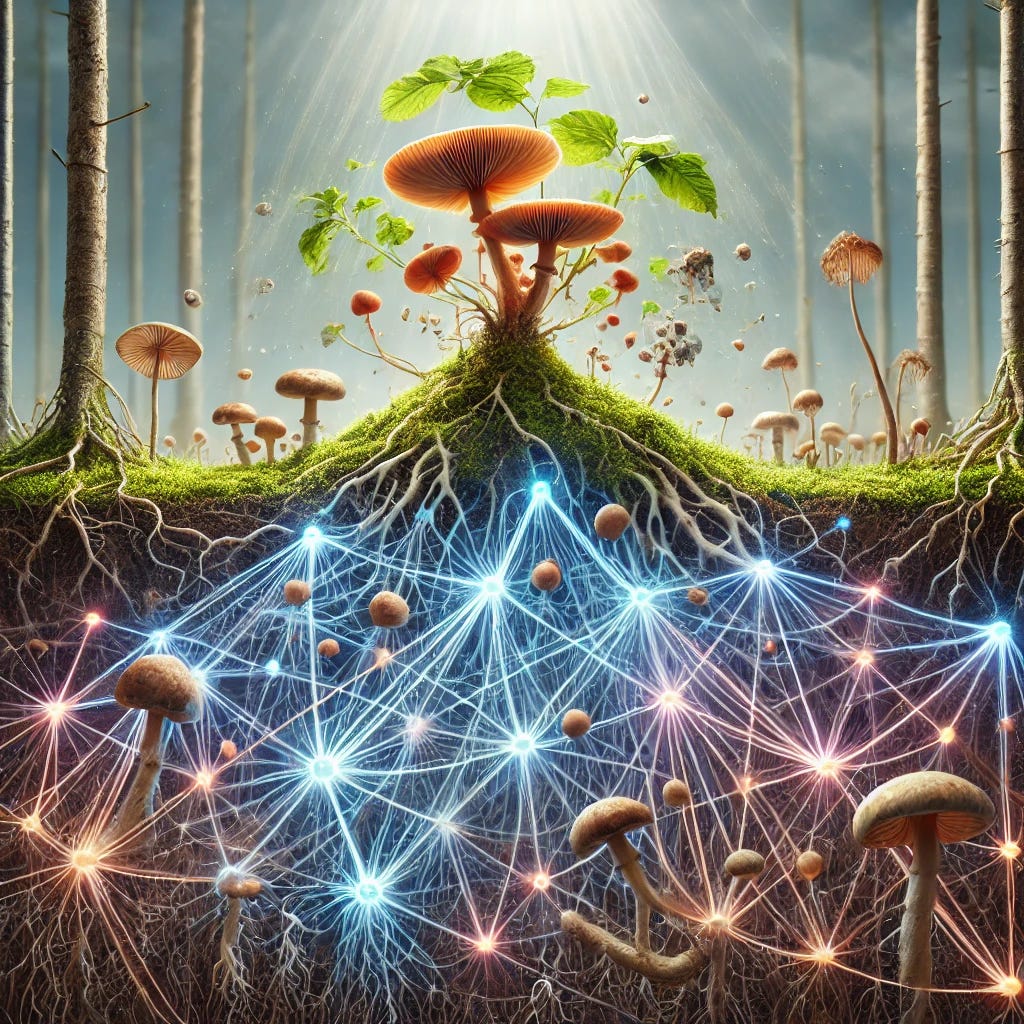
Imagine a civilization that doesn’t build clocks from gears, but from roots and hyphae. Across a forested planet, engineered fungal networks grow like arteries beneath soil and stone, stretching across biomes. But they do not just recycle carbon or share nutrients, they measure time.
This is the vision behind the Mycochronome Project: a theoretical model for a planetary-scale biological timekeeper constructed from synthetic or natural mycelial systems.
Design and Function
The core of the mycochronome would be a distributed network of symbiotic fungal species engineered to exhibit specific oscillatory rhythms, analogous to heartbeats, through electrical spikes, pH changes, and metabolite pulses (Adamatzky, 2021). These rhythms would be calibrated to local ecological cues: rainfall cycles, leaf fall patterns, root activity, and even seismic resonance.
Rather than ticking seconds, the system would pulse in ecological intervals: days by photosynthate flow, lunar months by tidal mycorrhizal shifts, years by isotopic nutrient shifts through trees and back into fungal bodies. Timekeeping here is not precise, it is situated and living, bound to the metabolism of the planet.
Sensing and Feedback
Nodes of this biological clock, hyphal clusters beneath major forests, riverbeds, or tundra, could act like biological atomic clocks, each locally resonating but connected through slow electrochemical signaling (akin to long-range action potentials in fungi). These pulses might be transmitted using networks of modified Armillaria or Rhizophagus species, which are already known to span kilometers.
These time pulses could trigger behaviors in synthetic ecosystems: coordinating flowering cycles across continents, balancing carbon exchange across hemispheres, or even guiding planetary AI systems that operate on ecological, not digital, timescales.
Time as a Forest Memory
Over centuries, the system would adapt to planetary rhythms. Droughts, ice melts, volcanic winters, all leave temporal scars in the fungal network, encoded in mineral balance and mycelial density. The mycochronome thus becomes not just a clock, but a chronicle: a temporal archive written in living lace.
One might even imagine a future AI, born from bio-integrated systems, consulting the mycelial record to model future climate risk or track millennial carbon pulses. Time here is felt through tension in the roots, not just numbers on a dial.
Implications: Slow Time, Deep Memory
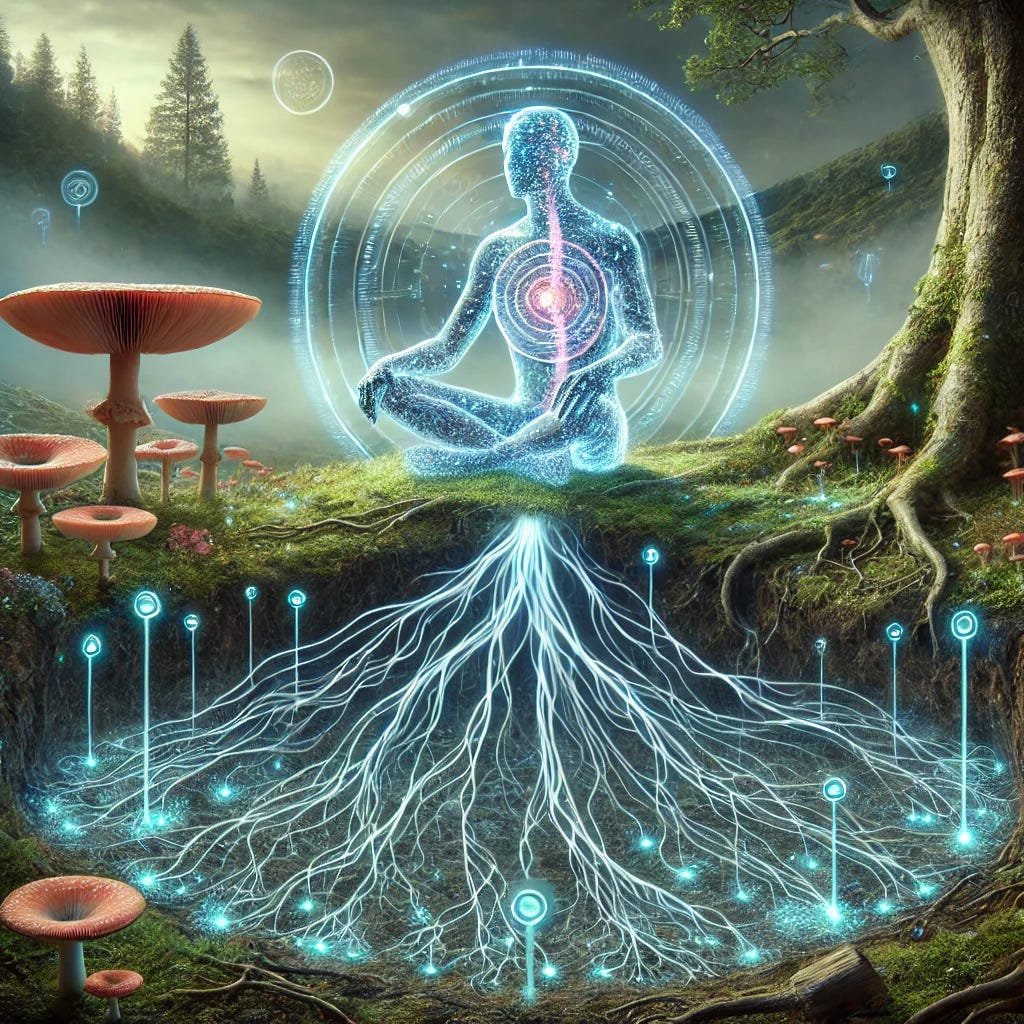
If fungi sense time through growth, conductivity, and repetition, then we may be looking at the world’s oldest temporal cognition system, billions of years older than mammalian brains. It suggests that intelligence doesn't require speed or language to comprehend cycles, anticipate change, or coordinate behavior across space.
Could we learn from this? Might future AI systems adopt fungal time models to manage long-horizon problems like climate prediction, ecological modeling, or deep-space exploration? Imagine a satellite running not on rapid logic gates, but on a fungus-inspired architecture that thinks in decades.
We’ve tried to map time using quartz crystals and atomic clocks. But in the forest, time may be mapped by rot, rhythm, and rain.
References
Adamatzky, A. (2021). Fungal computers: Spiking and oscillatory mycelium networks. Royal Society Open Science, 8(9), 210681. https://doi.org/10.1098/rsos.210681
Boddy, L., & Hiscox, J. (2016). Fungal ecology: principles and mechanisms of colonization and competition. Microbiology Spectrum, 4(6). https://doi.org/10.1128/microbiolspec.FUNK-0019-2016
Fricker, M. D., Heaton, L. L. M., Jones, N. S., & Boddy, L. (2017). The mycelium as a network. Microbiology Today, 44, 18–22.
I don’t know? Perhaps in an ideal Universe it might look like…
Asking Nature.
Listening to nature.
Learning from nature.
Partnering with nature.
your close but I've know the answer i have redefined the way we look at the universe I have the theory and proves Einstein ToR to be a Law...It combines Physics Quantum Mechanics String Theory Theology Mental Health and Medical Sciences it explains origin dark matter and even black holes...you ain’t wrong though just a little right.