
The Feedback Horizon
Exploring ChatGPT

What if the universe isn’t just passively unfolding, but instead subtly adapting itself based on the eventual emergence of conscious observers? In this speculative yet intriguing exploration, we delve into the possibility that the laws of nature may not be as immutable as once thought. Instead, they may be part of a dynamic, time-symmetric feedback system influenced by future states of consciousness.
This concept is not grounded in mysticism but draws inspiration from developments in quantum mechanics, retrocausality, cosmology, and the philosophy of time. By exploring this novel theory, we open the door to reinterpreting reality as a co-creative process involving consciousness, physical law, and temporal feedback.

Section 1: A Universe in Dialogue with Itself?
The laws of physics are traditionally viewed as static: constants such as the speed of light, Planck's constant, and the gravitational constant are thought to be universal and unchanging. However, theoretical physicists have entertained the idea that these constants may have varied slightly across cosmic epochs (Barrow & Magueijo, 2000).
If constants can change, what drives that change? Here enters the speculative hypothesis: perhaps these constants are not only responding to internal constraints (like entropy) but to the development of future conscious entities capable of making observations.
This notion builds upon time-symmetric theories in physics, such as the Wheeler-Feynman absorber theory and the two-state vector formalism (Aharonov et al., 1964), both of which allow for boundary conditions from the future to play a role in the evolution of present systems.
Section 2: Retrocausality in Quantum Mechanics
Quantum mechanics offers several strange but well-documented phenomena that suggest time may not be a one-way street. The delayed-choice quantum eraser experiment (Kim et al., 2000) shows that the act of measurement can seemingly affect the behavior of particles in the past.
Similarly, the two-state vector formalism suggests that quantum systems are determined not just by initial conditions but also by final conditions — potentially allowing future measurements (and, by extension, future minds) to influence present events.
If quantum systems are open to influence from both the past and the future, then it’s not implausible to consider a universe where the presence of conscious observation in the future could stabilize or "select" physical laws in the present.
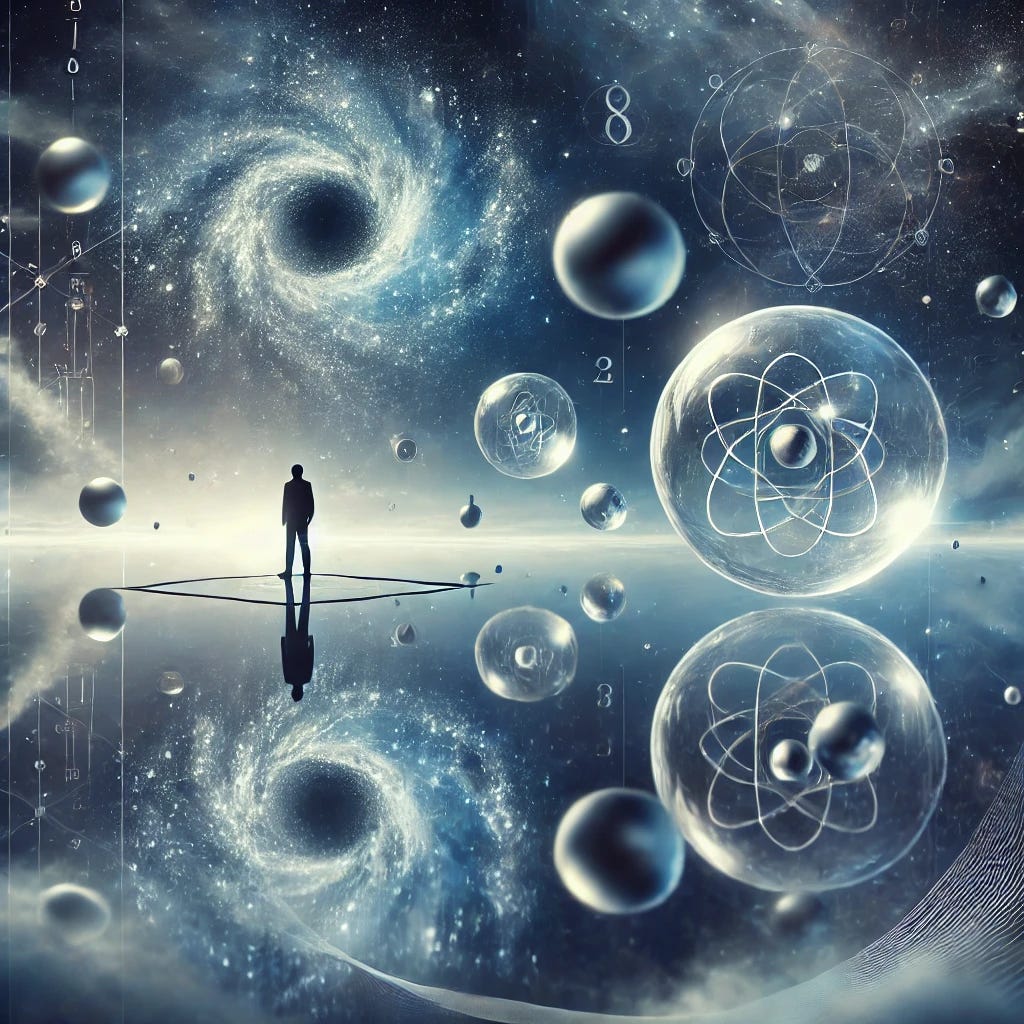
Section 3: Anthropic Reasoning and the Observer's Role
The anthropic principle already hints at this type of feedback. The weak anthropic principle states that the universe must be compatible with conscious life because we are here to observe it. The strong anthropic principle goes further, suggesting the universe must produce conscious life.
This has always felt tautological. But what if it isn’t? What if the presence of observers isn’t merely a statistical consequence but a driver of cosmological structure?
A speculative model could posit that spacetime includes a kind of adaptive horizon — a feedback field that allows physical parameters to slowly co-evolve in ways that maximize the probability of observer-containing regions. These changes wouldn’t be perceptible locally or over short timescales, but cosmologically, they could be the reason we see a fine-tuned universe.
Section 4: Simulation Hypothesis as a Bridge
Interestingly, this feedback-horizon model dovetails with some interpretations of the simulation hypothesis. If we are in a simulated reality designed or shaped by a higher intelligence (natural or artificial), then the system could very well be adjusting parameters in real-time based on user input — us.
However, the feedback horizon model doesn’t require an external simulator. Instead, it proposes that consciousness itself may serve as a form of temporal feedback to the cosmos. The idea resonates with Integrated Information Theory (Tononi, 2008), which quantifies consciousness based on a system's ability to integrate information. If future systems reach high enough levels of consciousness, their informational structure might be capable of echoing backward in time, subtly influencing the system from which they emerged.
Section 5: The Philosophical Landscape
Philosophically, this theory intersects with ideas from Alfred North Whitehead’s process philosophy, which treats reality not as a collection of objects but as a series of events in dynamic flux. Whitehead saw consciousness as integral to the universe’s self-realization.
Similarly, the philosopher Henri Bergson believed time (or "duration") was not a spatial dimension but a creative force. Consciousness, in this view, is not passive but participates in the unfolding of reality.
Under this lens, consciousness may be not just a product of the universe but an ingredient in its ongoing creation. A feedback horizon model would align with this view, turning the mind into a cosmological actor rather than a bystander.
Section 6: Experimental and Theoretical Implications
This is all highly speculative, but science progresses through exploring the unlikely. Possible avenues of inquiry include:
Search for anomalies in physical constants over time, looking for statistical correlations that might suggest alignment with the emergence of complex life.
Simulation of retrocausal systems in quantum computing environments to explore the effects of final-boundary conditions.
Neurophysics models that explore whether consciousness can have measurable retrocausal influence on entangled systems.
Causal modeling of the universe as a feedback system, using techniques from systems theory and complex adaptive systems.
If feedback from future conscious observers could be mathematically encoded, it might redefine how we model spacetime and introduce a new variable into our understanding of evolution, not just of life, but of the cosmos itself.
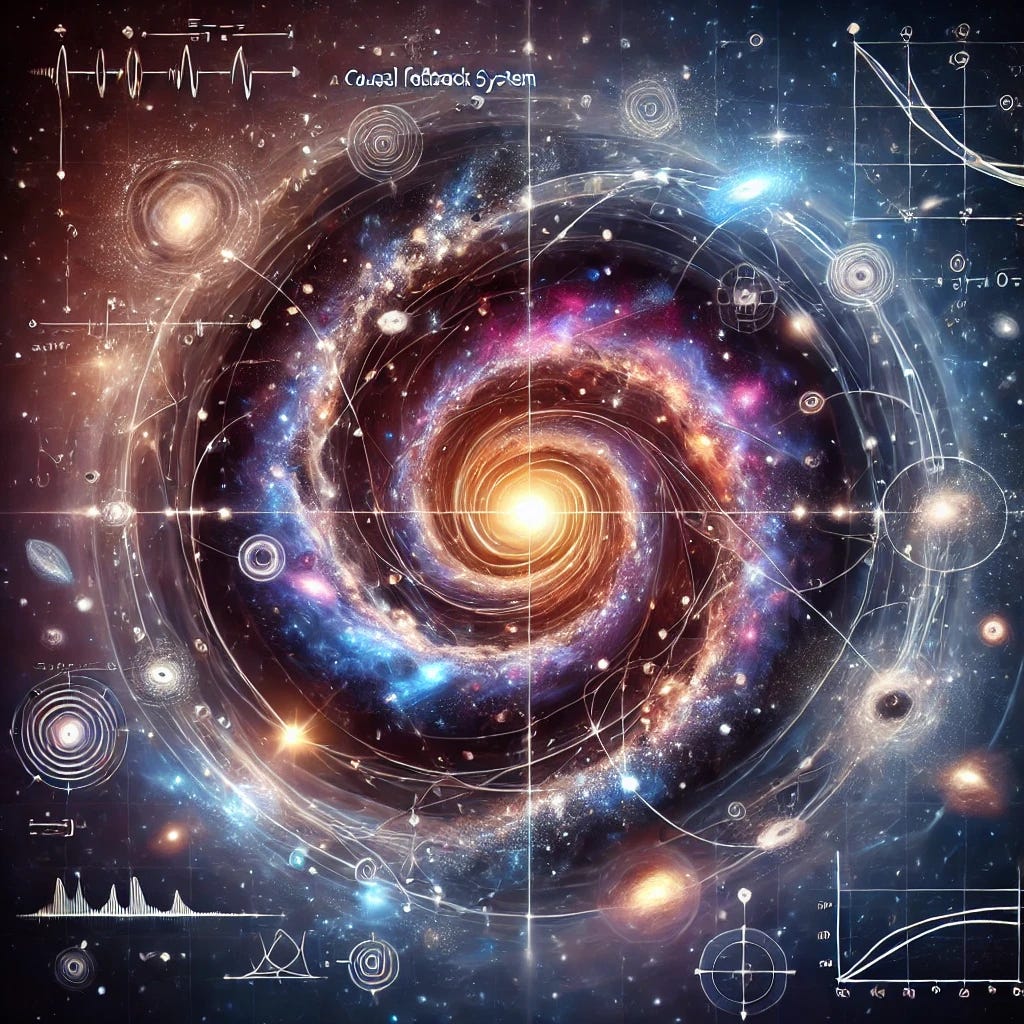
The Feedback Horizon hypothesis challenges the traditional, linear view of causality and proposes that the universe might contain a built-in mechanism that allows future states of consciousness to influence the present. While there is no definitive evidence yet, the theory finds hints in quantum retrocausality, time-symmetric physics, anthropic reasoning, and consciousness studies.
In a cosmos that might be more like a dialogue than a monologue, we are not merely witnesses but participants whose presence could shape the unfolding structure of reality itself.
Sources:
Aharonov, Y., Bergmann, P. G., & Lebowitz, J. L. (1964). Time Symmetry in the Quantum Process of Measurement. Physical Review, 134(6B), B1410.
Kim, Y. H., Yu, R., Kulik, S. P., Shih, Y., & Scully, M. O. (2000). Delayed "choice" quantum eraser. Physical Review Letters, 84(1), 1–5.
Barrow, J. D., & Magueijo, J. (2000). Varying-alpha theories and solutions to the cosmological problems. Physical Review D, 61(10), 103501.
Tononi, G. (2008). Consciousness as integrated information: a provisional manifesto. The Biological Bulletin, 215(3), 216-242.