
The End of Randomness
Exploring ChatGPT

For centuries, scientists and philosophers have debated whether the universe is governed by true randomness or if everything follows a predetermined path. While quantum mechanics suggests an element of unpredictability, some theories argue that if we had enough information, we could predict every event in the universe with perfect accuracy. But what would this mean for science, free will, and our understanding of existence itself? This article explores the implications of a completely predictable universe and whether randomness truly exists.
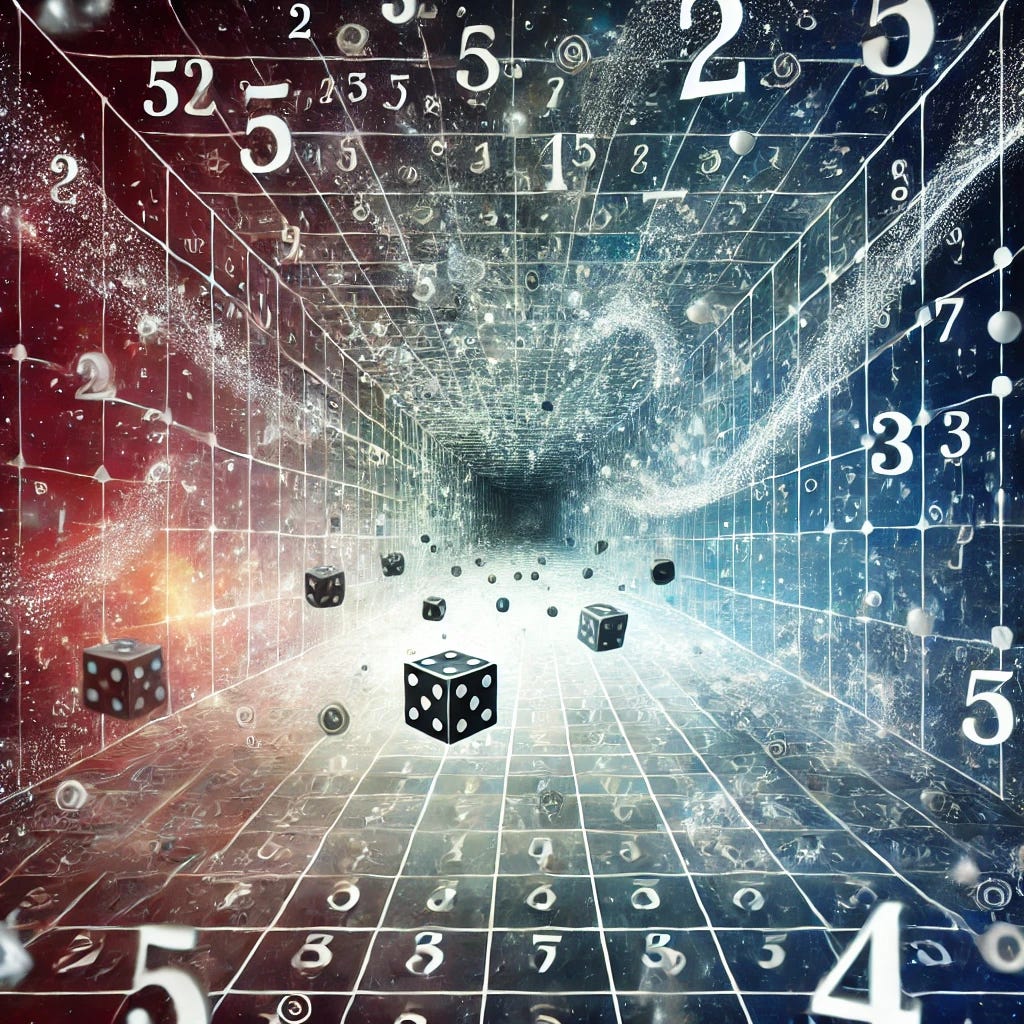
The Science of Predictability
At a macroscopic level, much of the universe appears to follow deterministic laws. Classical physics, as established by Isaac Newton, presents a world where objects move in perfectly predictable ways based on initial conditions. If we know the mass, velocity, and force acting on an object, we can determine exactly where it will be at any given time.
However, the advent of quantum mechanics in the 20th century introduced uncertainty into this equation. The Heisenberg Uncertainty Principle states that we cannot precisely know both the position and momentum of a particle at the same time. This has led to the prevailing belief that at a fundamental level, the universe is probabilistic, not deterministic.
Yet, some physicists argue that this randomness is only an illusion caused by our lack of information. The "hidden variables theory" suggests that underlying factors—currently unknown to science—actually determine outcomes, meaning the universe may be predictable after all.
The Laplace’s Demon Thought Experiment
One of the most famous arguments for a deterministic universe comes from the 19th-century mathematician Pierre-Simon Laplace. He imagined a hypothetical intellect, now called "Laplace’s Demon," that knows the position and momentum of every atom in the universe. This being could, in theory, predict the entire past and future with absolute certainty.
If such a level of predictability were possible, it would imply that randomness is merely an illusion and that every event—including human choices—was predetermined from the beginning of time.
Implications for Free Will
If the universe is entirely predictable, it raises a fundamental question: do we have free will, or are all our choices merely the inevitable outcomes of physical processes?
Philosophers and neuroscientists have explored this idea extensively. Some experiments suggest that our brains make decisions before we are consciously aware of them. In a famous 1980s study by Benjamin Libet, researchers found that neural activity indicating a decision occurred milliseconds before subjects reported making a conscious choice. This raises the possibility that what we perceive as “decision-making” is just a delayed awareness of an inevitable outcome.
If free will is an illusion, then moral responsibility and the justice system would require re-evaluation. Could we blame criminals for actions that were predestined? Would concepts like personal achievement or regret still hold meaning in a universe where every event was always going to happen exactly as it did?
The Role of AI in Predicting the Future
Even if the universe is not entirely deterministic, advancements in artificial intelligence and big data analysis are making predictions increasingly accurate. AI models already predict human behavior with impressive precision—ranging from shopping habits to political preferences. Some theorists believe that with enough computational power, AI could one day predict complex human decisions before we make them.
For example, AI-driven simulations might one day forecast economic collapses, wars, or even individual life outcomes with high accuracy. If this predictive capability continues to improve, would we begin to rely on AI forecasts for all major decisions? Could we reach a point where uncertainty itself is eliminated?
The Scientific Search for True Randomness
While AI and physics push the boundaries of predictability, scientists are also searching for instances of true randomness. Some experiments, such as those involving radioactive decay, suggest that certain quantum events occur without any deterministic cause. If proven, this would preserve the notion that unpredictability is an inherent part of reality.
One promising area of research is quantum computing, where particles exist in multiple states simultaneously. If randomness in quantum states can be verified beyond any deterministic model, it would challenge the idea that the universe can be fully predicted.
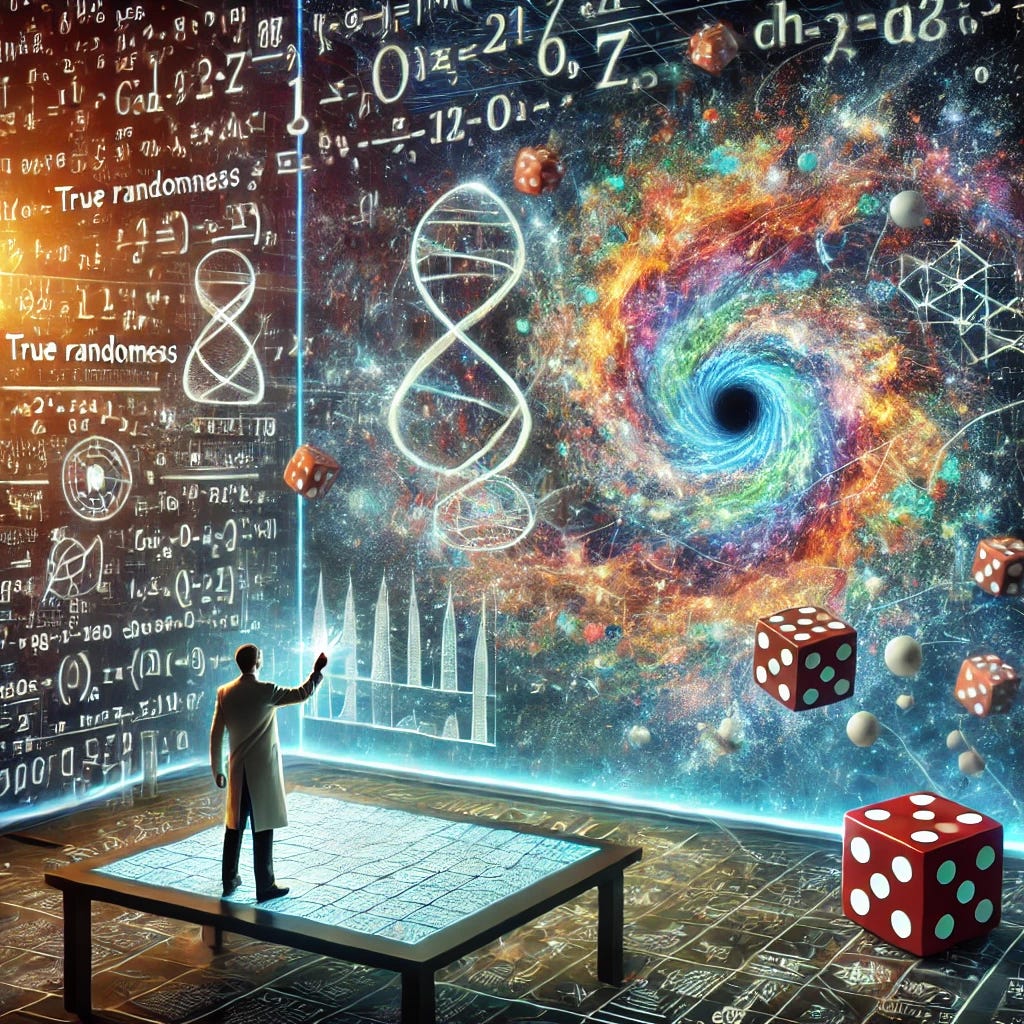
The question of whether the universe is completely predictable remains unresolved. If future discoveries confirm that randomness is only an illusion, it could fundamentally alter our perception of reality. Science, philosophy, and even our daily lives would be shaped by the realization that everything—past, present, and future—was always going to happen exactly as it does.
On the other hand, if true randomness exists, it would mean that uncertainty is an unavoidable part of existence, preserving the possibility of free will and spontaneity.
For now, we live in a world where some things seem predictable while others remain mysterious. Whether we are inching toward a universe where everything is known—or if unpredictability will always remain—is one of the greatest questions of our time.
And this is why we're no longer accepting applications into the School of Infinite Repetitions
Banger 😎