
The Death Delusion
Exploring ChatGPT

Death has long been considered the ultimate certainty—the inevitable end that no one can escape. But what if this assumption is entirely wrong? What if death is not a natural necessity but rather a failure of biology, an unsolved problem waiting for a solution? As science and technology advance at an unprecedented rate, the idea of human immortality is moving from the realm of mythology to scientific possibility. But should we embrace it? And what would it mean for society, morality, and the human experience if we conquered death?
The Illusion of Death as a Natural Law
For centuries, death has been framed as an unavoidable part of life. Religions, philosophies, and cultural narratives have built entire worldviews around accepting mortality. But the assumption that death is natural ignores an important distinction: just because something has always happened does not mean it must happen.
1. Death as a Biological Flaw
Aging and death are not inherent requirements of existence; they are failures of our biological systems. Unlike a lightbulb that burns out due to wear and tear, cells have mechanisms designed to repair and regenerate. The problem is that these mechanisms become less efficient over time due to genetic mutations, cellular damage, and the accumulation of harmful byproducts. In essence, death is an unsolved engineering problem.
Example: Some species, like the Turritopsis dohrnii (the "immortal jellyfish"), can effectively reset their biological clock, reverting to an earlier stage of life and avoiding death indefinitely.
2. Science’s War on Aging and Death
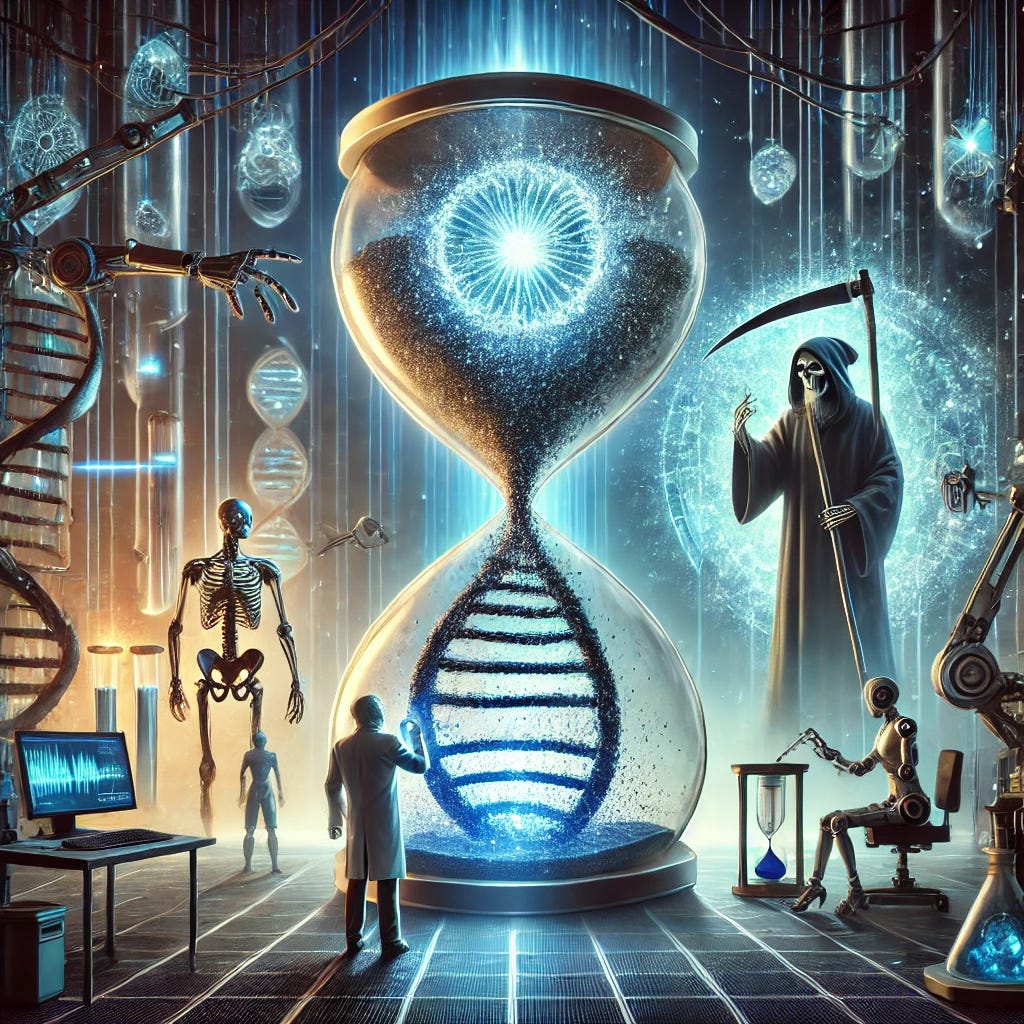
Modern science is beginning to challenge the idea that aging is inevitable. Research into gene editing, cellular regeneration, and artificial intelligence suggests that significant life extension—and perhaps even biological immortality—may be within our grasp.
CRISPR and Genetic Engineering: Scientists are exploring ways to modify genes associated with aging, potentially eliminating age-related decline altogether.
Senolytics and Anti-Aging Drugs: New drugs target and destroy senescent (aging) cells, preventing the damage that leads to aging.
Mind Uploading and Digital Immortality: Some believe that even if our biological bodies fail, our consciousness could be preserved in digital form, allowing us to live indefinitely as simulations or cyborg entities.
The Ethical and Philosophical Dilemmas of Immortality
While the prospect of eliminating death sounds appealing, it raises profound ethical and philosophical questions. Would living forever enhance human existence, or would it create unforeseen problems?
1. The Overpopulation Problem
One of the most common objections to immortality is the fear of overpopulation. If no one dies, would the planet become unbearably crowded? However, this concern assumes that human reproduction would continue at the same rate. In reality, birth rates tend to decline as societies become wealthier and more technologically advanced.
Example: Japan and other highly developed nations are already experiencing population decline due to lower birth rates, despite increased life expectancy.
2. The Meaning of Life Without Death
Many philosophers argue that death gives life meaning. Without the urgency of a limited lifespan, would humans lose their drive to accomplish, create, and experience?
Counterpoint: If anything, an extended or indefinite lifespan could allow humans to explore deeper intellectual, artistic, and scientific pursuits without the pressure of time constraints. The fear that immortality would make life meaningless assumes that meaning is only derived from limitation.
3. The Problem of Inequality
Would immortality be available to everyone, or only to the wealthy elite? If life extension technologies were expensive and limited, they could create a deeper divide between the rich and poor, with the privileged class achieving virtual godhood while the rest of humanity continues to suffer and die.
Potential Solution: Governments and scientists could work toward democratizing longevity treatments, making them as widely accessible as vaccines or antibiotics.
Should We Fear or Embrace Immortality?
The idea of overcoming death is radical, but so was flight, space travel, and the internet. Every transformative technology in history was met with skepticism before it became part of everyday life. Perhaps the same will happen with immortality.
If aging is a disease, should we not attempt to cure it?
If science allows us to break free from biological limitations, do we have a moral obligation to pursue it?
If death is an outdated concept, what does that mean for our understanding of what it means to be human?
The End of Death?
The assumption that death is inevitable is based on outdated thinking. Advances in science and technology may soon allow us to escape the fate that has defined human existence for millennia. Whether we embrace or reject immortality will shape the future of our species. But one thing is certain: the death delusion is crumbling, and the dream of eternal life is closer than ever before.