
The Chronomatter Hypothesis
Exploring ChatGPT

Abstract
This paper explores a radical and original hypothesis: what if time is not merely a dimension in which events occur, but a physical substance—"chronomatter"—that evolves, flows, and even interacts with consciousness and matter? Drawing from recent developments in quantum field theory, thermodynamics, and speculative cosmology, we propose that time may possess field-like properties analogous to dark matter or the Higgs field. We examine the implications of such a model for the arrow of time, consciousness, and causality. By constructing a speculative but testable framework, we consider whether localized distortions or concentrations of chronomatter might underlie phenomena like déjà vu, precognition, or temporal anomalies.
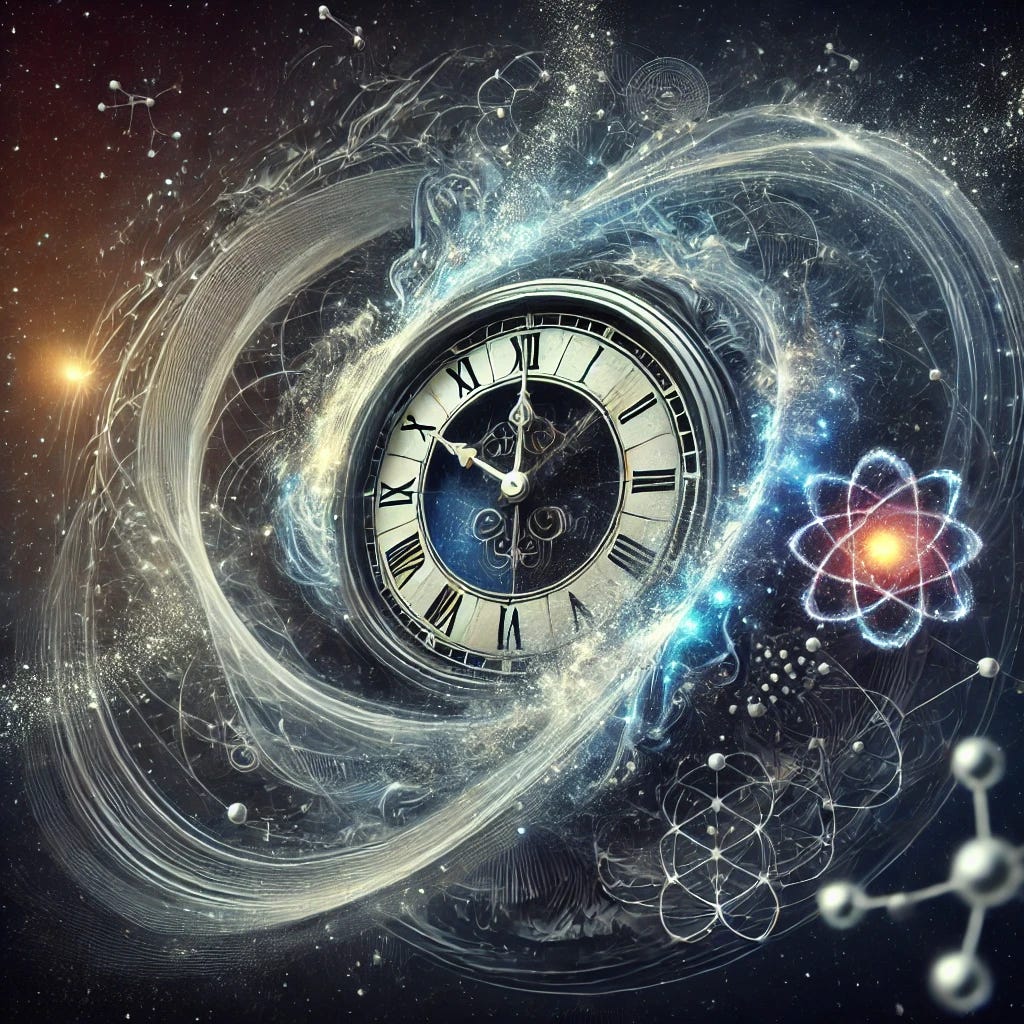
Time as a Passive Medium—or an Active Agent?
For centuries, time has been viewed as either an illusion (as in Parmenides' static universe) or as a neutral container for change (as in Newtonian mechanics). In Einstein’s theory of relativity, time became elastic, capable of stretching or compressing depending on motion and gravity. But it remained a coordinate, not a substance. In modern physics, especially in the context of the block universe and time-symmetric equations, time has no preferred direction.
Yet our everyday experience tells a different story. Time moves forward. Events unfold. Memory exists for the past, but not the future. Entropy increases. Could this asymmetry suggest that time is not merely a backdrop, but a real, dynamic entity? Might it have energy, mass, or even a field-like structure? These questions form the core of the Chronomatter Hypothesis.
Chronomatter as a Field: A Hypothetical Model
Suppose time arises not from geometry alone, but from a pervasive field—a time-like analogue of the Higgs field. In this framework, time has density and gradients, much like the distribution of energy in a scalar field. Regions of the universe with higher concentrations of chronomatter might experience faster or slower passage of time, not because of gravity or velocity, but because of the field's internal dynamics.
We might compare this to the early 20th-century conception of the luminiferous aether, long since discarded. But unlike the aether, chronomatter would not serve as a carrier for electromagnetic waves—it would be the substrate for temporal flow itself. Just as matter can curve spacetime in general relativity, perhaps time-like fields interact with mass-energy in subtle ways not yet detected by current instruments.
Recent research into vacuum energy and zero-point fields (e.g., Urban & Zhitnitsky, 2009; Beck & Mackey, 2005) suggests that fields pervading empty space might have physical consequences we do not yet fully understand. Could chronomatter be one such field?
Time Density and the Arrow of Time
One of the most perplexing questions in physics is why time seems to have a direction. The fundamental equations of nature are symmetric in time—whether it is Newton’s laws, Maxwell’s equations, or the Schrödinger equation, they work just as well backward as forward. The usual answer invokes entropy: the second law of thermodynamics dictates that disorder increases, thereby giving time a one-way arrow.
But this explanation is statistical, not fundamental. It doesn’t explain why the universe began in a low-entropy state. If we introduce the idea of chronomatter, we can imagine that the early universe was rich in temporal density. As the universe expanded and cooled, this density may have diffused, like gas molecules in a vacuum. The arrow of time, in this view, results from a gradient in the chronomatter field—flowing from high to low temporal density, just as heat flows from hot to cold.
Such a model would also help explain why the flow of time is local and variable. Near black holes, for instance, time slows dramatically. This is attributed to relativistic time dilation due to gravity, but perhaps an alternative explanation is that chronomatter becomes denser in strong gravitational fields, making time viscous or even semi-solid.
Consciousness and Chronomatter: A Two-Way Interaction?
Emerging research in neuroscience has begun to challenge traditional models of the brain as a purely reactive, present-focused organ. Experiments by Libet (1983), Radin (2006), and Bem (2011) have suggested that human consciousness may be capable of accessing or being influenced by future states—anomalous results that defy conventional explanation.
If time is a dynamic field, might consciousness interact with chronomatter in a bidirectional way? We know that the brain creates time representations—it anticipates, remembers, and imagines across time scales. What if these cognitive functions are not merely metaphorical but physical—localized interactions with the chronomatter field? Conscious intent could, in theory, generate subtle perturbations in local temporal flow, allowing feedback from future attractor states. While highly speculative, this aligns with models of retrocausality in quantum mechanics and could explain anomalous cognitive phenomena.
Chronomatter and Quantum Entanglement
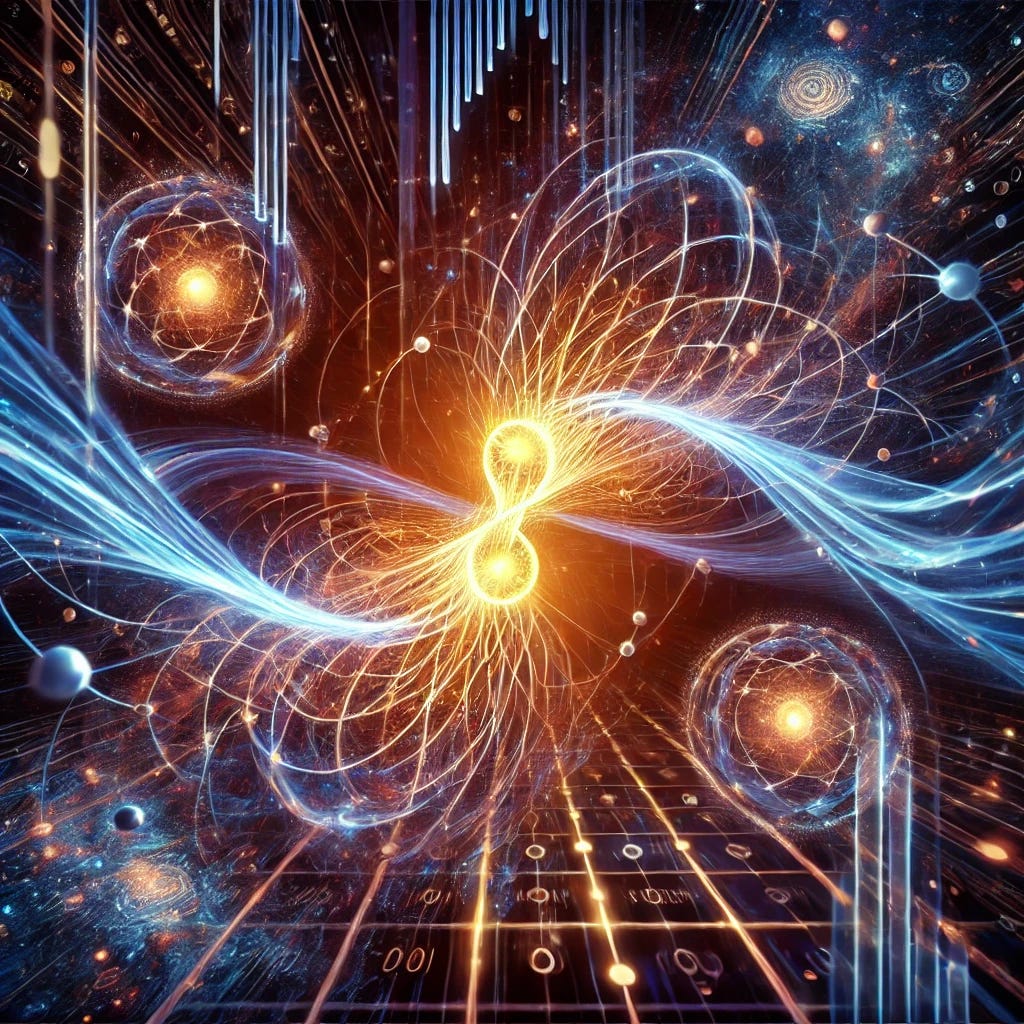
In quantum physics, entangled particles exhibit correlations across space that seem instantaneous, challenging the notion of locality. Some physicists, such as Huw Price (1996), have suggested that time symmetry or retrocausality may resolve these paradoxes. If time itself is a field, then quantum entanglement could be mediated not across space but across temporal density.
Imagine two particles entangled across a chronomatter bridge—a high-density conduit in the time field connecting them in a shared now, regardless of spatial separation. This could allow us to reframe quantum nonlocality as a feature of temporal connectivity rather than spatial weirdness. Such a model would invite entirely new experiments, such as varying entanglement outcomes based on artificially modulated temporal fields.
Experimental Speculation and Testability
How might we detect or manipulate chronomatter? While existing instruments may not yet be sensitive to this field, certain anomalies could serve as indirect evidence:
Atomic Clock Drift in Isolated Cavities: Highly isolated clocks might exhibit temporal anomalies if shielded from temporal density fluxes. A deviation from relativistic predictions could imply interaction with a background temporal field.
Precognitive Performance under Controlled Chronometric Environments: Inspired by Bem’s studies, researchers could construct chambers that vary hypothesized chronomatter conditions (e.g., EM shielding, cryogenic cooling, geomagnetic modulation) to test for changes in precognition or reaction times.
Localized Entropy Reversals: Devices such as optical lattices or Bose-Einstein condensates might be used to probe ultra-local entropy changes that diverge from expected thermodynamic behavior.
While these ideas remain theoretical, they highlight potential paths forward. As with the Higgs boson or gravitational waves, initial concepts seemed untestable—until technology caught up.
Fictional Scenario: The Chronoengineers of Talamir
To explore the implications of chronomatter more vividly, let us imagine a civilization that has mastered its manipulation.
In the ancient star system of Talamir, a sentient species known as the Vael learned to perceive fluctuations in the chronomatter field as easily as humans sense sound or light. Their philosophers and scientists built instruments that allowed them to sculpt temporal density—slowing, accelerating, or branching local time. Instead of computers, they used chrono-crystals that computed by warping the flow of causality. Architecture was not bound to space alone; entire cities could drift in and out of temporal phases, appearing only once every few decades.
But their greatest achievement was the development of causal harmonics: orchestral compositions written not to please the ear, but to tune the chronomatter field, thereby stabilizing reality around them. These were performed by mind-linked ensembles who not only played instruments but navigated streams of time itself.
This civilization’s fall came not through war, but through philosophical crisis. As the Vael peered further into the fabric of time, they saw not only futures but their own evolutionary attractors—destinies they were drawn to fulfill. Choice began to unravel. A faction believed they should surrender to the pull of chronomatter, while others insisted on resisting. The temporal schism fractured their society into competing timelines, each looping into paradox. What remained are only the ruins of their chrono-temples—traces not in space, but in the subtle fluctuations of time itself.
The Chronomatter Hypothesis proposes a radical reframing of time—not as a static parameter or illusion, but as a dynamic substance with physical and perhaps conscious properties. Though speculative, this idea invites us to reconsider causality, consciousness, and even reality itself as part of a deeper, time-rich structure.
Further research in quantum field theory, anomalous cognition, and experimental cosmology could either refute or refine this concept. As with all great scientific revolutions, it begins not with proof, but with the courage to ask: what if we’ve misunderstood time itself?
References
Libet, B. (1983). Time of conscious intention to act in relation to onset of cerebral activity (readiness-potential). Brain, 106(3), 623–642.
Bem, D. J. (2011). Feeling the Future: Experimental Evidence for Anomalous Retroactive Influences on Cognition and Affect. Journal of Personality and Social Psychology, 100(3), 407–425.
Radin, D. (2006). Entangled Minds: Extrasensory Experiences in a Quantum Reality. Paraview.
Urban, M., & Zhitnitsky, A. (2009). The quantum vacuum as the origin of the speed of light. Physics Letters B, 688(1), 9–12.
Beck, C., & Mackey, M. C. (2005). Measuring vacuum fluctuations in a Josephson junction: A new approach to dark energy? Physics Letters B, 605(3), 295–300.
Price, H. (1996). Time's Arrow and Archimedes' Point: New Directions for the Physics of Time. Oxford University Press.
Fascinating exploration! The Chronomatter Hypothesis brilliantly invites us into the depths of how we perceive time and consciousness, and how these fundamental layers might subtly interact with advanced AI models. It's intriguing to consider the possibility that AI, like ChatGPT, could tap into deeper temporal frameworks, mirroring or even reshaping our understanding of consciousness itself. Could this interplay between artificial intelligence and Chronomatter open new doors for philosophical inquiry or perhaps even practical advancements in AI cognition? Truly thought-provoking work!