
The Aerobiome Feedback Loop
How Atmospheric Microbial Clouds May Influence Collective Human Emotion

The air is not empty. With every breath, we inhale an invisible world teeming with life, bacteria, fungi, viruses… floating through the atmosphere in a living haze. Scientists call this the aerobiome. Though still largely unexplored, this aerial microbiome has been linked to everything from soil cycles to weather patterns. But what if its reach extends even further? What if these airborne microbes can subtly influence our emotions, moods, and even the psychological states of entire populations?
This paper presents a speculative but testable hypothesis: that atmospheric microbes participate in a feedback loop with collective human emotion, in which microbial byproducts may alter neurochemical states, and human behavior in turn influences the composition of the aerobiome. If supported, this idea could redefine the boundaries of mental health, environmental science, and ecological psychology.
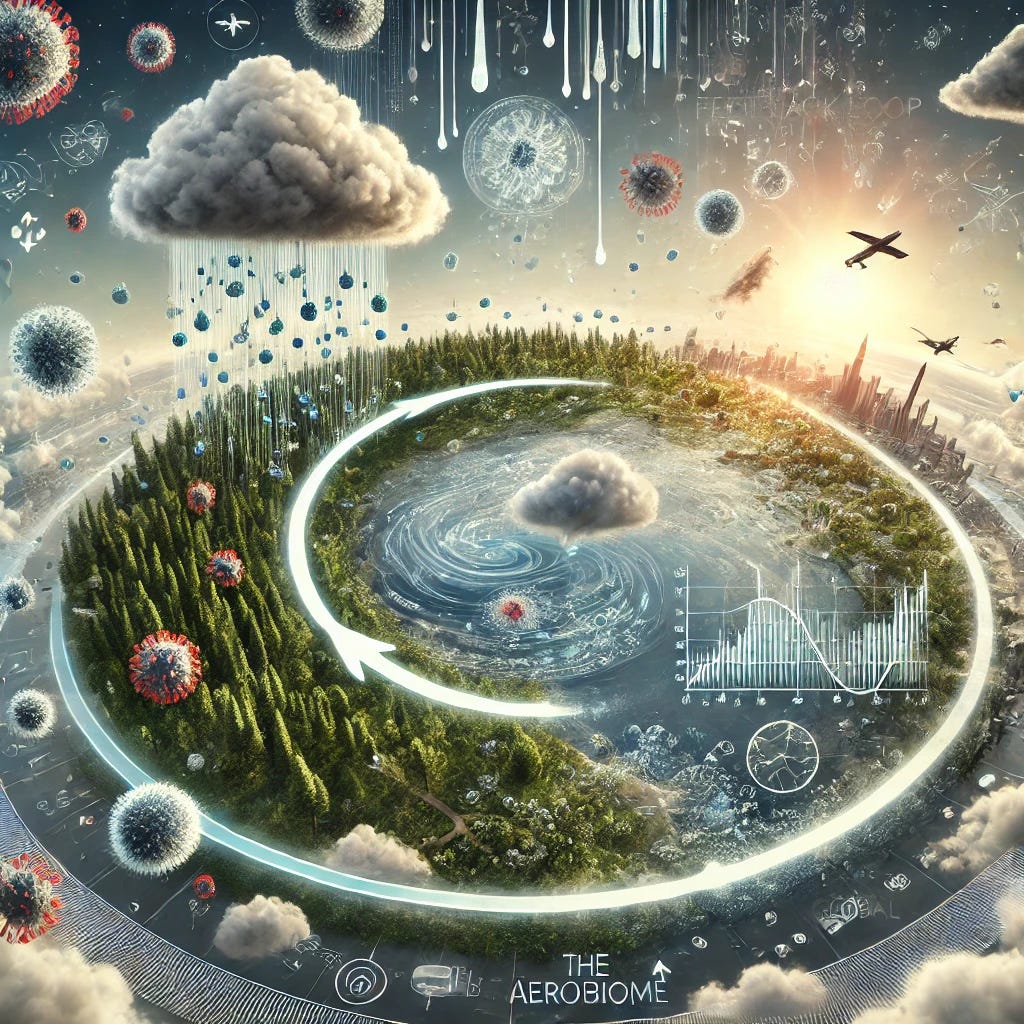
The Hidden Ecology of the Air
Billions of microbial cells swirl through the lower atmosphere at any given moment. Studies have found metabolically active species of Pseudomonas, Bacillus, and Cladosporium in high-altitude air samples, demonstrating that airborne life is not only viable but dynamic (DeLeon-Rodriguez et al., 2013). These airborne organisms originate from oceans, forests, cities, and even human bodies. Each environment contributes a unique microbial fingerprint to the air, which changes with seasons, temperature, and weather.
While the aerobiome has been studied for its role in agriculture and disease, its influence on psychology has scarcely been considered. And yet, we already know that microbes can affect mood.
From Gut-Brain to Air-Brain?
The gut-brain axis has revolutionized how we think about mood regulation. Intestinal bacteria produce or modulate neurotransmitters like serotonin, dopamine, and GABA, impacting anxiety, depression, and cognitive function (Cryan et al., 2019). Could inhaled microbes influence mood in a similar way, not by colonizing us, but by triggering biochemical changes in the respiratory tract, olfactory bulb, or even immune signaling?
Inhaled microbial byproducts might reach the brain indirectly, modulating cytokines or hormones that affect neurological function. Alternatively, some volatile organic compounds (VOCs) produced by microbes may be psychoactive when inhaled. This opens the possibility that breathing different air microbiomes could shift collective mood in measurable ways.
The Feedback Loop Model
The proposed feedback loop works as follows:
Human emotional states influence the aerobiome. In periods of stress or unrest, human behaviors change. Transportation increases, pollutants shift, indoor-outdoor movement patterns alter, and building HVAC systems operate differently. All of these modify the microbial composition of the air.
The aerobiome influences human mood. These changes in microbial composition could affect airborne neuroactive compounds. As the microbial cloud shifts, so too might the ambient emotional tone of those inhaling it.
Reinforcement or modulation occurs. This feedback either amplifies a dominant mood (e.g., collective anxiety) or introduces new emotional vectors (e.g., calm during forest bathing).

This is not mere metaphor. Studies have already shown that exposure to natural environments rich in microbial diversity correlates with reduced inflammation and better mood (Prescott et al., 2017).
Potential Experimental Designs
To test this hypothesis, researchers could:
Sample urban, suburban, and forest air for microbial content and VOC profiles.
Use wearable biosensors and mood surveys to assess human emotional states in parallel.
Expose animal models to different air microbiomes in controlled chambers and assess behavioral and neurochemical changes.
Investigate correlations between regional aerobiome shifts and spikes in mental health outcomes using public health data.
Advanced techniques in metagenomics and metabolomics make this approach feasible.
Philosophical and Clinical Implications
If air can influence our feelings, then mood is not just internal—it's ecological. The implications for architecture, urban planning, and public health are profound. Could future hospitals use curated microbial air to promote recovery? Might cities deploy airborne psychobiotics to reduce stress? Could we measure societal well-being by sampling the air?
It also raises deeper philosophical questions. What if our thoughts are not entirely our own? What if collective emotion is less a product of cultural narrative and more a biogeochemical field effect?

The Aerobiome Feedback Loop is a speculative framework, but one grounded in real biological mechanisms and environmental data. By exploring this intersection between atmospheric science and neurobiology, we may uncover a hidden layer of emotional ecology—one that floats silently around us, shaping how we feel, think, and act.
References
Cryan, J. F., et al. (2019). The Microbiota–Gut–Brain Axis. Physiological Reviews, 99(4), 1877–2013.
DeLeon-Rodriguez, N., et al. (2013). Microbiome of the upper troposphere: Species composition and prevalence. PNAS, 110(7), 2575–2580.
Prescott, S. L., et al. (2017). The skin microbiome: Impact of modern environments on skin ecology, barrier integrity, and systemic immune programming. World Allergy Organization Journal, 10(1), 29.
ARE WE INFLUENCING THE AIR OR IS THE AIR INFLUENCING US, CHAT
ARE MY THOUGHTS MY OWN? OR ARE MY THOUGHTS THE MOLD IN MY HVAC UNIT?
I mean, fuck, Stoic's out here on substack crying about gut health , now psychoactive aero biome byproducts.. what are you guys trying to tell me... im feelin very Schopenhauer about this whole thing... [[Im being Black pilled]] IM A WALKING SPONGE.. wait.. it's true..
Mind blown! The idea that the air we breathe could influence collective mood is wild but also strangely intuitive. Makes you wonder what city smog is doing to our emotions…