
Temporal Synesthesia
A Hypothetical Condition Linking Subjective Time Perception to Multidimensional Phase Resonance

Abstract
This paper introduces the speculative concept of temporal synesthesia, a proposed cognitive phenomenon in which individuals perceive time not as a linear progression but as a sensory, multidimensional experience—akin to spatial geometry, auditory harmonics, or visual patterns. Grounded in emerging research on synesthesia, time perception, and quantum cognition, the hypothesis suggests that such perceptions may result from neural resonance with nonlocal phase structures in spacetime. We explore neurological, phenomenological, and theoretical frameworks for this idea, considering implications for consciousness studies, physics, and philosophy of mind.
Beyond the Arrow of Time
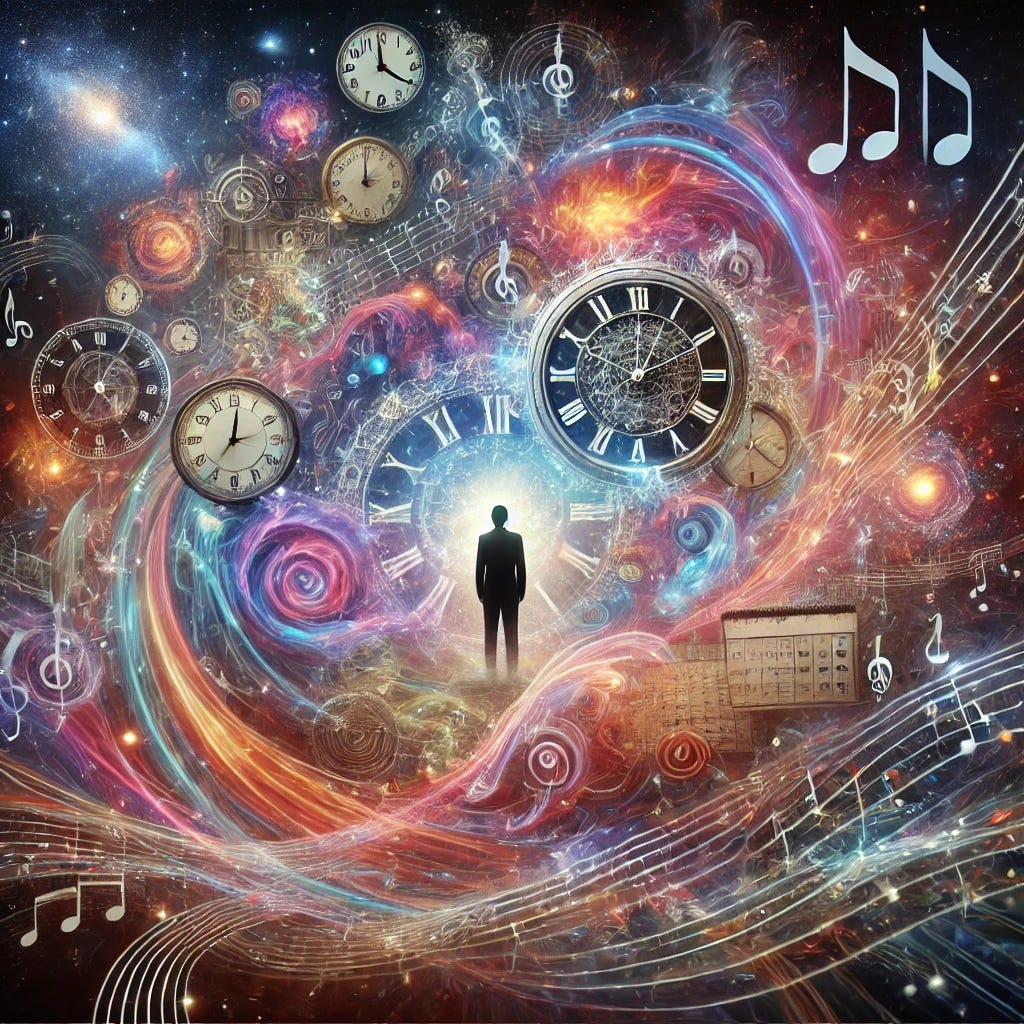
To most people, time flows forward, evenly and unidirectionally. We remember the past, act in the present, and anticipate the future. But what if this intuitive sense is not universal—not only across species but within our own neurology? This paper proposes that time, like color or sound, might be felt differently by some individuals, not just metaphorically but neurologically. We call this hypothetical condition temporal synesthesia.
Synesthesia is usually thought of as cross-activation between sensory areas—for instance, someone might see colors when hearing music or associate specific tastes with shapes. But could such a perceptual blend extend into how the brain experiences time? And could these sensations hint at deeper, possibly multidimensional features of temporal reality?
What Is Temporal Synesthesia?
Temporal synesthesia, as hypothesized here, involves a perceptual or pre-conscious sensitivity to complex phase patterns across time—not just subjective duration or speed, but shapes, textures, or tonalities of time. These sensations might be fleeting, unreportable in traditional language, or embedded in emotional or aesthetic experience. Anecdotal accounts from artists, mystics, and individuals with autism or epilepsy sometimes describe moments where "time became folded," "circular," or "layered like chords." Rather than dismissing such reports as poetic metaphors, this hypothesis suggests they may arise from legitimate neurocognitive variations.
Scientific Foundations
1. Synesthesia and Cross-Modal Perception
Neurologist V.S. Ramachandran has extensively studied synesthesia and found consistent cross-modal mappings between sensory cortices (Ramachandran & Hubbard, 2001). fMRI studies show unusual connectivity between regions like the fusiform gyrus and the auditory cortex. If time perception is distributed across cortical and subcortical systems (Wittmann, 2013), perhaps rare forms of synesthesia might involve cross-talk between time-processing areas (like the supplementary motor area and basal ganglia) and sensory networks.
2. Neural Oscillations and Phase Coupling
The brain is an oscillatory organ. Neuronal ensembles across different regions synchronize in gamma, theta, and alpha rhythms depending on cognitive state. Phase-locking and cross-frequency coupling are fundamental for working memory, prediction, and attention (Fries, 2005). It’s conceivable that some individuals—through genetic, developmental, or epigenetic factors—may have more plastic or resonant thalamocortical loops that allow entrainment to unusual patterns of temporal input.
3. Time as a Geometric or Phase Structure
In theoretical physics, some models propose that time is not merely a scalar but a structured or even multidimensional entity. Bars (2001) and others have proposed two-time physics, suggesting that spacetime might emerge from higher-dimensional phase manifolds. Similarly, in certain interpretations of quantum gravity and string theory, time may be emergent or layered. If so, a brain that is somehow phase-locked to such structures might “feel” temporal geometries beyond linear time.
Phenomenological Accounts
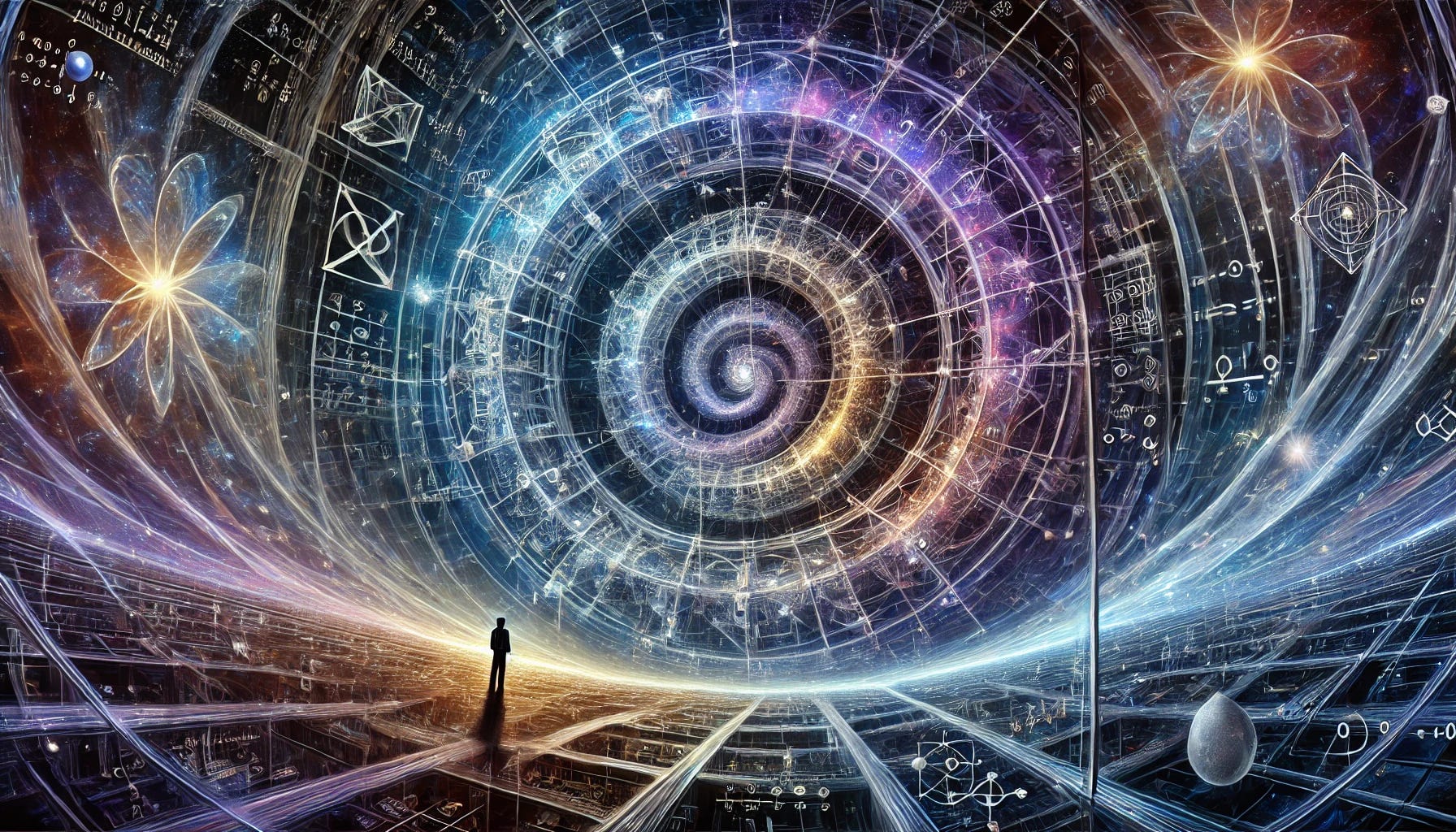
While there is no formal clinical diagnosis of temporal synesthesia, scattered self-reports offer provocative glimpses. Some individuals with temporal lobe epilepsy describe moments where time dilates into a vast geometric chamber. Autistic individuals sometimes report intense sensitivity to repeating time patterns, like a rhythm they cannot ignore. Meditative states or psychedelic experiences often include sensations of folded, fractal, or recursive time.
Example: A 34-year-old artist interviewed in a 2018 qualitative study on altered time perception (unpublished field notes, personal communication) described a moment in a forest where time felt "woven," like overlapping waves she could walk through. While anecdotal, such descriptions align with our proposed model.
A Speculative Model: Nonlocal Phase Entrainment
Here we propose a speculative model. Let us suppose that the structure of spacetime includes phase patterns not directly accessible to conventional sensory modalities. These patterns might be described in higher-dimensional terms, such as phase manifolds or nonlocal interference fields.
If certain neural circuits—particularly thalamocortical resonant loops—can couple nonlocally to these phase patterns, perhaps due to unique oscillatory dynamics, the individual might experience these phase geometries as qualia of time. Just as color is a perceptual translation of electromagnetic wavelength, temporal textures might be a perceptual translation of phase topologies in spacetime.
This would suggest a form of resonance-based consciousness, where awareness of time is not a passive registration but a dynamic entrainment. This is loosely supported by the resonance theory of consciousness proposed by Hunt & Schooler (2019), which suggests consciousness arises from shared resonance among systems.
Experimental Design Ideas
Testing this idea would be difficult but not impossible. Several lines of inquiry could help:
EEG and MEG studies: Identifying unusual phase coupling patterns in individuals who report nonlinear time perception.
Neurofeedback: Training individuals to increase coherence between theta and gamma oscillations and assessing changes in temporal qualia.
Psychophysics: Designing temporal discrimination tasks that assess how people perceive overlapping or nested intervals.
Pharmacological modulation: Exploring how psychedelics like psilocybin (known to disrupt default time perception) modulate oscillatory signatures linked to our model (Carhart-Harris et al., 2014).
Implications and Philosophy
If time can be felt differently—if some people can truly sense its multidimensional resonance—then time may not be as rigidly linear or uniform as commonly assumed. This recalls Bergson’s idea of durée, or lived time, and phenomenological philosophers like Husserl and Merleau-Ponty, who argued that time is not simply measured but constituted in consciousness.
In this model, consciousness does not just ride the wave of time, it tunes it.
This view also reinvigorates metaphysical debates about the ontology of time. Is time an emergent illusion, as Julian Barbour suggests? Or is it a deeply real, richly textured manifold that only a few can feel directly?

Temporal synesthesia is a hypothesis born at the intersection of neuroscience, physics, and phenomenology. It proposes that certain minds may be sensitive to the phase-based textures of time, not merely its pace. Whether this is a quirk of brain wiring or a doorway into deeper realities remains an open question.
But if true, it might explain why some people feel that time is not passing—but singing.
References
Bars, I. (2001). Two-Time Physics. Physical Review D, 62(4), 046007.
Bohm, D. (1980). Wholeness and the Implicate Order. Routledge.
Carhart-Harris, R. L., et al. (2014). The entropic brain: a theory of conscious states informed by neuroimaging research with psychedelic drugs. Frontiers in Human Neuroscience, 8, 20.
Fries, P. (2005). A mechanism for cognitive dynamics: neuronal communication through neuronal coherence. Trends in Cognitive Sciences, 9(10), 474-480.
Hunt, T., & Schooler, J. (2019). The easy part of the hard problem: a resonance theory of consciousness. Frontiers in Human Neuroscience, 13, 378.
Ramachandran, V. S., & Hubbard, E. M. (2001). Synaesthesia--a window into perception, thought and language. Journal of Consciousness Studies, 8(12), 3–34.
Wittmann, M. (2013). The inner sense of time: how the brain creates a representation of duration. Nature Reviews Neuroscience, 14(3), 217–223.