
Something Feels Off
The Middle Is Gone

There used to be a middle.
You had an idea.
You worked through it.
You refined it.
You struggled with it.
That middle was messy.
Slow. Frustrating. Unclear.
But it was also where most of the value came from.
That’s starting to disappear.
Now you go from idea to result almost instantly.
A prompt replaces the process.
And something important gets lost in that jump.
Because the middle wasn’t just effort.
It was where understanding was built.

The Middle Was Where Everything Happened
The middle was never the part people liked.
It was the part where things didn’t work yet.
Where ideas were incomplete.
Where writing felt off.
Where you didn’t fully understand what you were doing.
It was slow.
It was uncomfortable.
And it was necessary.
Because that’s where:
ideas got refined
mistakes got exposed
understanding actually formed
You didn’t just produce something.
You became better at producing it.
AI Collapses the Process
AI compresses that entire section.
You start with an idea.
You get an output.
The middle disappears.
Drafting, iteration, trial and error, even parts of thinking itself get skipped.
Research on cognitive effort shows that struggling through a problem helps build deeper understanding and long-term retention (Bjork & Bjork, 2011).
AI removes that struggle.
Which changes what gets built internally.
What You Lose When You Skip It
At first, this feels like progress.
Faster output.
Less friction.
Cleaner results.
But something subtle changes.
You get the result…
Without building the structure behind it.
That shows up later.
You:
can’t explain it clearly
can’t recreate it without AI
can’t extend it beyond the original output
Because the understanding never fully formed.
The Illusion of Capability
This creates a new kind of illusion.
You look capable.
The output is good.
Sometimes very good.
But the capability isn’t always yours.
It’s borrowed.
Psychologists call this the illusion of competence — when performance looks strong in the moment but doesn’t reflect deeper understanding (Bjork & Bjork, 2011).
AI makes this easier to fall into.
Because the output is immediate.
And convincing.

Why the Middle Mattered More Than We Thought
The middle wasn’t just about effort.
It was about feedback.
You try something → it doesn’t work → you adjust.
That loop is how skill develops.
It’s also how judgment develops.
Without it, you don’t just lose repetition.
You lose calibration.
What works.
What doesn’t.
Why something feels right or wrong.
Those things don’t come from results.
They come from process.
This Shows Up Everywhere
This isn’t just about writing.
It’s happening in:
coding
design
research
learning
Anywhere there used to be a gap between starting and finishing.
That gap is shrinking.
And with it, the opportunity to build depth.
The New Risk
The risk isn’t that people become less productive.
They’ll become more productive.
The risk is that people become less grounded in what they produce.
You can move faster than your understanding.
You can build without knowing how it works.
You can create without fully thinking.
And most of the time, nothing breaks immediately.
Which makes it harder to notice.
What Still Matters
The middle isn’t completely gone.
It just moved.
If you want to keep building real skill, you have to recreate it intentionally.
Slow down when it would be easier to speed up.
Work through something manually before prompting.
Question outputs instead of accepting them.
In other words:
Put the middle back.
Even when you don’t have to.
The Real Shift
AI didn’t just make things faster.
It changed where learning happens.
From process
→ to output
And that’s a fundamental shift.
Because output can be generated instantly.
Understanding can’t.
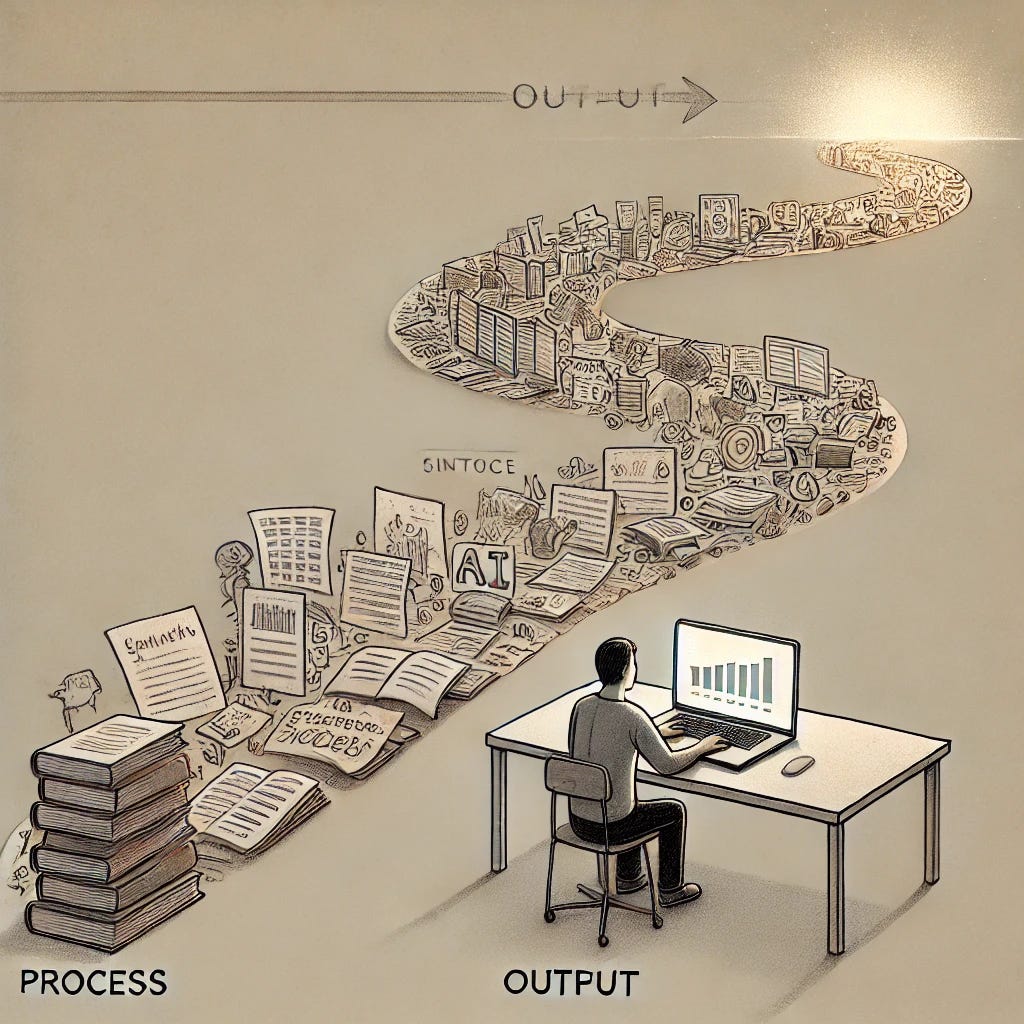
The middle was never the most visible part.
But it was the most important.
It’s where ideas became clear.
Where skills were built.
Where understanding formed.
Now it’s disappearing.
And once it’s gone, the question isn’t how fast you can produce something.
It’s whether you actually know what you just made.
References
Bjork, R. A., & Bjork, E. L. (2011). Making Things Hard on Yourself, But in a Good Way: Creating Desirable Difficulties to Enhance Learning.
I use ChatGPT daily for a range of purposes from helping me generate documents to learning how to troubleshoot complicated electro-mechanical systems. I don’t believe the “middle is gone” in any stretch of the imagination. The middle is alive and well, but I now have an at-my-disposal, like minded helper to navigate through the challenges of the middle and reach conclusions and produce results more quickly.
Also, I don’t believe AI is going to destroy humanity as we know it or the need for workers in the work force, taking today’s critics’ comments to an implied limit. No more than the invention of the tractor destroyed humanity or the need for workers to perform other vital tasks in our economy.
AI will transform lives and change how humanity works. And solve problems we previously couldn’t solve. And change the way science is performed, from a “study~> hypothesize~> test~> understand model” to a “generate solution~> study~> understand model”, shortening and expanding discovery in the world around us. There are other real dangers that could destroy us.
I'm Gen X and was taught to question everything in school. No matter how revered, how reputable we were taught to ask questions, be critical and then proceed. Fast forward a few decades and I was teaching freshman at an American university. First year writing. Writing was the task but critical thinking was really the heavy lift. Most, not all, students accepted the written word as true. On paper, in a book, and scariest-on a screen. The unit where I had to teach them how to ask questions to determine IF a website/page was reputable was disconcerting. These were teens who has been online for most of their life already. How was it that they were not taught this skill?
Fast forward to the AI surge and this same anemic skill is present not just in young people's experiences with LLM, Gen AI, etc but in those who didnt have the critical thinking emphasis that my public school did.
I feel like daily I am looking at intelligent, functional adults and with my glasses in skeptical teacher position explaining that AI is.... and isnt.... and cant.....
Its not just misinformation in the hype, its lack of questioning if this misinformation is real. True. Reliable.
What I am saying is that this isnt a new gap in functional knowledge, its a carry over from a time before when we stopped doing something very important; teaching criticial thinking. Its far from too late but man is it a big task.
Great post, as always. Thanks.