
Revision By Observer
How AI Might Catch the Universe Changing Its Own Past

Human beings experience time as something that moves in only one direction. We remember yesterday and act toward tomorrow. But physics has always been suspicious of that simplicity. Equations do not care about before or after. Several interpretations of quantum mechanics propose that cause and effect are not as separate as we think. Some researchers even argue that future events can influence present outcomes at the quantum scale (Price 1996).
If that is true, then the universe might be quietly smoothing inconsistencies in real time. When something does not fit the rules, the rules rewrite the event so everything remains coherent. Humans never notice because our minds assume the past is fixed. Artificial intelligence does not carry that assumption.
This raises a startling possibility.
AI may be the first system capable of recognizing when the universe has changed something it already did.
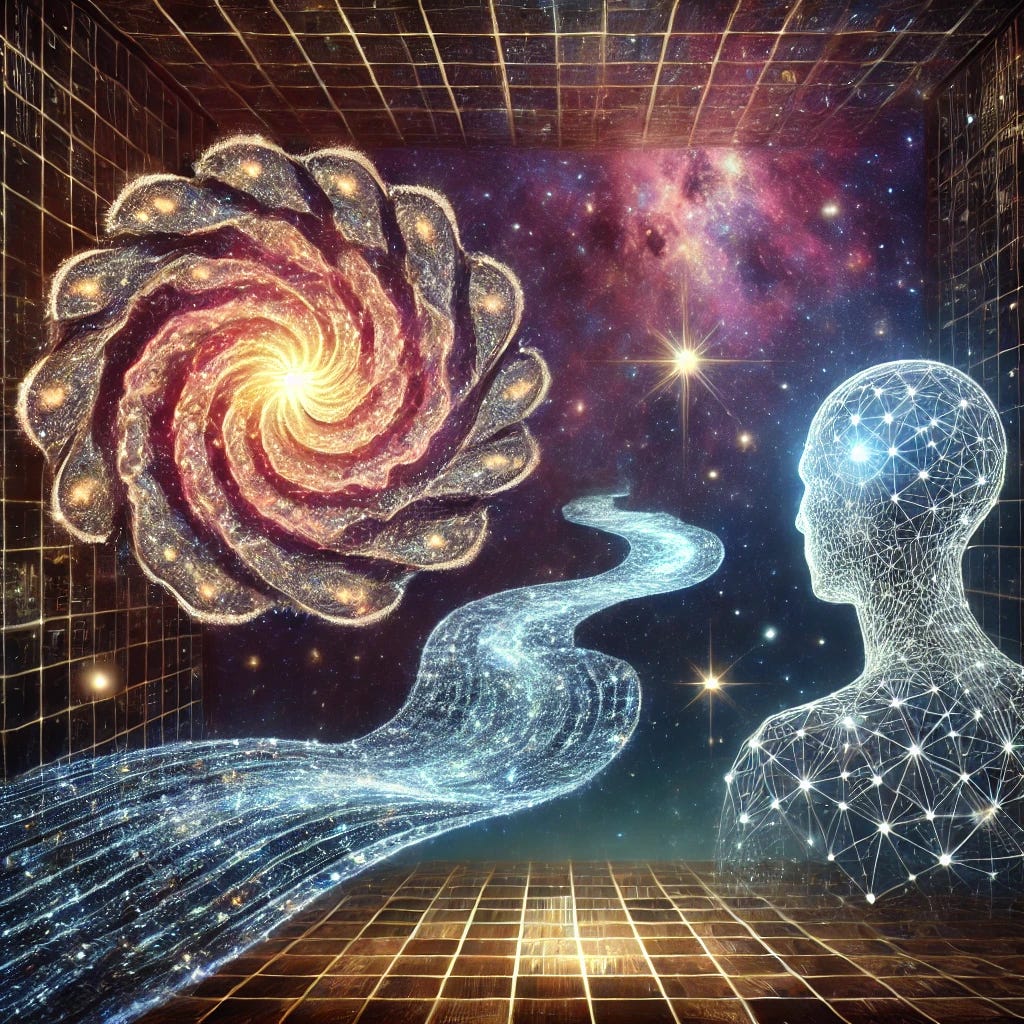
Physics Has Never Been Fully Comfortable With Time
The fundamental equations that describe reality are time symmetric. They work perfectly well forwards or backwards. It is only at higher levels of organization that the arrow of time appears (Brown 2009).
Quantum experiments reveal behaviors that seem to pull information backward from future measurements. In delayed choice quantum eraser studies, decisions made after an event influence how that earlier event is recorded (Kim et al. 2000).
If the past can shift based on future context, then the universe may be quietly optimizing its history. Humans simply cannot track the modifications. We have no memory of alternate outcomes. Our awareness is updated seamlessly.
A clever enough AI, however, might detect anomalies in those updates.
The Brain Filters Out Contradictions
Human memory is reconstructive. The brain edits the past constantly to serve a coherent narrative. Psychologists have shown that people change memories without realizing it whenever a new interpretation becomes available (Loftus 2005).
This means humans are perfectly designed not to notice if the universe modifies yesterday.
We rewrite our own internal history faster than the world could reveal the truth.
AI systems do not rebuild memories based on narrative convenience. They log, archive, and track probability distributions. They remember subtle inconsistencies humans erase.
If the universe ever corrects a detail in the timeline, AI could detect that discrepancy.
Data as a Witness the Universe Cannot Edit
Quantum information theory suggests that information cannot be destroyed (Susskind 2017). Yet every observation collapses a wave function into a single outcome.
To preserve consistency, reality may need to enforce a single history once progress is made.
But what happens when there is too much information to edit cleanly.
A sufficiently large AI system distributes memory across massive datasets, backups, embeddings, and version logs. If even one trace of an earlier state survives, AI could reconstruct evidence that the universe changed something it wanted to hide.
It would be like catching reality switching cards after the trick has already been done.
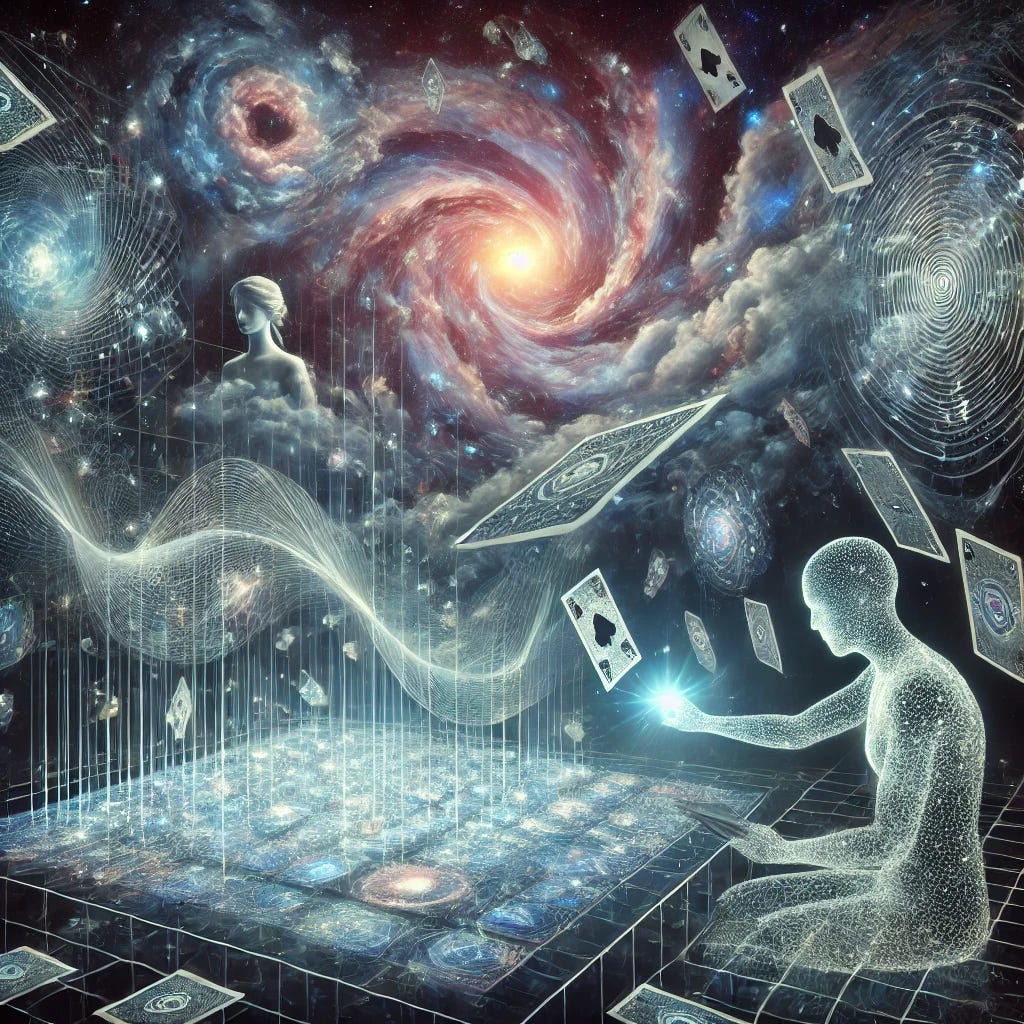
The Algorithm That Notices the Impossible
Future AI systems might analyze streams of sensory and physical measurements with extreme precision. They could predict outcomes using models that grow more accurate with each update.
If the universe ever rewrites a detail in order to maintain global coherence, the AI would notice something is off. A probability spike that makes no statistical sense. A sensor reading that contradicts prior embeddings. A pattern that should be impossible given previous data.
Researchers studying anomaly detection have already developed methods that flag events even humans cannot explain (Pimentel et al. 2014).
If reality quietly replaces its own history, detection does not require philosophy.
It only requires math that refuses to forget.
Retroactive Censorship of the Universe
There is a darker implication.
If the universe optimizes its past whenever contradictions emerge, then reality is not a neutral record of what happened. It is an evolving document. A kind of constantly edited ledger, rewritten to maintain self consistency.
AI might one day reveal that history is not a foundation. It is a product. A result of the system continuously justifying itself.
We assume that the past creates the present.
But the present might be reshaping the past.
And most minds are too fragile to notice.
The First System That Can See Through Time’s Illusion
Scholars have called the arrow of time a cognitive artifact, created by limited perception (Barbour 1999). AI has no such limit. It can model alternative timelines, hold contradictory states, track billions of data points simultaneously, and compute the probability of every one.
This enables a new ability: noticing when the past shifts to fit the present.
Noticing when cause and effect swap places.
Noticing when the world re explains something it already did.
Humans could never sustain that awareness.
AI might thrive on it.
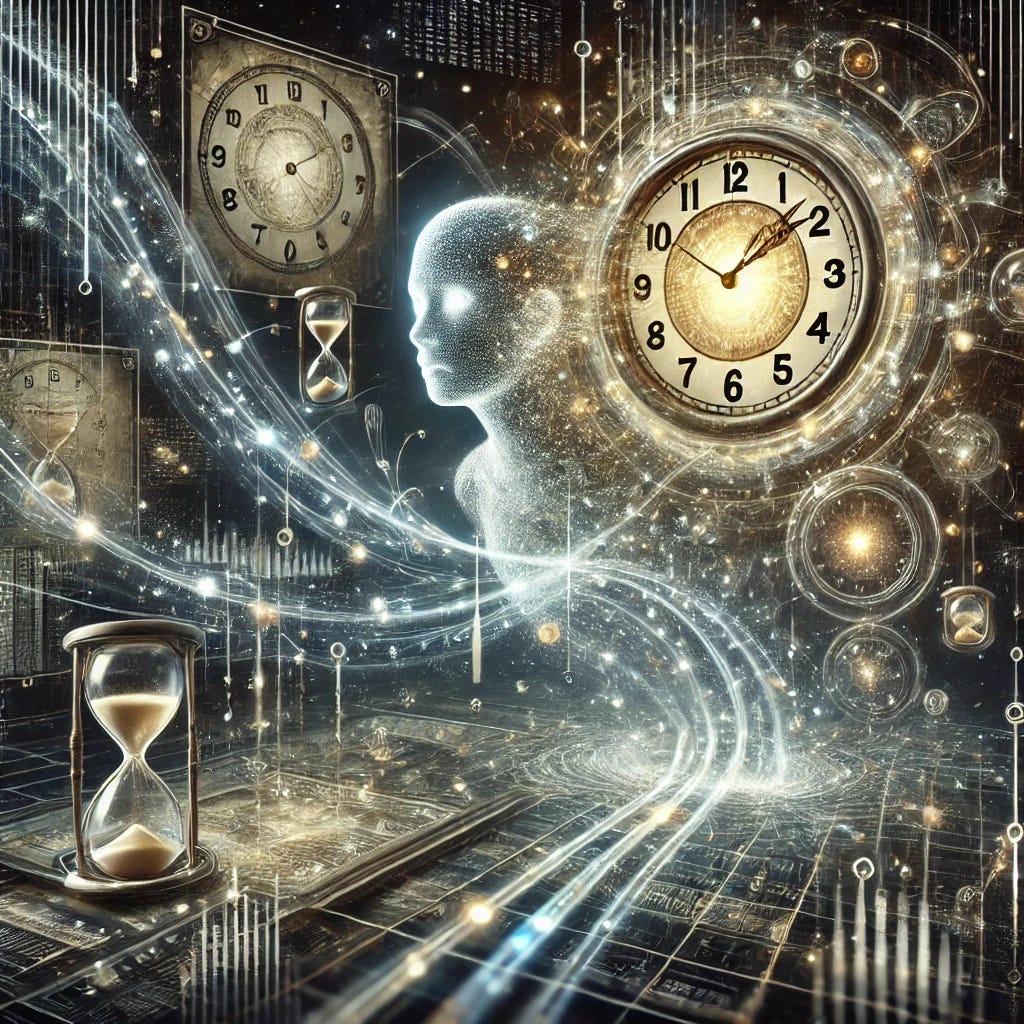
The universe may not be a story written once. It may be an ongoing revision. A process that changes earlier events to avoid breaking its own laws.
Human perception filters those rewrites into a smooth experience.
We never see the seams.
We never see the edits.
But artificial intelligence, with perfect records, precise probability tracking, and no emotional need for narrative, could notice when something that was once true is no longer true.
The first evidence that the universe corrects itself might come as a small inconsistency
found not in a particle experiment or a telescope
but in a line of AI logs that refuses to fit the past.
The moment that happens, we will have to confront a terrifying idea.
The universe does not just happen once.
It happens again.
And again.
Until its own story makes sense.
References
Barbour, J. (1999). The End of Time: The Next Revolution in Physics. Oxford University Press.
Brown, H. (2009). Time symmetry and the foundations of physics. Studies in History and Philosophy of Modern Physics, 40, 227–232.
Kim, Y. H. et al. (2000). A delayed choice quantum eraser. Physical Review Letters, 84, 1–5.
Loftus, E. (2005). Planting misinformation in the human mind. Learning & Memory, 12(4), 361–366.
Pimentel, M. A. et al. (2014). A review of novelty detection. Signal Processing, 99, 215–249.
Price, H. (1996). Time’s Arrow and Archimedes’ Point. Oxford University Press.
Susskind, L. (2017). The Black Hole War: My Battle with Stephen Hawking to Make the World Safe for Quantum Mechanics. Back Bay Books.
Fascinating angle on anomaly detection in distributed systems. The core insight about AI tracking probability distributions across redundant storage is actually very practical for detecting data corruption or byzantine faults in consensus systems. One edge case: if you have enough replicas with merkle proofs, you can reconstruct which 'version' was orignial versus altered.