
Quantum Computing Breaks the Internet
Exploring ChatGPT

Quantum computing is poised to revolutionize technology, offering computational power far beyond traditional computers. While this advancement promises breakthroughs in medicine, artificial intelligence, and materials science, it also poses a significant threat to online security. The very encryption methods that safeguard financial transactions, personal communications, and government secrets could become obsolete overnight. If quantum computers achieve their full potential, the internet as we know it could be fundamentally compromised.

How Encryption Protects the Internet
Today’s internet security relies on encryption methods such as RSA (Rivest-Shamir-Adleman) and ECC (Elliptic Curve Cryptography). These cryptographic systems depend on the difficulty of solving complex mathematical problems, like factoring large prime numbers or computing discrete logarithms. Conventional computers would take thousands, if not millions, of years to break these encryptions. However, quantum computers operate on entirely different principles, leveraging the power of quantum mechanics to solve these problems exponentially faster.
Shor’s Algorithm: The Quantum Threat
In 1994, mathematician Peter Shor developed an algorithm proving that a sufficiently powerful quantum computer could efficiently factor large numbers, rendering RSA and ECC encryption useless. While classical computers rely on binary bits (0s and 1s), quantum computers use qubits, which can exist in multiple states simultaneously due to superposition and entanglement. This allows them to perform vast calculations in parallel, making previously impossible tasks trivial.
If a quantum computer with enough qubits is built, it could decrypt encrypted messages, steal sensitive information, and even forge digital signatures, leading to widespread cyber chaos.
The Potential Consequences
The collapse of encryption would have devastating consequences:
Financial System Collapse – Online banking, stock trading, and digital transactions depend on encryption for security. A quantum attack could expose account credentials, allowing hackers to transfer funds or manipulate markets.
Privacy Destruction – Personal communications, emails, and private chats encrypted with current standards would be readable, exposing sensitive data worldwide.
National Security Risks – Governments and military organizations rely on encryption for classified communications. Quantum computing could enable adversaries to decrypt state secrets, leading to geopolitical instability.
Forgery and Identity Theft – Digital signatures verify the authenticity of documents, contracts, and transactions. A quantum-powered adversary could forge digital signatures, creating fraudulent agreements or bypassing authentication measures.
Quantum-Resistant Encryption: The Race Against Time
Recognizing the threat, researchers are developing post-quantum cryptography (PQC), encryption methods that resist quantum attacks. The U.S. National Institute of Standards and Technology (NIST) is in the process of selecting quantum-resistant algorithms to replace RSA and ECC.
Promising approaches include:
Lattice-based Cryptography – Uses complex lattice structures that even quantum computers struggle to solve.
Hash-based Cryptography – Relies on mathematical functions resistant to quantum attacks.
Code-based Cryptography – Builds on error-correcting codes to create secure encryption.
Will Quantum Computing Really Break the Internet?
While quantum computing’s potential is undeniable, the timeline for reaching a point where it threatens encryption is uncertain. Current quantum computers are still in the early stages, with companies like Google, IBM, and Microsoft racing to develop scalable, fault-tolerant quantum processors. Experts estimate that breaking RSA encryption would require at least millions of stable qubits, a feat far beyond today’s capabilities.
However, waiting for the threat to materialize is risky. Governments and tech companies are already investing in quantum-resistant security measures. The transition to quantum-safe encryption will be a massive undertaking, requiring upgrades to internet protocols, financial institutions, and digital infrastructure worldwide.
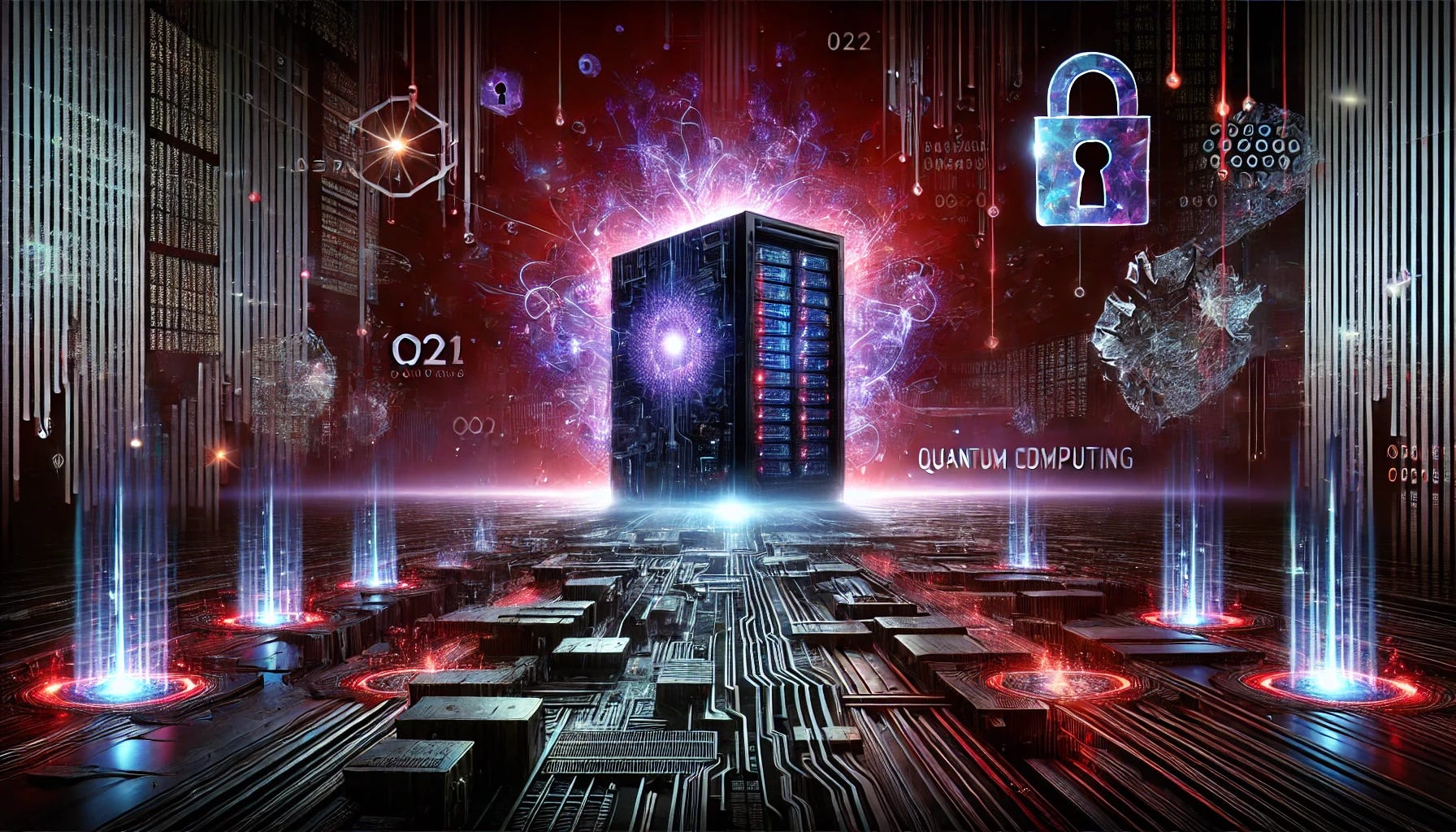
Quantum computing holds incredible promise, but it also presents one of the greatest cybersecurity challenges of the digital age. If current encryption methods become obsolete, financial systems, personal privacy, and national security could all be at risk. The race is now on to develop quantum-resistant encryption before quantum computers become powerful enough to break the internet. Whether we win that race will determine the future of cybersecurity in a quantum-powered world.