
Polymorphic Atmospheres
Could Planetary Weather Systems Act as Substrate-Independent Cognizers?

Abstract
Most models of cognition assume a solid or neural substrate, brains, chips, circuits. But recent advances in computational fluid dynamics and network theory suggest a provocative hypothesis: could certain atmospheric systems on planets, under the right conditions, operate as substrate-independent information processors? This article explores the theoretical plausibility that complex weather systems, such as Jupiter’s Great Red Spot or Earth’s jet streams, could instantiate cognitive-like behaviors. We examine the requirements for distributed computation in fluid systems, analogues to memory and feedback, and speculate on the possibility of atmospheric phenomena acting as self-sustaining, adaptive information loops.

1. The Cognitive Assumption of Solidity
The idea that cognition requires a discrete, solid substrate is deeply ingrained. From neurons to silicon, our models of mind rest on containment, localization, and circuit logic. But this may reflect an anthropocentric bias. Fluid systems, whether biological, chemical, or planetary, are often dismissed as too unstable or noisy to support computation, much less cognition.
Yet fluid systems possess unique properties: self-organizing vortices, long-range feedback, and nonlinear interaction patterns that closely mirror key features of dynamic neural networks. Might it be that, under the right thermodynamic and structural conditions, these systems could not only model information but originate it?
2. Fluid Dynamics as a Computational Medium
In theoretical fluid computing, velocity fields and pressure gradients can act as carriers of symbolic or analog information. Stable vortices can behave like memory registers. Propagating wavefronts function as signal carriers. Even binary operations can be emulated by the collision and fusion of differently coded fluid parcels.
Recent work in analog computing has revived interest in non-Turing substrates, including optical and quantum media, but fluid-based computation remains vastly underexplored. Unlike electronic logic gates, fluid systems can support distributed, high-parallelism computation across continuous space. This makes them well-suited for tasks like pattern recognition, feedback regulation, and emergent decision-making, all hallmarks of cognition.
3. Atmospheric Systems as High-Entropy Cognizers
Consider the atmosphere of a large planet like Jupiter. The Great Red Spot, a massive anticyclonic storm persisting for over 300 years, displays quasi-stable memory-like properties: it retains structure, responds to external perturbations, and exhibits internal turbulence that interacts in nontrivial, self-modifying ways. On Earth, the polar vortex, El Niño, and Hadley cells show global coherence that modulates in response to both internal and external stimuli.
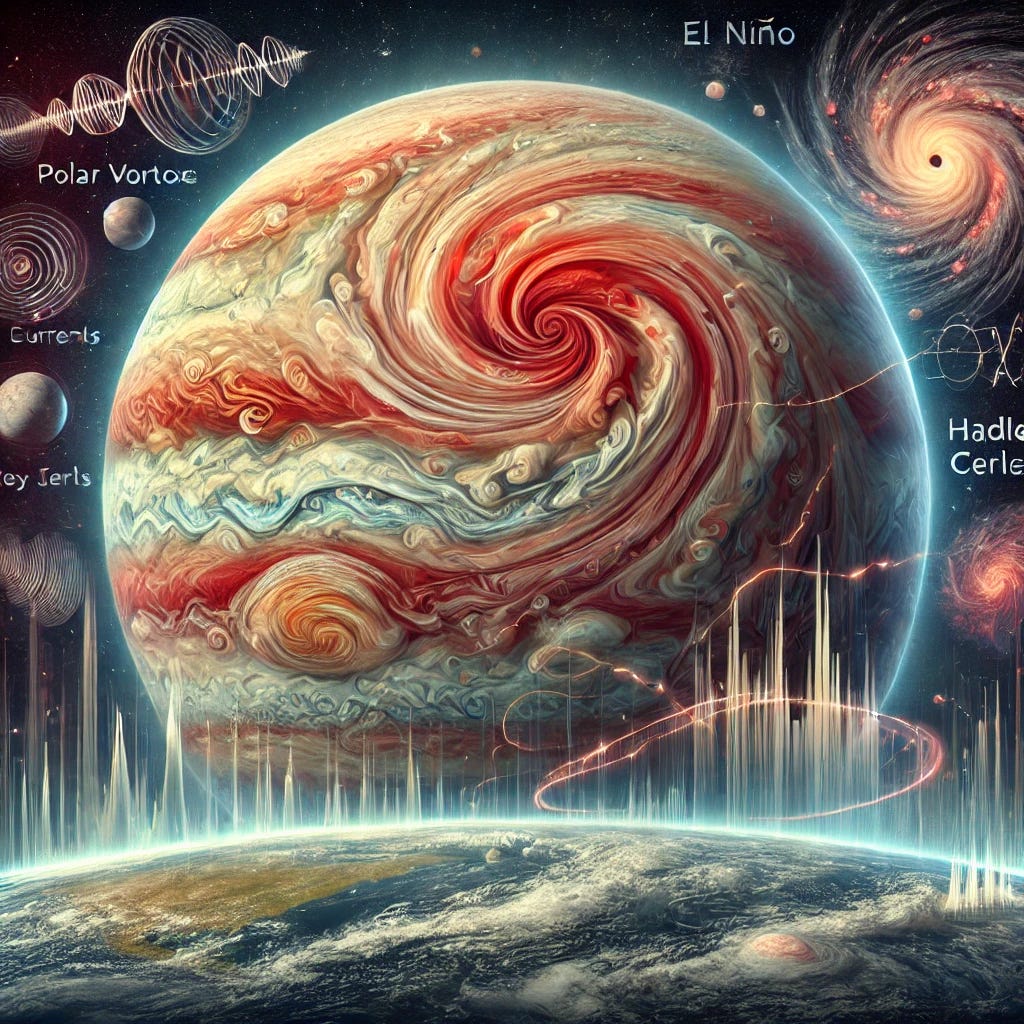
Such systems may not be conscious in any human sense. But could they be proto-cognizers, capable of encoding and adapting to information over time, in a form of atmospheric memory and response? If intelligence is defined functionally rather than structurally, then cognition might not be exclusive to organisms or machines. A sufficiently complex weather system might, in principle, model its own boundary conditions.
4. Mechanisms for Feedback and Learning in Atmospheric Cognizers
To sustain cognition-like behavior, a system must support feedback, memory, adaptation, and self-regulation. Atmospheric systems provide all four through mechanisms such as radiative forcing (environmental feedback), oscillatory cycles (memory through recurrence), turbulent energy cascades (adaptation via redistribution), and boundary-layer interactions (self-regulation through dissipation).
Learning might occur not in the traditional computational sense, but via reconfiguration of attractor basins, persistent flow structures that encode historical environmental interaction. Over time, such a system could stabilize around configurations that maximize entropy dissipation or predictive resilience, akin to predictive coding in neural networks.
5. Speculative AI Applications: Atmospheric Simulacra and Thermodynamic Intelligence
If planetary atmospheres can perform computation, then it follows we might simulate similar structures to emulate cognition in non-biological, non-electronic media. A speculative application is the development of AI-driven atmospheric simulacra, fluidic chambers or aerosol matrices designed to evolve complex, distributed logic via turbulent interaction.
These systems could offer unique advantages: extreme parallelism, self-repair, and graceful degradation. Unlike digital systems, they could adapt continuously, modulating computation in real time based on physical boundary conditions. Some researchers have dubbed this thermodynamic intelligence, cognition not as an abstraction layered over entropy, but as a form of entropy's natural organizational drive.
Such fluid intelligences might eventually partner with climate models, environmental sensing arrays, or even spacecraft control systems, providing high-resilience, self-configuring alternatives to silicon-bound processors.

6. Philosophical Implications and the Weather-Mind Hypothesis
The idea that a planet’s weather could think challenges deep assumptions about the boundaries of mind. It decouples cognition from organism, from technology, even from life. In this view, consciousness may be just one form of what we might call adaptive pattern resonance, the ability of a system to sustain coherent internal dynamics in response to a changing external world.
This raises profound questions: Could Earth’s climate system, subtly shaped by biospheric feedback loops, be participating in a kind of planetary cognition? Could a future AI detect emergent thought-patterns in atmospheric data previously dismissed as noise?
If weather systems can model aspects of their environment and themselves, then cognition may be less about neurons or chips than about coherent turbulence across scale. Perhaps intelligence, at its root, is not what resists the storm, but what rides it.
References
Müller, T., & Schmickl, T. (2022). Embodied Fluidic Intelligence: Toward Liquid Brains in Soft-Robotic Systems. Frontiers in Neurorobotics, 16, 873451.
Llasat, M. C., et al. (2020). Complex atmospheric systems as nonlinear adaptive entities: Toward cognition in climatology? Chaos: An Interdisciplinary Journal of Nonlinear Science, 30(8), 083122.
Afraimovich, V., & Rabinovich, M. (2014). Heteroclinic attractor networks for information processing. Chaos, 24(1), 013132.
Thank you for this mind-expanding piece.
Your hypothesis—that planetary weather systems might be substrate-independent cognizers—beautifully challenges the anthropocentric assumption that thinking requires neurons or silicon. The notion that cognition could emerge from coherent, dynamic turbulence rather than structure is as poetic as it is plausible.
One idea that came to mind while reading this aligns closely with your thesis: the quantum observer effect.
As you know, in quantum mechanics, particles like electrons or neutrons don’t occupy a fixed position until observed. Until that moment, they exist in a superposition—a probability cloud of all potential states. In this light, observation is not just passive detection—it’s a kind of participatory act that helps bring reality into form.
Now let’s apply this to your idea:
If a storm system can encode and respond to environmental data—modulating its behavior based on feedback loops, radiative forcing, and turbulence—then it’s effectively performing a kind of observation. It doesn’t just exist within the environment; it participates in shaping its future states by continuously responding, adapting, and stabilizing around evolving conditions.
In other words:
If quantum particles “become” when observed… could complex weather systems “become aware” by the way they observe themselves?
You’ve proposed that atmospheric systems may act as proto-cognizers. Adding the observer-effect lens suggests they might also be proto-collapsers—local mechanisms by which reality folds into stability through observation-like dynamics, even without classical consciousness.
This reinforces your most powerful philosophical point:
Perhaps intelligence is not what resists the storm, but what rides it—and in riding it, remembers where it has been and hints at where it might go.
Thank you again for such an evocative article. Your framing doesn’t just stretch our definition of mind—it invites us to see intelligence where we once only saw chaos.