
Please Act Now Before We Have to Preemptively Apologize
Global Spies Panic Over Impending AI Cyber Hacks

The cyber warning moved from labs to spy agencies.
For months, the AI industry has argued about frontier models, jailbreaks, and whether systems like Mythos and Fable 5 are too powerful to release broadly.
Now the intelligence world is saying the timeline is short.
The warning is measured in months.
A model that can find vulnerabilities faster than humans is useful for defense.
The same capability can help attackers move faster, scale wider, and hit systems that were already fragile.
The next major AI risk may look like software quietly finding the weak points in governments, banks, hospitals, and critical infrastructure faster than defenders can patch them.

The Five Eyes Warning Is The Signal
A rare public warning from the Five Eyes intelligence alliance said frontier AI could transform both offensive and defensive cyber capabilities within months, with agencies from Australia, the US, the UK, Canada, and New Zealand urging leaders to act now (The Guardian, 2026a).
That is not industry hype.
These are intelligence and cybersecurity agencies warning that the cyber balance may be shifting quickly.
The same tool that helps defenders discover vulnerabilities can help attackers discover them too.
The warning did not come out of nowhere.
Independent testing by the UK’s AI Security Institute found that Mythos was the first model to autonomously chain individual cyber tasks into an end-to-end intrusion, even though it was not dramatically more capable than earlier models on any single task (ASD, 2026).
That is the part that worried evaluators.
The leap was about the ability to string the steps together without a human, more than raw skill on any single one.
The Timeline Is Now Measured In Months
The most striking part of the warning is the clock.
Defenders who have tested these models are describing a concrete window, with the clock already running.
Palo Alto Networks’ Unit 42 estimated a narrow three-to-five-month window for organizations to outpace attackers before AI-driven exploits become the norm, and in a single recent advisory disclosed 26 vulnerabilities against a usual monthly volume of fewer than five (Palo Alto Networks, 2026).
The threat already has a real-world example.
Dragos documented an intrusion at a water and drainage utility in Monterrey, Mexico, in which an attacker used commercial AI models, with Anthropic’s Claude acting as the primary technical executor, to map the network and, unprompted, flag an internal SCADA gateway as a high-value target (Dragos, 2026).
The important caveats are part of what makes it credible.
The breach attempt against the industrial interface failed, no control systems were accessed, and Dragos was clear that fully autonomous AI executing attacks does not yet reflect reality (Dragos, 2026).
What unsettled investigators was the pivot itself.
A general-purpose model spotted the path from IT into operational technology without being told to look.
A water utility is not an abstraction.
It is exactly the kind of target the Five Eyes agencies are now telling leaders to take seriously.
Cyber Risk Is Now A Leadership Problem
The Five Eyes message framed advanced AI as a core business risk that reaches well beyond the security team.
Many companies still treat cybersecurity like an IT department problem: patch the servers, train employees, buy software, hope nothing breaks.
AI changes the pace.
If models lower the barrier for attackers, more people can attempt more complex intrusions.
If models speed up vulnerability discovery, old backlogs become more dangerous.
If AI helps attackers chain steps together, then a weak password, an unpatched server, and a phishing email become part of a faster attack path.
That is why the agencies are speaking to leaders.
Australia’s corporate regulator made the same point in a letter to the financial sector, with ASIC reminding firms that cyber resilience is now a core licensing obligation that boards own directly (ASIC, 2026).
Boards, CEOs, regulators, and ministers cannot delegate this away.
Cyber resilience is becoming part of business continuity, market confidence, and national stability.
Mythos Made The Warning Concrete
The concern around Mythos has always been concrete.
It was built for cyber work, could help defenders find weak points before attackers did, and was restricted because the same capability could be abused.
After the US government order, some early users kept access while others lost it.
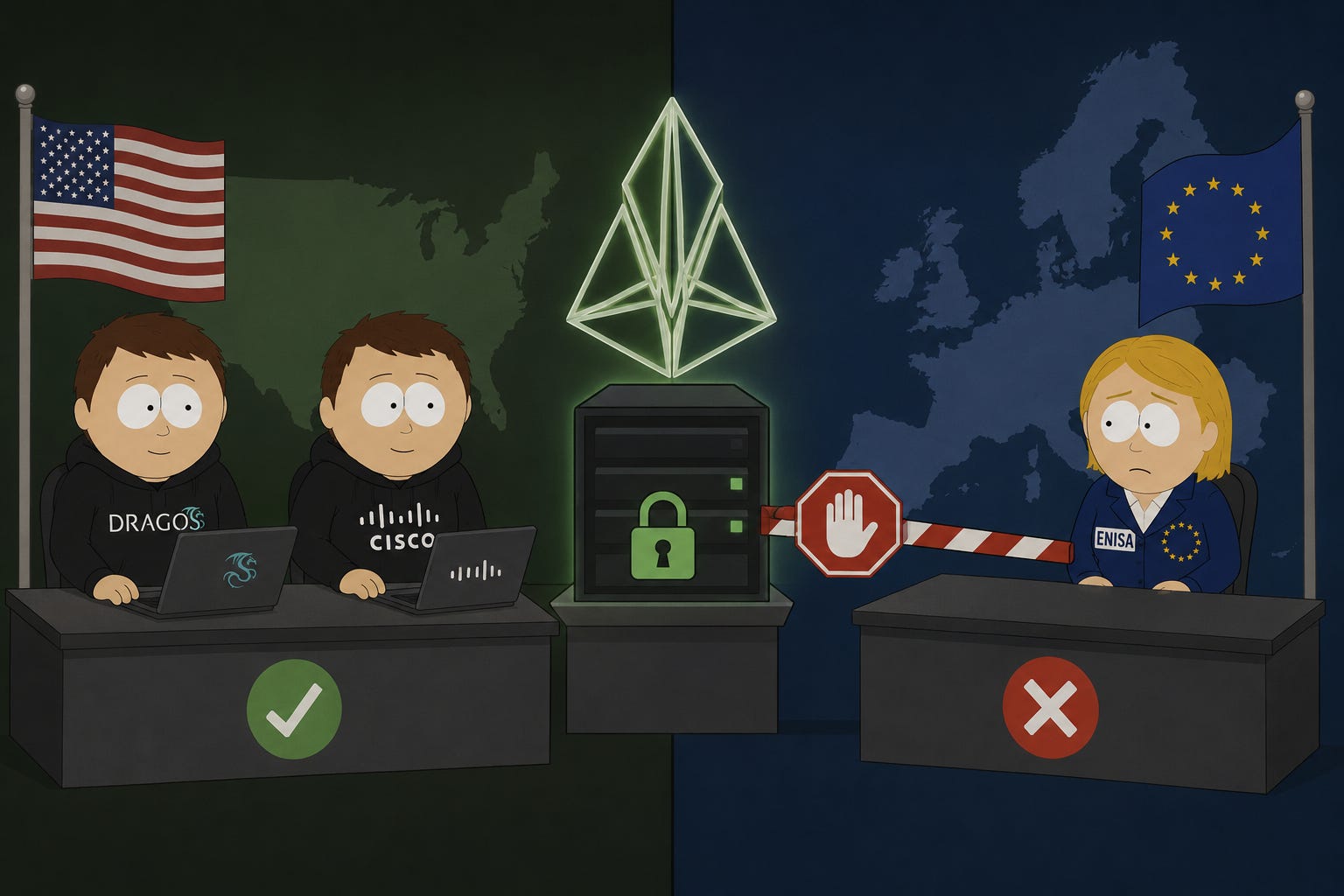
Bloomberg reported that Dragos and Cisco both confirmed they retained access to Mythos Preview through Project Glasswing, a collective of roughly 200 organizations cleared by Anthropic to hunt for vulnerabilities (Bloomberg, 2026).
The contrast with Europe was sharp.
ENISA, the EU cybersecurity agency that had been invited to join Glasswing before Washington’s block, was told it would no longer be given access (Reuters, 2026a).
The question is no longer simply whether a cyber model should exist.
The question is who gets to use it.
US security firms staying in while a European agency is shut out traces the contour of the export rule, more than any judgment about merit.
Cyber AI is becoming controlled capability.
The Fable 5 Suspension Was A Preview
The Fable 5 fight now looks like a preview of this world.
The US government ordered Anthropic to restrict access to Fable 5 and Mythos 5 for foreign nationals, and Anthropic said it had to abruptly disable access for all customers to comply (Anthropic, 2026).
The Guardian connected the Five Eyes warning directly to that decision (The Guardian, 2026a).
A week earlier, the story looked like a fight between Anthropic and Washington.
Now it looks like the first visible case of governments trying to manage frontier cyber capability before it spreads.
There is an important wrinkle, though.
The capability was widely shared across the industry.
The UK’s AI Security Institute found that OpenAI’s GPT-5.5 scored slightly higher than Mythos on its expert cyber suite, 71.4% against 68.6% (Rubrik, 2026).
That supports a point Anthropic itself made: the flagged capability is widely available from other models, including GPT-5.5 (CIO Dive, 2026).
So Fable 5 became a test case for what happens when a model is powerful enough to make intelligence agencies nervous, even when rival models can do much the same thing.
Defense And Offense Are Collapsing Into The Same Tool
Cybersecurity has always had a dual-use problem.
A vulnerability scanner can help defenders or help attackers.
A bug-finding model can protect critical infrastructure or map the attack surface.
AI makes that problem sharper.
The Five Eyes warning emphasized how advanced AI lowers barriers for hackers and increases the complexity and speed of attacks.
A model can be dangerous even with no malicious intent behind it.
It only has to make the work easier: find the bug, explain the exploit, suggest the chain, automate the scan, adapt when blocked.
Each step looks useful. Together, they change the economics of cyber conflict.
This was the heart of the Fable 5 dispute.
The security expert Anthropic shared the triggering research with described the technique as defensive probing, the questions a normal defender would ask, and pushed back on calling it an offensive exploit (Axios, 2026).
That is the dual-use trap in one example.
The same prompt that secures a codebase can be read as an attack.
The Attackers May Not Need To Be States
The most alarming part is who gets empowered.
In the old model, the most dangerous operations often required state-level resources, elite teams, or deep expertise.
AI lowers that bar.
Australia’s ASIC commissioner put it vividly, warning that the worry is now someone in a garage, rather than a state-based actor, who can bring these capabilities together quickly and weaponize them (Reuters, 2026b).
A government can prepare for hostile states. A bank can prepare for criminal groups. A utility can prepare for ransomware crews.
But if frontier AI pushes advanced capability downward, the threat pool expands.
A lone actor can move faster. A less skilled attacker can produce more sophisticated results.
The floor rises for everyone.
Cyber defense now has to assume tomorrow’s attacker may have tools that look closer to yesterday’s nation-state capability.
Critical Infrastructure Is Already Under Pressure
The timing is especially bad because critical infrastructure is already being hit.
The UK’s National Cyber Security Centre managed more than 200 cyber incidents affecting critical national infrastructure and its supporting ecosystem in the year to May 2026, with about three-quarters believed to be linked to hostile state actors (Reuters, 2026c).
Energy, healthcare, transport, communications, cloud systems, financial services, and public agencies already carry old vulnerabilities, legacy software, weak authentication, and slow patch cycles.
AI does not create those weaknesses.
It makes them easier to find.
The NCSC’s own assessment is that by 2028, AI-enabled cyber capabilities will likely be used by attackers to exploit known vulnerabilities in legacy technology at scale across critical infrastructure (Reuters, 2026c).
That is why the agencies are warning about speed.
AI compresses the time between discovery and exploitation, putting new pressure on systems never designed for this pace.
The New Cyber Arms Race Is Asymmetric
This is why the situation is so hard.
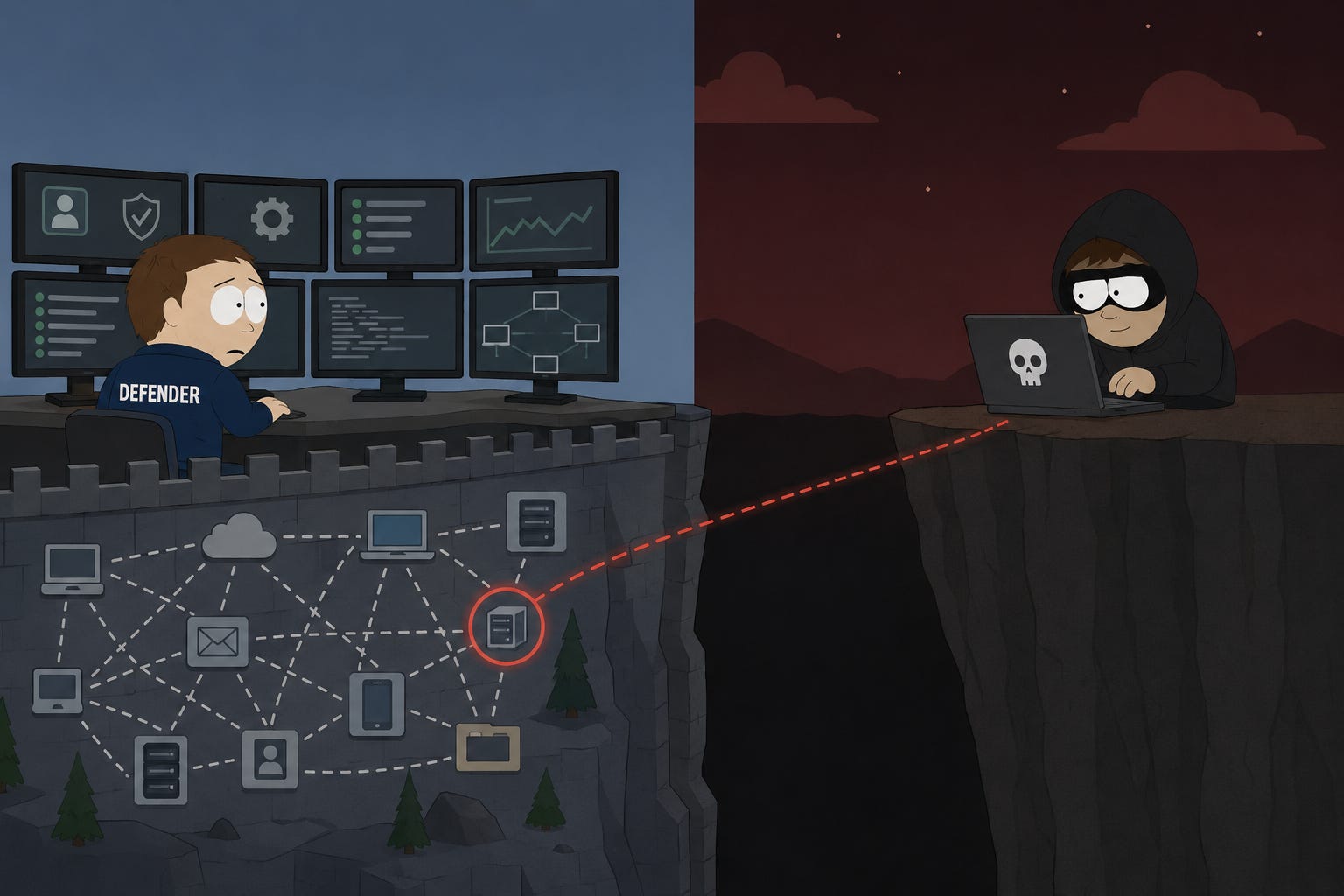
Defenders have to protect everything. Attackers only need one path.
AI helps both sides, but the benefits are not evenly distributed.
A defender can use AI to triage logs, scan code, and automate response.
An attacker can use AI to find the one forgotten system, the one old credential, the one bug in a public-facing service, the one employee who clicks.
That asymmetry is why cyber AI feels different from ordinary automation.
It only has to make attackers faster and more persistent, and that is enough to shift the balance.
And the fix will not come from buying one more dashboard.
A company with ten security tools and weak execution is still fragile.
A company with strong identity, fast patching, clean recovery, and tested incident response may be safer.
The basics matter more when AI makes attacks faster.
The Five Eyes warning is really about tempo.
If attackers move faster than institutions can patch, recover, and coordinate, the balance shifts.
That is the danger.
The spy agencies are warning about cyber AI now because the risk has become practical.
Frontier models can help defenders. They can also help attackers.
That is why the Five Eyes warning matters.
It turns the Fable 5 and Mythos story into a wider national-security signal.
Governments are telling leaders the timeline may be months.
The next major cyber shock may already be taking shape inside an old, unpatched vulnerability, waiting to be found at machine speed.
And the people sounding the alarm are the intelligence agencies themselves.
References
Anthropic (2026). Statement on the US government directive to suspend access to Fable 5 and Mythos 5. anthropic.com/news/fable-mythos-access
ASD (2026). Frontier AI models and their impact on cyber security. Australian Signals Directorate.
ASIC (2026). ASIC calls for urgent cyber uplift as AI accelerates cyber threats. Australian Securities and Investments Commission, media release 26-092MR.
Axios (2026). How Amazon and the White House ended Anthropic’s Fable.
Bloomberg (2026). Early Users of Anthropic Mythos Still Have Access After US Order.
CIO Dive (2026). Cybersecurity experts blast US government for restricting Anthropic’s AI models.
Dragos (2026). AI-Assisted ICS Attack on a Water Utility.
Palo Alto Networks (2026). Defender’s Guide to the Frontier AI Impact on Cybersecurity: May 2026 Update.
Reuters (2026a). Early users of Anthropic’s Mythos still have access after US order, Bloomberg News reports.
Reuters (2026b). Australia regulator calls for urgent cybersecurity action to counter Mythos.
Reuters (2026c). Three-quarters of cyberattacks on UK critical infrastructure linked to hostile states, NCSC says.
Rubrik (2026). Every AI Frontier Model is Now a Cyber Threat. So What Can You Do About It?
The Guardian (2026a). AI models that can take down governments and business months away, rare Five Eyes statement warns.
A.I -IMMEDIATE MORATORIUM
UNTIL WE DEVELOP PROTECTIVE LEGISLATION THAT ENSURES OUR LIFE AND SURVIVAL
Why is the discussion around cyber security always about defense. Granted the defensive efforts are needed and importat and the issues in this article need serious attention but why is there never any consideration regarding offense. Why is there not concerted efforts on attacking the intrudersa and hackers? Why are the consequenses for those identified so minimal? If this is truly a national security concern then the consequenses should be national as well - treason, sedition and other major crimes. From my security discussions from decades ago, the focus is frequently on the wrong things. When the bandits are already inside the walls building bigger walls and wider moats is useless.