
Phantom Work Is Rising
You’re Busy But Nothing Exists

It Looks Like Work
You open a doc.
You start writing.
You refine.
You rewrite.
It feels productive.
There’s movement.
There’s output.
There’s progress.
But something is off.
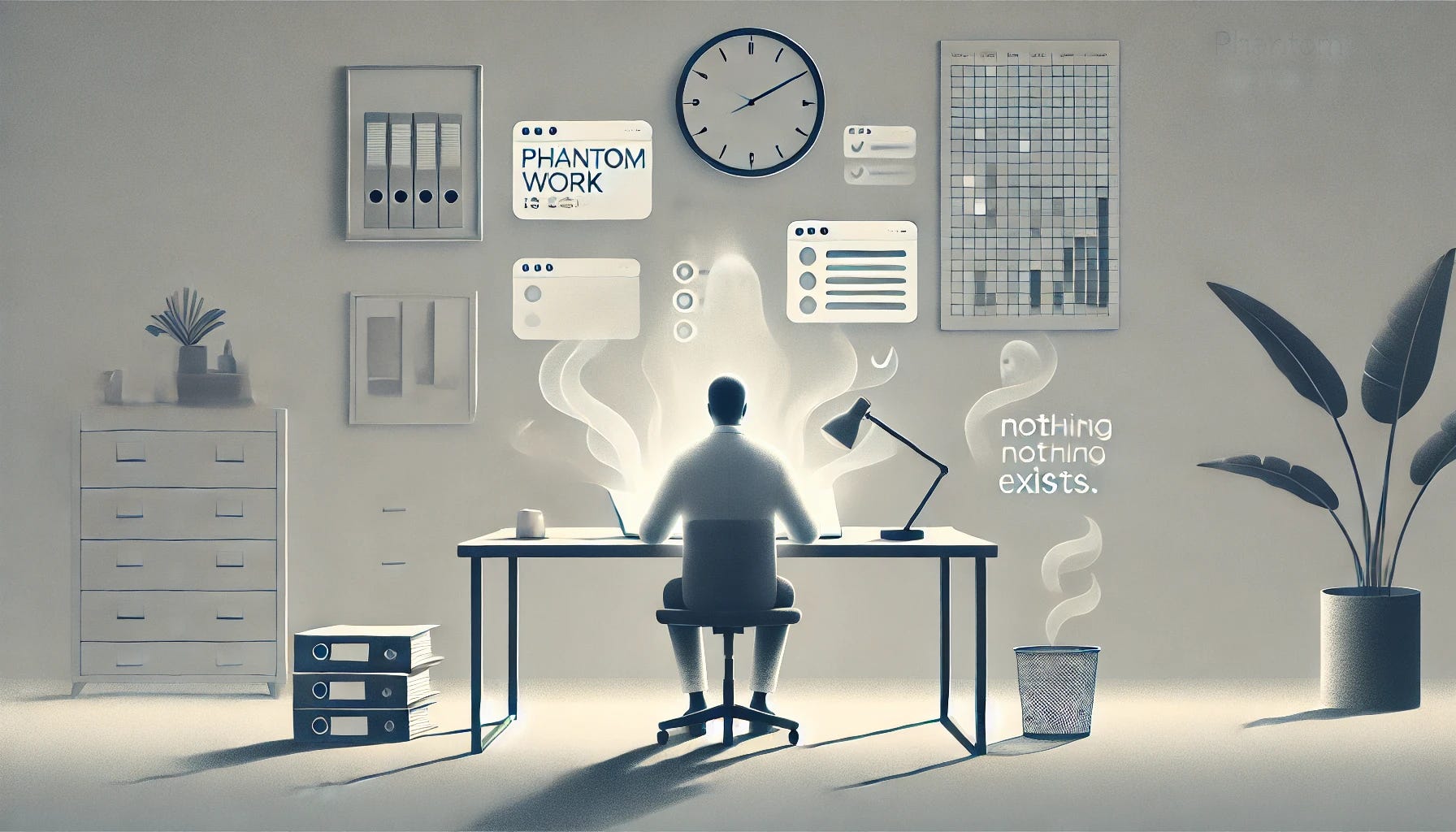
Nothing Actually Needs to Exist
Most of what you’re creating…
Doesn’t have to be created.
You can generate ten versions instantly.
Refine endlessly.
Rewrite without cost.
So the work doesn’t move toward completion.
It loops.
This aligns with what Herbert Simon described as bounded rationality, where decisions are often shaped by constraints, remove those constraints, and the decision itself starts to dissolve (Simon, 1972).
The Work Detaches From the Outcome
Before, work pointed somewhere.
A finished article.
A shipped product.
A final decision.
Now it doesn’t have to.
You can stay in the middle indefinitely.
Generating.
Adjusting.
Exploring.
Without ever needing to land.
Iteration Becomes the Work
This is the shift.
Work used to be:
effort → result
Now it becomes:
generation → regeneration → refinement
The process replaces the outcome.
And when iteration becomes frictionless, it starts to resemble what researchers call non-terminating optimization loops, where systems continue refining without a natural stopping condition (Russell & Norvig, 2021).
The Cost of Doing More Drops to Zero
When it’s this easy to create…
There’s no reason to stop.
Another version is always one prompt away.
Another improvement.
Another variation.
So stopping starts to feel arbitrary.

Stopping Used to Mean Something
There used to be a moment where you decided:
“This is done.”
That moment carried weight.
It required judgment.
Commitment.
Constraint.
Research on creative work shows that constraints are often what force completion and originality (Amabile, 1996).
Now those constraints are weakening.
Phantom Work Feels Productive
This is what makes it dangerous.
You’re active.
Engaged.
Producing.
But the output isn’t accumulating.
It’s cycling.
You’re doing work…
That doesn’t resolve.
The Loop Becomes Invisible
Over time, you stop noticing it.
Because everything looks like progress.
Clean drafts.
Better phrasing.
Sharper structure.
But none of it forces a decision.
And without a decision, the work never exits the loop.
This Changes What Work Is
Work used to reduce uncertainty.
Now it can exist entirely inside it.
You can explore forever.
Without committing to a direction.
Without accepting tradeoffs.
Cal Newport describes meaningful work as requiring sustained focus toward a defined outcome, something phantom work quietly avoids (Newport, 2016).
The Hidden Trade-Off
You gain speed.
Flexibility.
Endless optionality.
But you lose friction.
And friction is what used to create finality.
Why This Matters
Because real work still has a constraint:
It has to end.
It has to ship.
It has to commit.
It has to become something fixed.
Phantom work doesn’t.
The Shift
AI didn’t just make work faster.
It made it optional to finish.
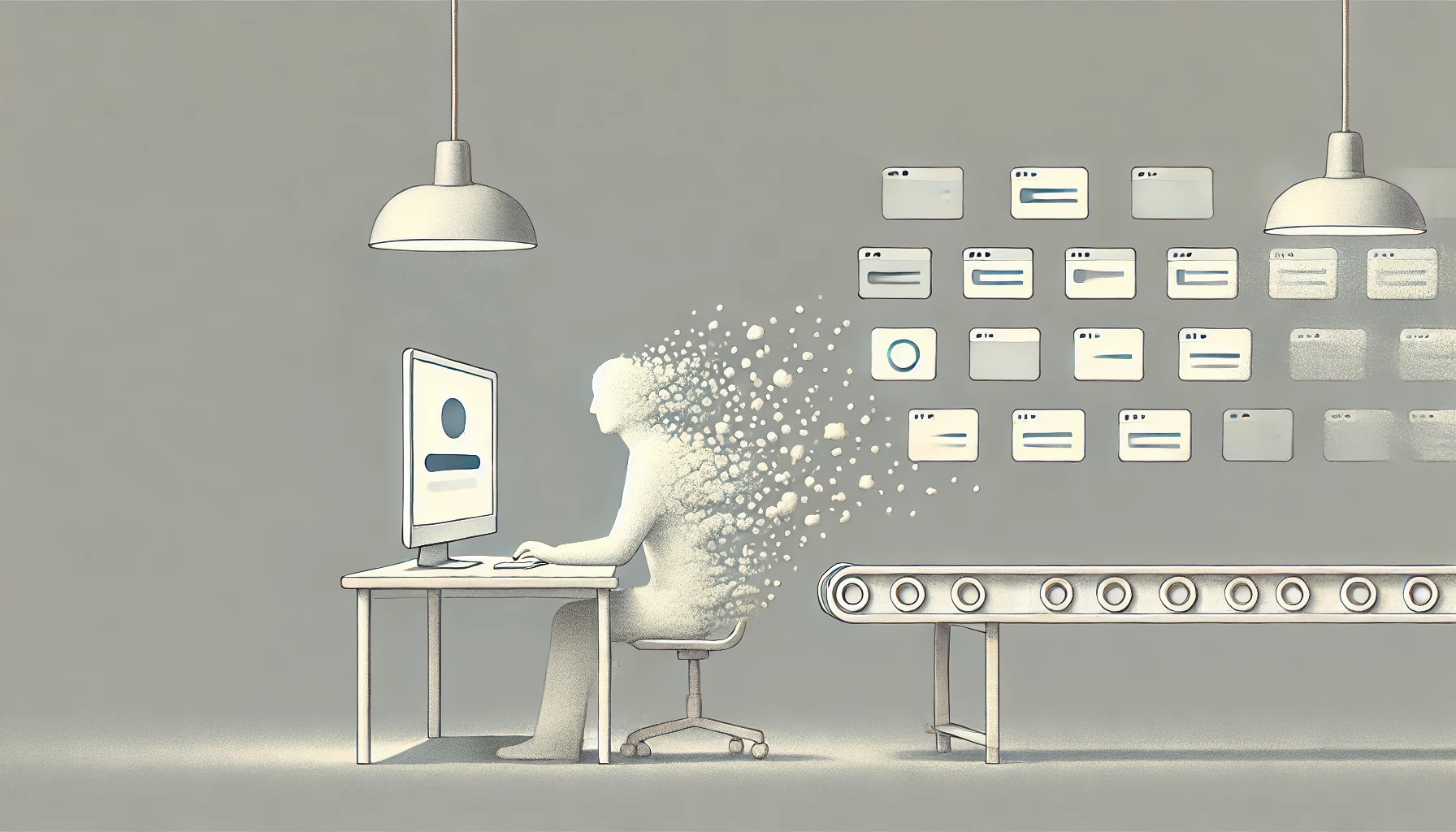
Most people won’t notice this happening.
They’ll feel busy.
Productive.
In motion.
But motion isn’t the same as progress.
And in a system where nothing forces completion…
You can work forever.
Without ever actually finishing anything.
References
Amabile, T. M. (1996). Creativity in Context. Westview Press.
Newport, C. (2016). Deep Work: Rules for Focused Success in a Distracted World. Grand Central Publishing.
Russell, S., & Norvig, P. (2021). Artificial Intelligence: A Modern Approach (4th ed.). Pearson.
Simon, H. A. (1972). Theories of Bounded Rationality. Decision and Organization.