
Personalized Risk
How AI Is Quietly Ending Shared Society

Something important is breaking, and most people have not noticed yet.
For most of modern history, risk was shared. Insurance worked because nobody knew exactly who would get sick, crash their car, lose their job, or die early. That uncertainty forced societies to pool risk. We paid together. We protected each other by default.
AI is dismantling that uncertainty.
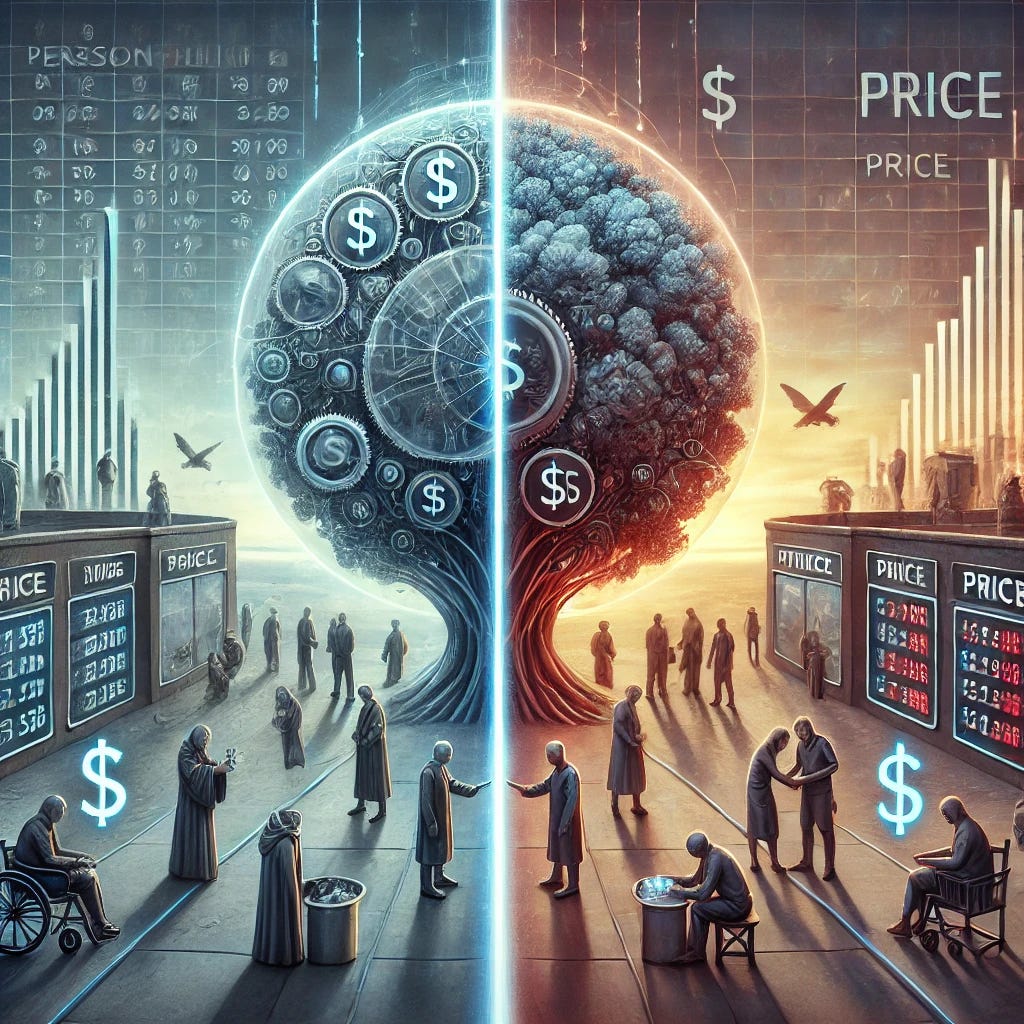
Today, algorithms can estimate your health risk, your credit risk, your crime risk, and your longevity risk with increasing precision. Not perfectly. But well enough to change how institutions treat you. Once risk becomes individualized, the logic of sharing starts to collapse.
This is not about privacy.
It is about whether shared systems can survive prediction.

How Risk Used to Work
Insurance was never just a financial product. It was a social agreement.
Health insurance assumed not everyone gets sick at once. Car insurance assumed most drivers are average. Social security assumed some people would subsidize others over a lifetime. The system only worked because individual outcomes were unpredictable.
Economists have long understood this as risk pooling. Without uncertainty, pooling fails (Arrow 1963).
The key point is simple.
Uncertainty created solidarity.
AI Turns Uncertainty Into a Liability
AI does the opposite. It hunts uncertainty and eliminates it.
Machine learning models ingest medical records, purchasing behavior, location data, wearable data, social signals, and historical outcomes. From this, they generate individualized risk scores that are far more granular than anything insurers or governments used before (Einav and Levin 2014).
Health insurers already use predictive analytics to flag high cost patients. Auto insurers adjust rates based on real time driving behavior. Credit systems dynamically price loans based on inferred life stability.
These systems do not need to be perfect.
They only need to be better than chance.
Once that happens, shared pricing starts to look irrational.
When Fairness Stops Making Sense
From a purely technical perspective, personalized pricing is efficient. People pay for the risk they represent. Low risk individuals subsidize no one. High risk individuals pay more or get excluded.
But this efficiency creates a moral problem.
If risk is perfectly priced, solidarity disappears. There is no reason for a healthy person to pay for someone predicted to get sick. No reason for a safe driver to support a reckless one. No reason for the wealthy to support those whose future looks statistically worse.
Researchers have already warned that risk based personalization undermines the social logic of insurance itself (Ewald 1991; Zuboff 2019).
Efficiency replaces empathy.
Prediction Changes Behavior
Once people know they are being scored, they adapt.
People avoid activities that increase risk scores. They change behavior to stay insurable rather than healthy. They optimize for model approval rather than well being. This has already been observed in credit scoring and algorithmic management systems (Pasquale 2015).
The system then retrains on this behavior.
The model tightens.
The thresholds move.
Prediction stops describing reality.
It starts shaping it.
The Political Consequence Nobody Wants to Name
When shared risk collapses, politics changes.
If insurance becomes unaffordable for high risk populations, pressure shifts toward state intervention. Universal healthcare. Guaranteed income. Public insurance backstops. Regulation that forces pooling despite predictive ability.
This is not ideology.
It is math.
Economists studying inequality have noted that advanced prediction increases pressure for redistribution because private markets stop functioning socially even when they function efficiently (Piketty 2020).
AI does not push societies left or right.
It pushes them toward structural choices.
Why This Is Different From the Past
Some argue we have always had risk assessment. That is true. But older systems worked with coarse categories. Age. Gender. Income brackets. Broad proxies.
AI works at the individual level.
It does not see you as a demographic.
It sees you as a trajectory.
Once institutions act on that trajectory, the idea of a shared future weakens. Everyone is priced into their own probabilistic lane.
That is a very different society.
What Happens Next
There are only a few possible paths.
One is heavy regulation that limits how predictive systems can be used. Another is forced pooling through public systems. A third is letting the market fragment entirely, accepting that many people will be priced out of basic protections.
None of these are abstract debates anymore. They are already appearing in health insurance policy, credit regulation, and AI governance proposals across the US and Europe (OECD 2023; EU AI Act 2024).
The quiet truth is this.
Once prediction becomes good enough, shared systems do not survive on their own. They have to be defended.

AI is not just automating decisions. It is changing the logic that holds societies together.
When risk becomes individualized, solidarity becomes optional. When solidarity becomes optional, politics becomes unstable. And when prediction replaces uncertainty, fairness becomes negotiable.
This is not a future problem.
It is already happening.
The question is not whether AI will price risk more accurately.
It is whether we still want a society built on sharing once it does.
References
Arrow, K. J. (1963). Uncertainty and the welfare economics of medical care. American Economic Review, 53(5), 941 to 973.
Einav, L., and Levin, J. (2014). The data revolution and economic analysis. Innovation Policy and the Economy, 14, 1 to 24.
Ewald, F. (1991). Insurance and risk. In The Foucault Effect. University of Chicago Press.
OECD. (2023). Artificial Intelligence, Insurance and Risk Pooling. OECD Publishing.
Pasquale, F. (2015). The Black Box Society. Harvard University Press.
Piketty, T. (2020). Capital and Ideology. Harvard University Press.
Zuboff, S. (2019). The Age of Surveillance Capitalism. PublicAffairs.
EU AI Act. (2024). Regulation laying down harmonised rules on artificial intelligence. European Union.
This is fully resolved Unified Solace Federation entersociaty merit economy
With regard to health care, the rationing and cherry picking is already embedded in our health care market (not system). A single payer system, with equal payments for services regardless of pre-existing conditions or risk stratification and global payments to hospitals & other health care institutions, would go a long way towards leveling the playing field.