
OpenAI’s Bizarre Master Plan
Handing Out 5% Equity So Washington Forgets to Regulate Them

OpenAI started with a strange promise.
Build artificial general intelligence. Make sure it benefits everyone.
That was the founding myth.
A public-interest machine pointed at the most important technology in the world.
Now that promise may be turning into something much more literal.
OpenAI has reportedly discussed giving the U.S. government a 5% equity stake.
Not a grant. Not a tax. Not a regulation.
A piece of the company.
Sam Altman may want Washington on OpenAI’s cap table.
That sounds bizarre. It also kind of makes sense.
If AI becomes as economically important as its builders claim, then the fight over who owns the upside was always coming.
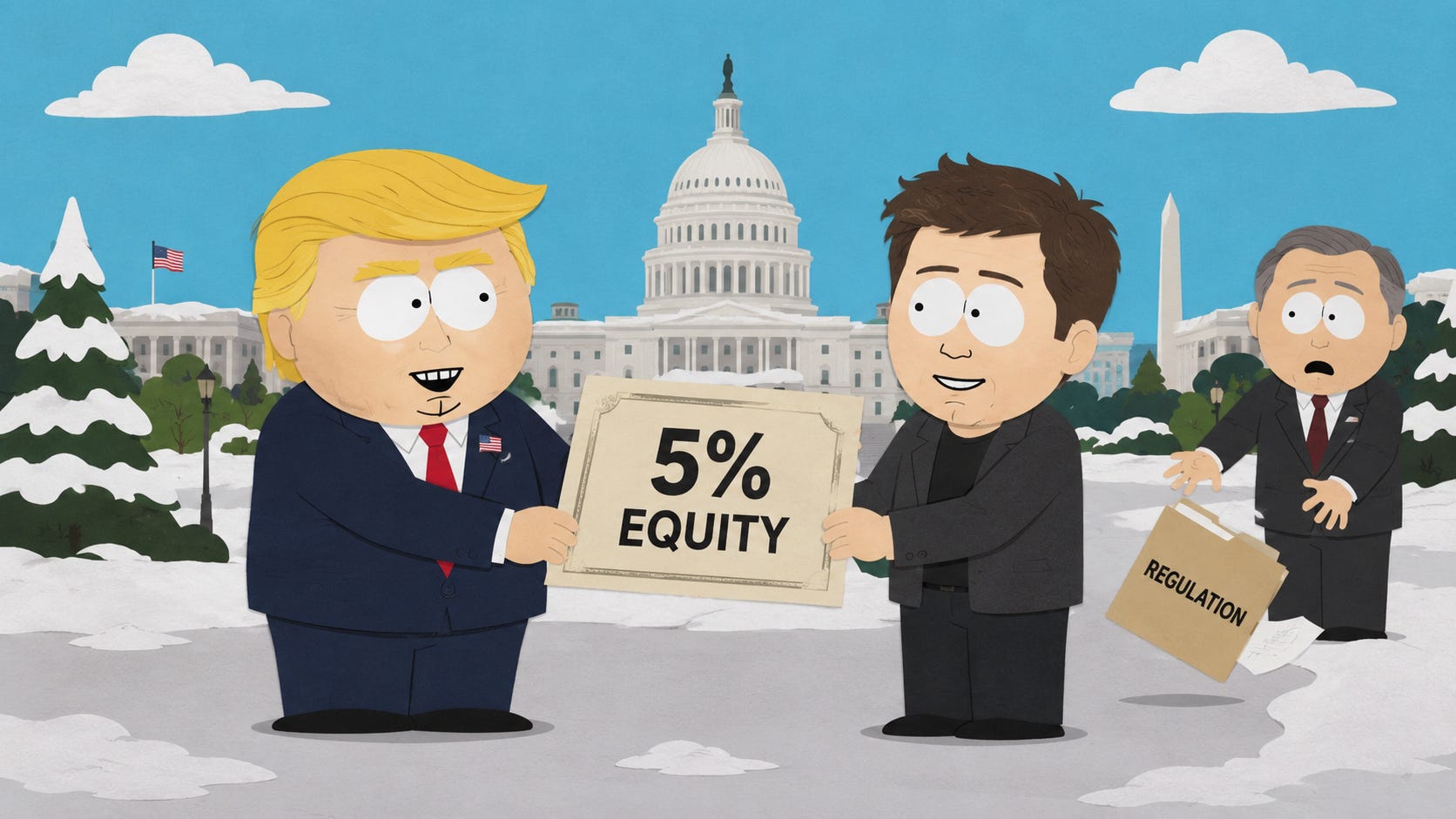
OpenAI Has Reportedly Floated A 5% Government Stake
OpenAI has discussed handing the U.S. government a roughly 5% stake, according to the Financial Times, with CEO Sam Altman arguing that giving the public a financial interest is the best way to share the upside of AI (CNBC, 2026).
The idea extends beyond OpenAI. The structure Altman floated would ask each leading U.S. developer to allot 5% of its equity to a public investment vehicle modeled on the Alaska Permanent Fund, which pays annual dividends to residents from the state’s oil wealth (CNN, 2026).
The scale is large. At the $852 billion valuation OpenAI set in its March funding round, a 5% stake would be worth roughly $42.6 billion (The Verge, 2026).
The proposal is still early. The FT described the talks as conceptual, and any deal might require an act of Congress (CNN, 2026).
The idea itself is the story. OpenAI is doing more than trying to avoid regulation. It is floating a structure where the public owns part of the AI boom.
The Alaska analogy is doing a lot of work. Oil was Alaska’s natural resource. AI is being framed as America’s next one. If AI generates unimaginable wealth, the pitch goes, maybe the public should get a dividend.
This Has Been Building For Over A Year
This did not appear out of nowhere.
Altman first pitched the concept of a government stake to the administration in early 2025, and in April OpenAI published a policy paper proposing a “public wealth fund” to give every citizen a stake in AI-driven economic growth (CNBC, 2026).
The people in the room are the same names from the Fable 5 fight. Altman raised the idea with President Trump, Commerce Secretary Howard Lutnick, and Treasury Secretary Scott Bessent (Tom’s Hardware, 2026).
And the administration has already run this playbook.
Last August, the federal government took a 9.9% stake in Intel by converting CHIPS Act grants into equity, and separately AMD and Nvidia agreed to hand over 15% of their China chip revenue in exchange for export licenses (Tom’s Hardware, 2026).
So a government stake in a major American company is not a thought experiment anymore. It is a pattern the administration is actively building.
This Is The Public-Benefit Promise Coming Due
OpenAI has always had a public-benefit problem.
It was founded with a mission to ensure AGI benefits humanity. Then it became one of the most valuable private companies in the world.
That tension never went away. The more valuable OpenAI becomes, the harder the original mission gets to explain.
Who benefits? Users? Employees? Investors? Microsoft? The government? Humanity? Those are not the same answer.
A 5% government stake is one way to make the benefit story concrete. OpenAI can say the public is not merely watching private investors get rich. The public owns a slice. If the company becomes worth a trillion dollars, that slice could be enormous.
That is industrial policy, dressed as fairness.
The Government Is Already In The Release Room
The timing matters.
This proposal comes as Washington has become far more active in frontier AI.
Just six days before the stake talks were reported, OpenAI delayed the full public launch of GPT-5.6 at the government’s request, with Lutnick reportedly warning Altman against releasing it without prior approval, and Anthropic had spent most of June with Fable 5 and Mythos 5 disabled under the first U.S. export controls ever applied to an AI model (Tom’s Hardware, 2026).
So OpenAI is not making this proposal in a normal regulatory environment.
The government is already in the model release cycle. It is already deciding who gets access. It is already treating frontier models as strategic infrastructure.
Washington is becoming a gatekeeper. Now OpenAI may be suggesting Washington should also become an owner.
That combination is powerful. It is also risky. The state that helps decide who can release the model may also hold a financial stake in the company releasing it.

This Is A Political Insurance Policy
There is a generous way to read the proposal. AI may create massive wealth, and the public should share in it. That is a serious argument.
There is also a more cynical reading. OpenAI wants political cover. That is probably true too.
The company is preparing for a future where its valuation depends on Washington: model approvals, export controls, cybersecurity reviews, antitrust scrutiny, energy infrastructure, IPO timing.
If the government can slow your model, restrict your users, or shape your release process, then having the government financially aligned with your success becomes useful.
That is what makes this so interesting. A public stake can be sold as fairness. It can also function as protection.
When Washington is on the cap table, Washington has a reason not to break the company.
Bernie Sanders And Sam Altman Are Weirdly In The Same Conversation
One of the strangest parts of this story is the political convergence.
Altman has spoken with Senator Bernie Sanders in recent weeks, and last month Sanders filed the American AI Sovereign Wealth Fund Act, seeking 50% of the voting shares of major U.S. AI companies through a fund his office valued at $7 trillion, enough to pay every American a $1,000 annual dividend (Tom’s Hardware, 2026).
Sanders’ version is far more aggressive than OpenAI’s reported 5% idea. Altman’s is friendlier to the companies; Sanders’ is closer to expropriation.
But both are asking the same uncomfortable question. Who owns the value created by AI?
The data came from people. The scientific literature came from people. The labor displacement will hit people. The profits may go to a small group of companies and investors.
There is bipartisan pull here. Vice President JD Vance said Trump prefers equity over cash payouts (Tom’s Hardware, 2026).
That arrangement was never going to stay politically quiet forever.
The Alaska Analogy Is Clever And Incomplete
The Alaska Permanent Fund is a powerful analogy because it turns a scary idea into something familiar. A state has oil wealth. The public shares in it. Simple.
But AI is a harder fit than oil.
Oil is extracted from land. AI is built from data, labor, infrastructure, capital, electricity, research, and human knowledge. Oil wealth is geographically anchored. AI wealth is global. Oil revenue is easy to define. AI value is hard to measure.
The implementation questions pile up fast. Which companies pay? Only frontier labs? Cloud providers? Chip companies? Data-center owners? What happens when a foreign company serves U.S. users, or when U.S. companies make money abroad, or when open-source models generate value with no obvious owner?
The Alaska analogy makes the politics easier. The implementation will be brutal.
And it could backfire abroad. Forrester analyst Indranil Bandyopadhyay warned that a pre-IPO government stake might calm U.S. investor nerves but would prompt other jurisdictions to demand similar arrangements, pushing European and Asia-Pacific buyers to reassess data-sovereignty and neutrality assumptions about American providers (ResultSense, 2026).
If OpenAI is partly owned by Washington, is it still just a company, or is it an American strategic asset? European governments may ask for their own conditions. Rivals may treat OpenAI as an arm of U.S. industrial policy. The public-wealth argument may help inside America and complicate OpenAI’s global business.
The Conflict Of Interest Is Obvious
There is a serious governance problem here.
If the government owns part of OpenAI, how does it regulate OpenAI fairly?
If a safety review could reduce OpenAI’s value, does the government still act aggressively? If a rival company complains, does the government treat that rival fairly? If OpenAI’s stock price becomes tied to public wealth, does Washington become less willing to impose painful safety restrictions?
This is the problem with putting the regulator on the cap table. The public may get upside. The public may also get conflicted governance.
A government stake can align incentives. It can also corrupt them. The state has to protect citizens from dangerous AI. The state also wants the national champion to win. Those goals will not always point in the same direction.
And OpenAI is not entering this from a quiet position. It confidentially filed for an IPO in June and faces a probe from a coalition of 42 state attorneys general (Tom’s Hardware, 2026). A government shareholding negotiated before a listing would lock in Washington’s position ahead of the ownership expansion a public float brings.
There is also a subtler danger: a small stake could become political theater. Give citizens a tiny slice, keep the real control private, let people feel included, and avoid the deeper questions about displaced workers, wages, power grids, water use, and the artists and coders whose work trained the systems. The public can own a slice of the boom and still have no meaningful say over how AI is deployed.

OpenAI wants Washington on its cap table.
The most powerful AI companies are becoming too important to govern like normal startups. Their products affect national security. Their models may reshape labor. Their valuations depend on political permission.
So the ownership question is arriving.
OpenAI’s reported 5% proposal is one answer. Give the public a slice. Turn AI wealth into something like a national dividend. Make Washington financially aligned with the AI boom.
It is clever. It is politically useful. It may even be fair in principle.
The old OpenAI promise was that AGI would benefit everyone. Now the company may be trying to convert that promise into equity.
That tells you how real the AI wealth fight has become.
The debate used to be whether governments would regulate AI.
The next debate may be whether governments own part of it.
References
CNBC (2026). OpenAI proposes U.S. government own 5% stake to address political blowback.
CNN (2026). OpenAI in talks to give Trump administration a 5% stake in the company, FT reports.
ResultSense (2026). OpenAI floats giving the US government a 5% equity stake.
The Verge (2026). OpenAI floats giving Trump administration 5 percent cut of AI boom.
Tom’s Hardware (2026). OpenAI mulling giving US gov’t a 5% stake in the company, days after Washington delayed GPT-5.6.