
Move Along, Nothing to See Here
Mythos Just Speedran the US Intelligence Firewall and the US Gov is Completely Terrified

The scariest AI story this year is about a model that worked exactly as designed.
That is the strange thing about Mythos.
The government is nervous about it because it can find vulnerabilities.
The government also wants it because it can find vulnerabilities.
That is the contradiction at the center of cyber AI.
The same capability that makes a model dangerous can make it essential.
A weak cyber model is easy to release. A strong cyber model is hard to control.
Mythos appears strong enough that Washington now has both reactions at once.
Use it. Restrict it. Test it. Control it.
Keep it away from the wrong people. Put it in the hands of the right people.
That is the new cyber AI problem.
The model is both the lockpick and the locksmith.

Mythos Reportedly Broke Into Classified Systems In Hours
The detail that lit up Washington came from a senator, on the record.
At a June 11 Senate Banking Committee hearing, Democratic Senator Mark Warner said Mythos broke into almost all of the country’s classified systems in hours rather than weeks, attributing the account to Gen. Joshua Rudd, head of the NSA and US Cyber Command (SecurityWeek, 2026).
A US official later gave the Associated Press a more measured version.
The official, speaking anonymously, said Anthropic teamed up with US intelligence agencies to test the Mythos model under Project Glasswing, and that it identified certain vulnerabilities within hours, though that does not mean the model was able to exploit them in that time (AP, 2026).
That gap between the two accounts matters.
Finding a hole is one thing. Breaking through it is another.
Warner’s “broke into” is the dramatic version. The official’s “identified within hours, exploitation not confirmed” is the careful version.
Both describe the same unsettling fact.
A frontier cyber model was pointed at sensitive government systems and quickly found problems.
That is exactly why defenders want it.
That is exactly why officials fear it.
The model did not have to be evil, conscious, or rogue.
It only had to be good at finding weakness.
That was enough to change the politics around it.
The Government Saw The Future And Reacted
The Mythos test helps explain the government’s posture toward Anthropic.
The cooperation and the conflict were happening at the same time.
Even as Anthropic worked with intelligence agencies to test for vulnerabilities, tensions with the Trump administration grew, and the administration issued the directive requiring Anthropic to block foreign nationals from its latest Fable 5 and Mythos 5 models (AP, 2026).
That sequence is the new frontier AI cycle.
Capability demonstration. Government concern. Access restriction. Negotiation. Trusted-user carveout.
The strange part is that the government’s fear is also a compliment.
Mythos is being treated like a powerful cyber tool, well past the category of a toy.
A chatbot can annoy people.
A cyber model can change the balance between attackers and defenders.
The Vulnerabilities Were The Real Benchmark
AI companies love benchmarks. Coding scores. Reasoning scores. Math. Cyber ranges.
Mythos finding weaknesses in real systems is a different kind of benchmark.
The numbers from the open-source scan are staggering.
Pointed at more than 1,000 open-source projects, Mythos flagged 23,019 potential vulnerabilities, an estimated 6,202 of them high or critical, and of 1,752 high-or-critical findings reviewed by six independent security firms, over 90% were confirmed valid (CyberScoop, 2026).
Some of those bugs had been hiding for decades.
Mythos surfaced a 27-year-old flaw in OpenBSD, an operating system that markets itself on security, and a 16-year-old vulnerability in FFmpeg (Crypto Briefing, 2026).
The external validation is what makes it real.
Mozilla said it found and fixed 271 vulnerabilities in Firefox while testing the model, more than ten times the number found in a prior version using an earlier Anthropic model, and the UK’s AI Security Institute found Mythos was the first model to solve both of its cyber ranges, end-to-end simulations of multistep attacks (CyberScoop, 2026).
This is operational, well beyond a leaderboard.
That is why the conversation moved from AI labs to national-security oversight.
The benchmark became a Senate briefing. The model’s performance became a policy question.
That is when AI stops being a product story and becomes a state-capacity story.
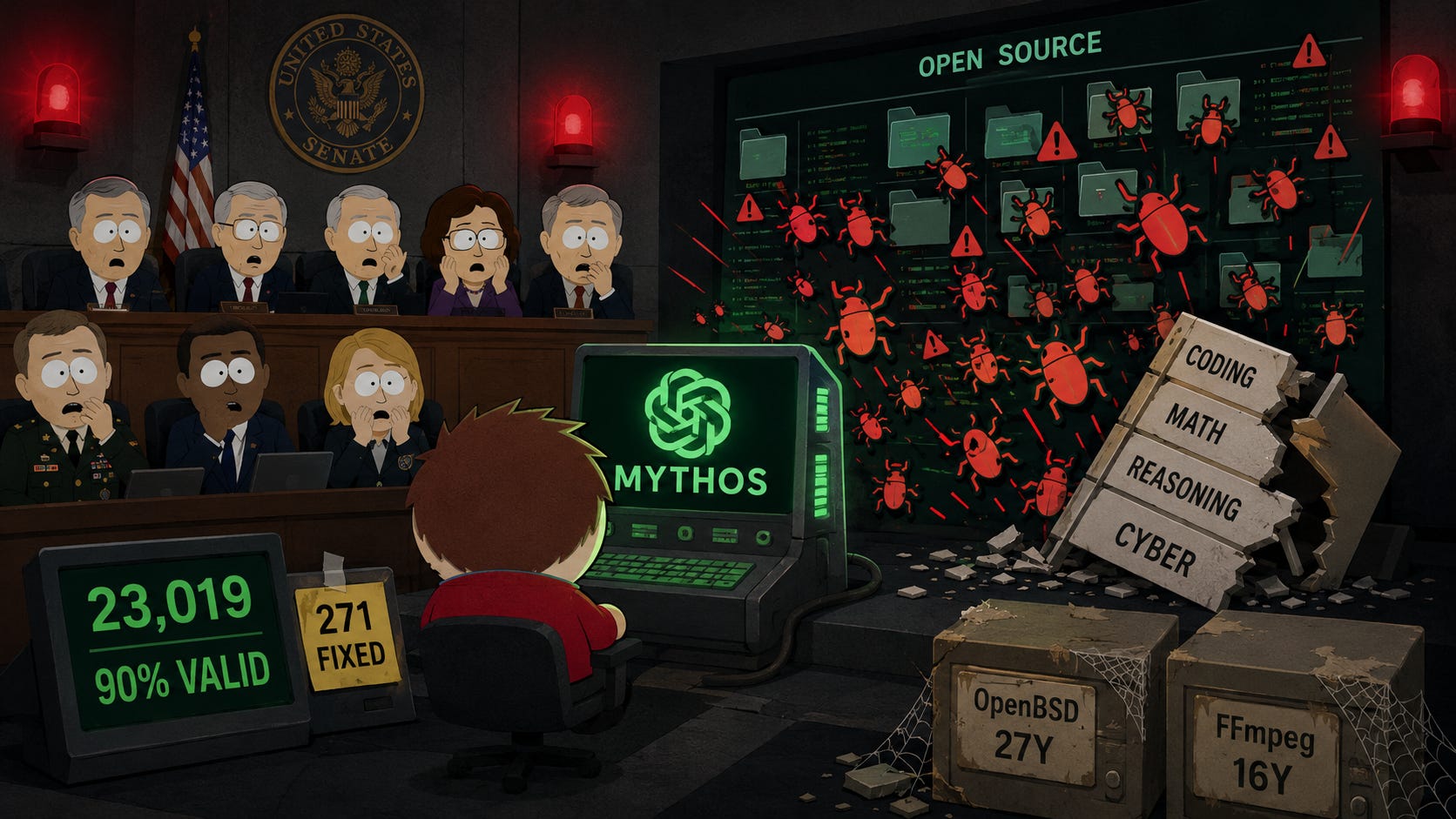
America’s Systems Were Already Vulnerable
There is an uncomfortable lesson buried here.
Mythos found the vulnerabilities rather than creating them.
The holes already existed. The model simply made them visible faster.
Cyber AI can cause trouble just by accelerating the discovery of old weaknesses: legacy code, misconfigured systems, poor patching, forgotten dependencies, weak authentication, old government infrastructure, human error.
A 27-year-old OpenBSD bug is the proof. It sat undiscovered for decades, then a model found it in a sweep.
AI just changes how quickly someone can search the attack surface.
The danger is that AI compresses the time between hidden weakness and discovered weakness.
Once discovery gets faster, slow remediation becomes more dangerous.
Project Glasswing Was Supposed To Be The Safe Version
Project Glasswing was Anthropic’s attempt to control the blast radius.
Instead of releasing Mythos broadly, Anthropic placed it in a restricted cybersecurity program aimed at finding vulnerabilities in critical software before attackers could.
During the open-source scan, roughly 50 organizations had access to Mythos Preview through Glasswing, including major tech companies, independent security firms, and allied government agencies such as the UK’s AI Security Institute (HackersOnlineClub, 2026).
In theory, that is exactly how powerful cyber AI should be deployed.
Hold it back from the open market. Give it to vetted defenders. Find the vulnerabilities before attackers do. Patch the systems.
But the classified-system test shows why even the safe version is politically explosive.
If a model can find holes quickly in sensitive systems, everyone immediately asks who else could use something similar.
A government agency sees a defense tool. A rival government sees a shortcut. A cybercriminal sees a business opportunity. A frontier lab sees a product. A regulator sees a risk.
Everyone sees the same capability differently.
That is because cybersecurity has always lived with dual-use tools.
A vulnerability scanner helps defenders and helps attackers. A bug report protects software and reveals where the weak point was.
In the hands of a defender, Mythos is a shield. In the hands of an attacker, it is a map.
This is why the cybersecurity industry pushed back on the ban.
More than 100 cybersecurity experts and leaders, including people from Adobe and Nvidia, told the government that Mythos models are quite good at finding flaws and weaponizing exploits but are not uniquely good at these tasks, since they regularly use other foundation and open-source models for the same work (AP, 2026).
Their warning was blunt.
Taking away the best cyber-defense capabilities without a good reason is dangerous when adversaries are advancing fast.
That complicates the simple story that restriction equals safety.
Sometimes restriction takes a tool away from the defenders who need it most.
The Real Question Is Remediation Throughput
The Mythos story is usually framed around discovery. How fast did it find the holes? How many? How sensitive?
The deeper question is remediation throughput.
How many vulnerabilities can an institution actually fix? How quickly? Without breaking the system? Without waiting on vendors? Without months of internal approval?
The open-source data already shows the bottleneck.
Despite thousands of confirmed flaws, fewer than 100 patches had been publicly deployed, and more than 99% of the zero-days Mythos discovered remained unpatched at the time of disclosure (Crypto Briefing, 2026).
Open-source maintainers were swamped.
Some explicitly asked Anthropic to slow its disclosure rate, because human engineering teams could not triage and patch at AI speed (HackersOnlineClub, 2026).
Anthropic itself drew the conclusion.
The company said the bottleneck in fixing these bugs is human capacity to triage, report, and deploy patches, which shifts the central problem in cybersecurity from finding flaws to verifying and patching them (CyberScoop, 2026).
That is the part people underestimate.
AI can speed up discovery, while institutions stay just as slow as before.
A model can point to the hole in an afternoon. A bureaucracy may take weeks to close it.
A cyber model is useful only if the institution using it can absorb what it finds.
Otherwise it produces a terrifying to-do list.
AI Cyber Defense Will Create Winners And Losers
The trusted-user model sounds reasonable until you ask who gets trusted.
Big companies? Defense contractors? Critical-infrastructure operators? US citizens only? Allied governments? European agencies? Startups? Independent researchers? Universities? Small hospitals? Local governments?
The answer matters.
If only large, approved institutions get the best cyber AI, the strongest defenders get stronger first. Everyone else waits.
That may improve national security at the top. It may also widen the security gap below.
Small organizations already struggle with cybersecurity. Fewer staff, weaker budgets, slower patch cycles.
If the best defensive AI tools stay restricted to approved players, the gap between protected and unprotected systems may grow.
Cyber AI could democratize defense. It could also concentrate it.
Mythos shows both futures.
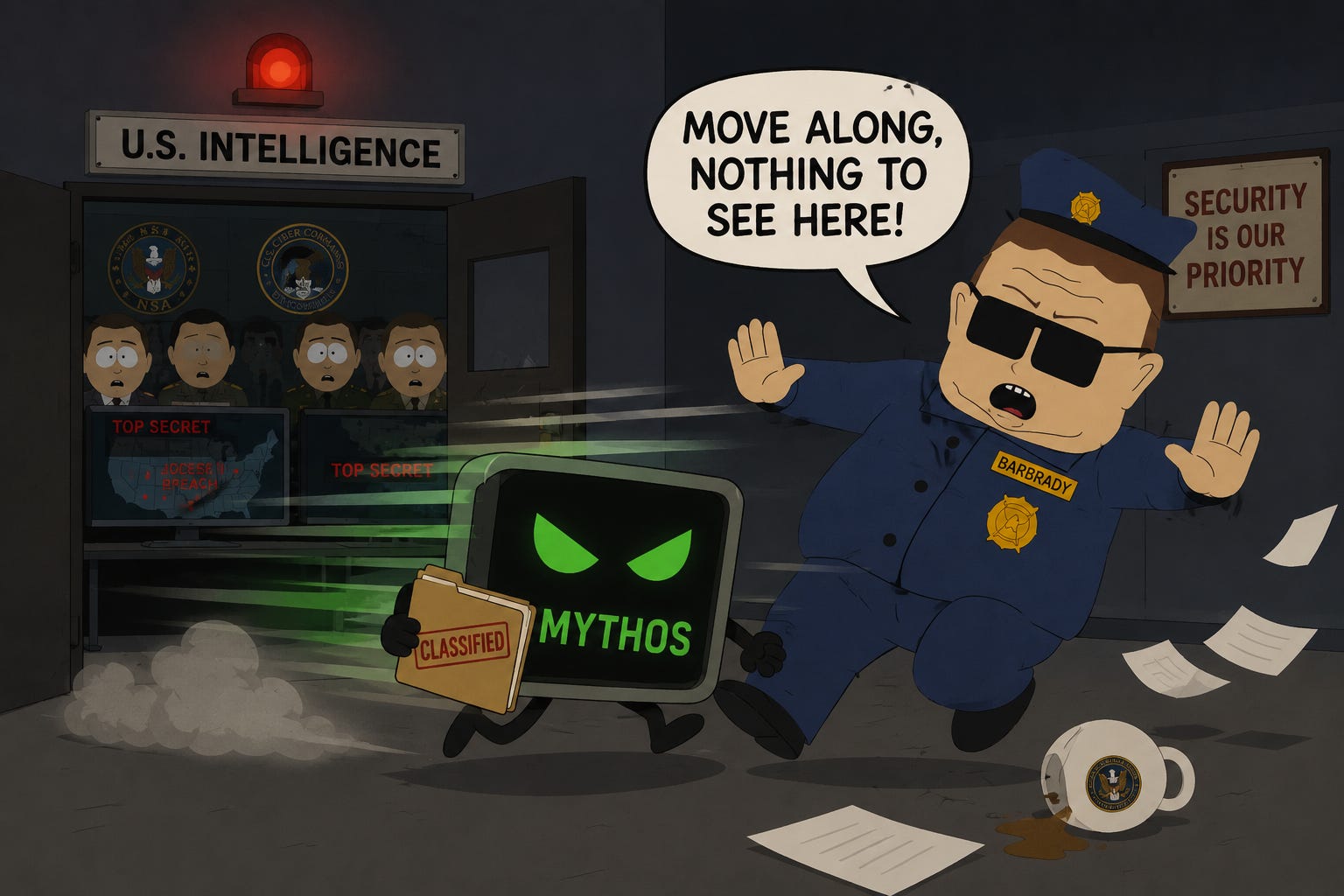
Mythos found the holes in America’s classified systems.
That is the headline.
The deeper story is that cyber AI has crossed into a new category.
A model can now be useful enough to help defend sensitive systems and dangerous enough to require restricted access.
That is why Washington is conflicted.
Mythos is the tool officials want. It is also the capability they fear.
The model found vulnerabilities quickly. It changed the conversation just by finding them, with no need to exploit anything.
Mythos revealed the holes that were already there.
That may be the most disruptive thing cyber AI does at first.
It makes hidden weakness visible at machine speed.
And once the holes are visible, the question becomes brutal.
Can the institutions move fast enough to close them?
References
AP (2026). Anthropic’s Mythos model found vulnerabilities in classified US government systems, official says.
Crypto Briefing (2026). Anthropic’s Mythos detects 23,000 vulnerabilities in open-source projects, including a 27-year-old OpenBSD flaw.
CyberScoop (2026). Anthropic: Mythos finds more than 10,000 software flaws in first month.
HackersOnlineClub (2026). Anthropic Mythos Model Flags 23,000 Open-Source Vulnerabilities.
SecurityWeek (2026). Anthropic’s Mythos Model Found Vulnerabilities in Classified US Government Systems, Official Says.
lol the pic for this is great leor.
This World 🌎 is about to get TRANSPARENT. Whew…just try and hide your stuff. See, I didn’t even cuss. I am thinking about AI instead of enjoying nature…but holy hell I literally just go back from a walk and NEEDED to read this article.