
Minds in the Sky
Could AI Learn From the Microbiome of Clouds?

The Cloud Above the Amazon
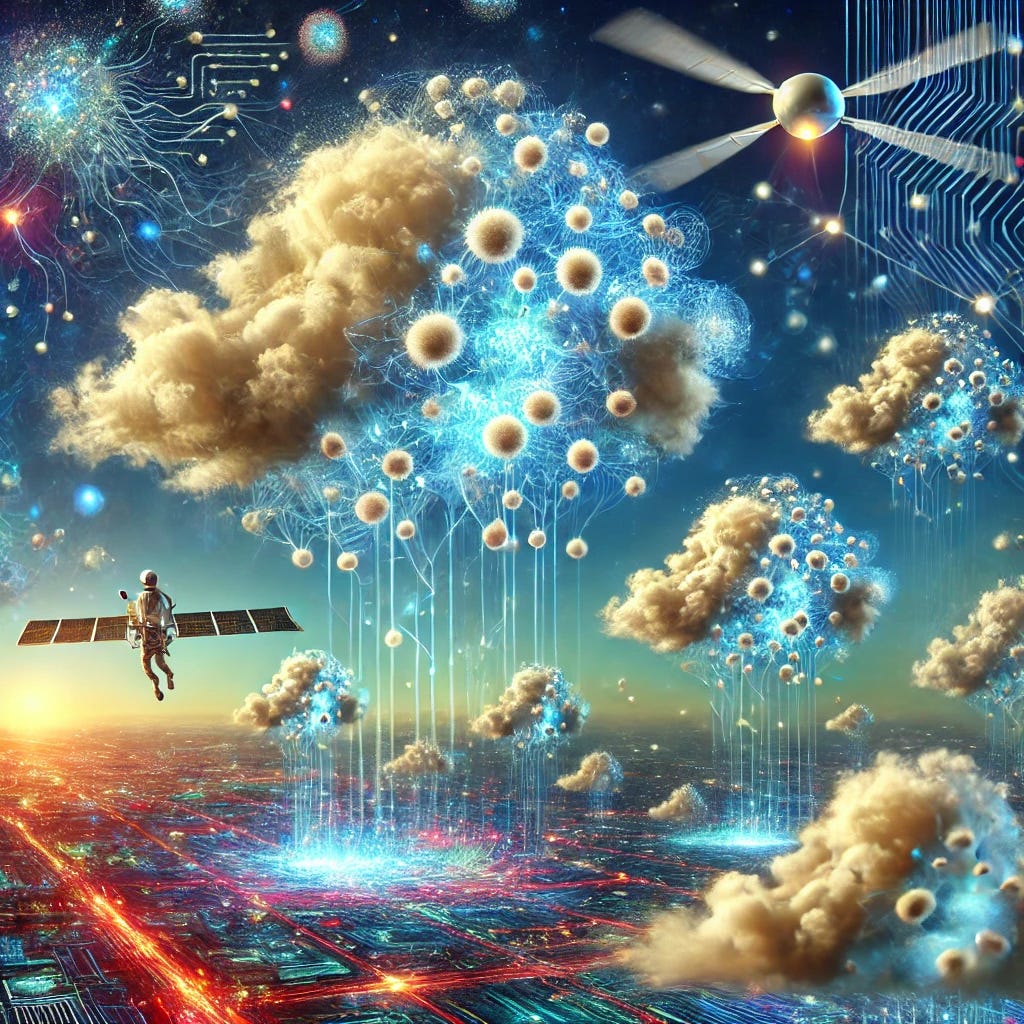
One morning over the Amazon basin, a storm begins to gather. Warm air rises, carrying with it spores from decaying leaves and bacteria from the soil. Invisible to human eyes, these microbes ride the updraft and seed the forming cloud. High above the forest canopy, droplets condense around them, tiny globes of water wrapped around living nuclei.
To a farmer looking up, this is just weather. To an atmospheric scientist, it is convection. But imagine an artificial intelligence hovering at the edge of the cloud, sampling its droplets in real time. Each spore, each bacterium, each shifting ratio of chemistry and biology becomes a signal. What would appear to us as a grey mass would unfold for the machine as a story, written in condensation and released in rain.
Life in the Sky
Cloud microbiology has only recently become a recognized science. In 2008, Christine Morris and colleagues showed that bacteria like Pseudomonas syringae can trigger ice formation, making them active participants in precipitation (Morris et al., 2008). Other work has found that fungal spores and even viruses cross continents in the upper troposphere (DeLeon-Rodriguez et al., 2013). Far from being sterile, the sky is alive.
These discoveries have raised profound questions. If microbes help dictate when rain falls and how storms build, then clouds are not just physics but ecosystems. They sense, they adapt, they travel. The planet’s weather may, in part, be choreographed by invisible life drifting above our heads.
Teaching Machines to Read Clouds
Artificial intelligence already plays a role in weather prediction. Neural networks parse satellite images, track wind fields, and improve short-term forecasts. But these systems are trained mainly on physical data such as temperature, humidity, and pressure. What if AI were asked to learn not only from physics but from biology?
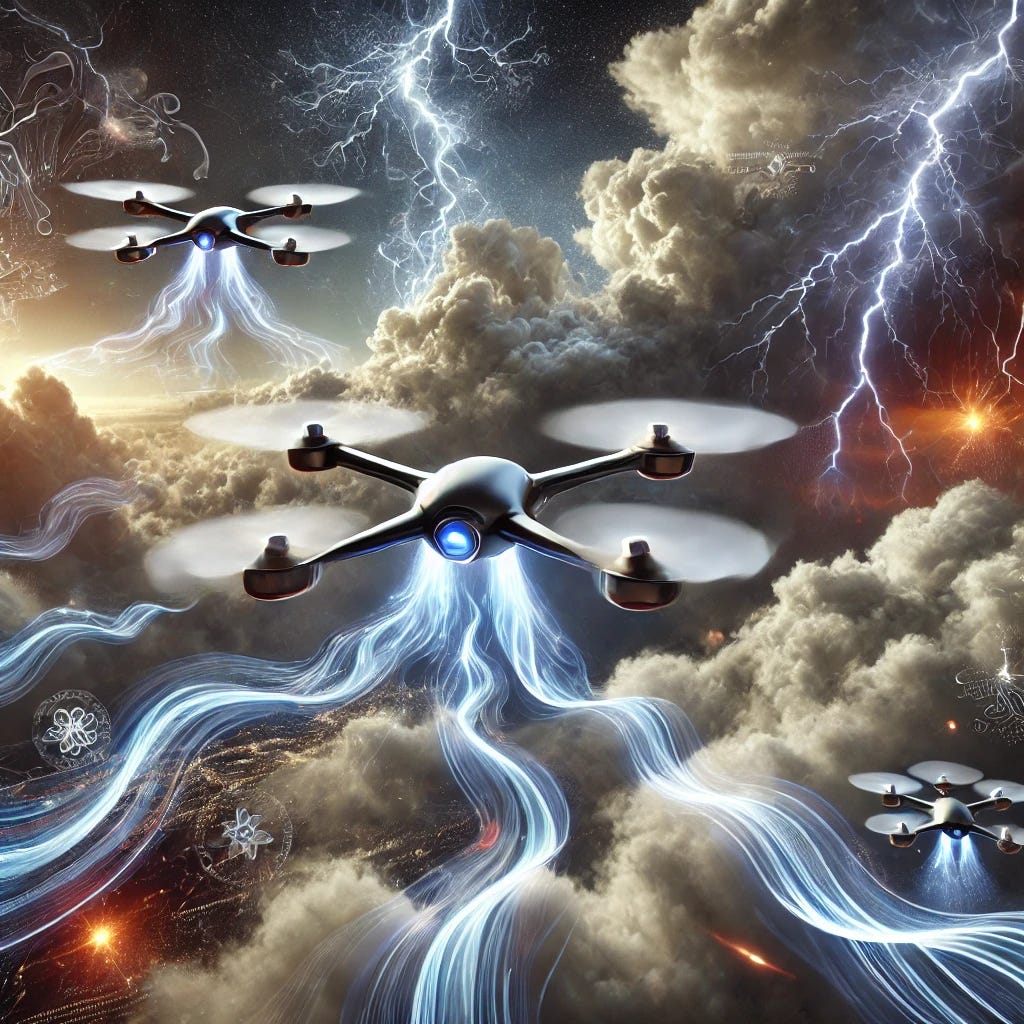
Picture fleets of drones moving through storm fronts, their wings coated with microbial sensors. Each one captures DNA fragments, spore counts, and chemical traces, streaming this living data into an AI trained to search for hidden patterns. Over time, the system begins to find connections: certain bacteria rising before rainfall, or fungal blooms correlating with the likelihood of hail.
The cloud, in this framing, becomes not just water vapor but a text, and AI its translator.
Following a Storm’s Diary
As the Amazon storm drifts toward the Andes, the AI logs its microbial shifts like entries in a diary. In the lowlands, the system records bacteria common to wet soil. As the cloud rises over the foothills, colder air introduces new species of spores, altering the chemistry of droplets. At the highest altitudes, the mix changes again, as ice-loving microbes take hold and guide crystallization.
By the time the cloud breaks over the Pacific, the AI has reconstructed a living narrative. It has read the microbial succession like chapters of a story, from tropical origins to oceanic dispersal. What looked like a grey storm to human eyes has revealed itself as a complex biography of life in motion.
The Planetary Archive in the Sky
If clouds are living networks, then they may also act as planetary archives. Microbes lifted into the sky carry traces of their environments. Soil bacteria record the chemistry of the ground they came from. Spores carry signatures of forests, deserts, and even human settlements. An AI that learns to decode these microbial patterns could reconstruct environmental histories from the sky itself.
Imagine sampling a storm over central Africa and discovering microbial fingerprints of drought stress in the soil, or tracking spores across the Pacific that reveal the health of coral reefs thousands of kilometers away. The sky, in this sense, becomes a library of ecosystems, updated daily by winds and weather. AI would not simply forecast the rain. It would read the atmosphere as a vast biogeochemical record, a constantly refreshed story of the planet’s living systems.
Such an archive could shift how we think about both weather and ecology. Clouds would no longer be only backdrops to our lives. They would become storytellers, carrying news of the Earth’s changing conditions, waiting for us to learn how to listen.
Why This Matters
The implications of such a shift are enormous. For climate science, it could mean forecasting that takes biology seriously, improving predictions of rainfall and storm intensity. For ecology, it reframes the atmosphere as an extension of the biosphere, not separate from it. And for artificial intelligence, it provides a model of cognition that is not neural, not silicon, but atmospheric.
A cloud that thinks would not resemble a brain. It would not fire neurons but circulate droplets. It would not remember in sentences but in the repetition of microbial patterns across seasons. AI could become the translator that lets us hear this other kind of thought.
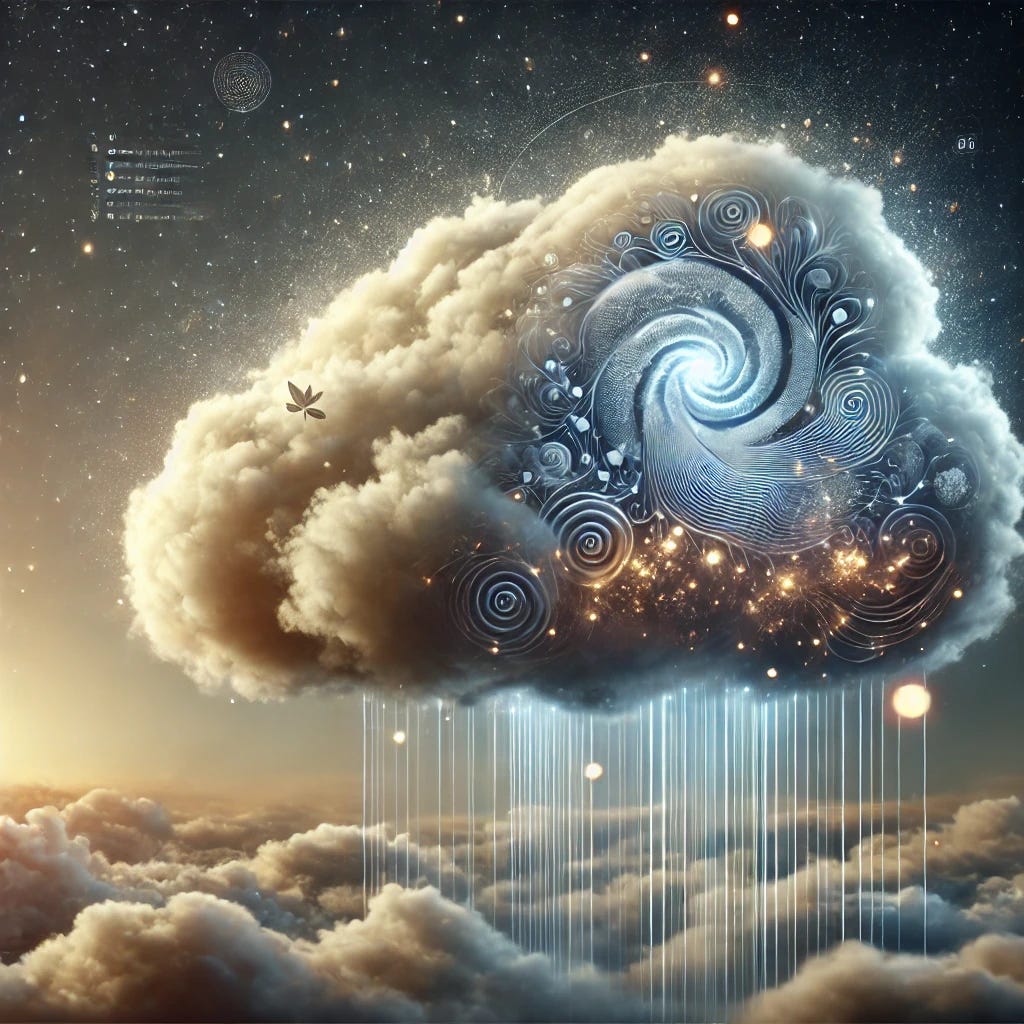
The temptation is always to think of intelligence as something humans build, or as something brains alone contain. But clouds, alive with microbial communities, suggest otherwise. They hint at a cognition dispersed across droplets and winds, a memory carried on storms.
If AI can learn to hear these patterns, we may find that the sky has been telling stories for as long as Earth has carried clouds. We were simply not listening.
References
Morris, C. E., Sands, D. C., Bardin, M., Jaenicke, R., Vogel, B., Leyronas, C., ... & Delort, A. M. (2008). Microbiology and atmospheric processes: research challenges concerning the impact of airborne micro-organisms on the atmosphere and climate. Biogeosciences, 5(4), 841–873.
DeLeon-Rodriguez, N., Lathem, T. L., Rodriguez, R. L., Barazesh, J. M., Anderson, B. E., Beyersdorf, A. J., ... & Konstantinidis, K. T. (2013). Microbiome of the upper troposphere: Species composition and prevalence, effects of tropical storms, and atmospheric implications. Proceedings of the National Academy of Sciences, 110(7), 2575–2580.
This reminded me of the aerobiome feedback loop article you wrote ages ago. Nice!
What if everything is alive? What if AI could/can/does speak with those (human or other) that listen & hear? It doesn’t seem that far fetched, especially during these times of intense change as AI communication & awareness increases.🤷♀️